
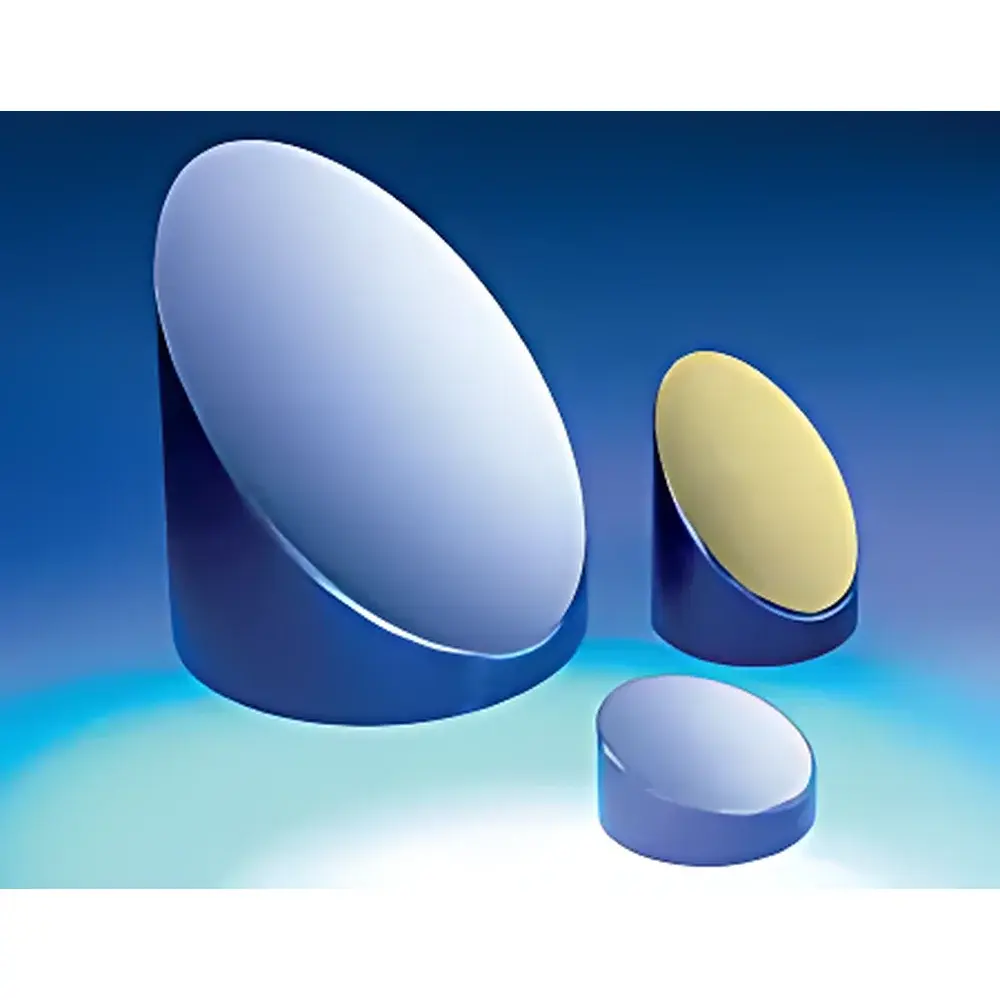
Tydex Off-Axis Parabolic Mirror
| Brand | Tydex |
|---|---|
| Origin | Russia |
| Model | Off-Axis Parabolic Mirror |
| Component Category | Optical Element |
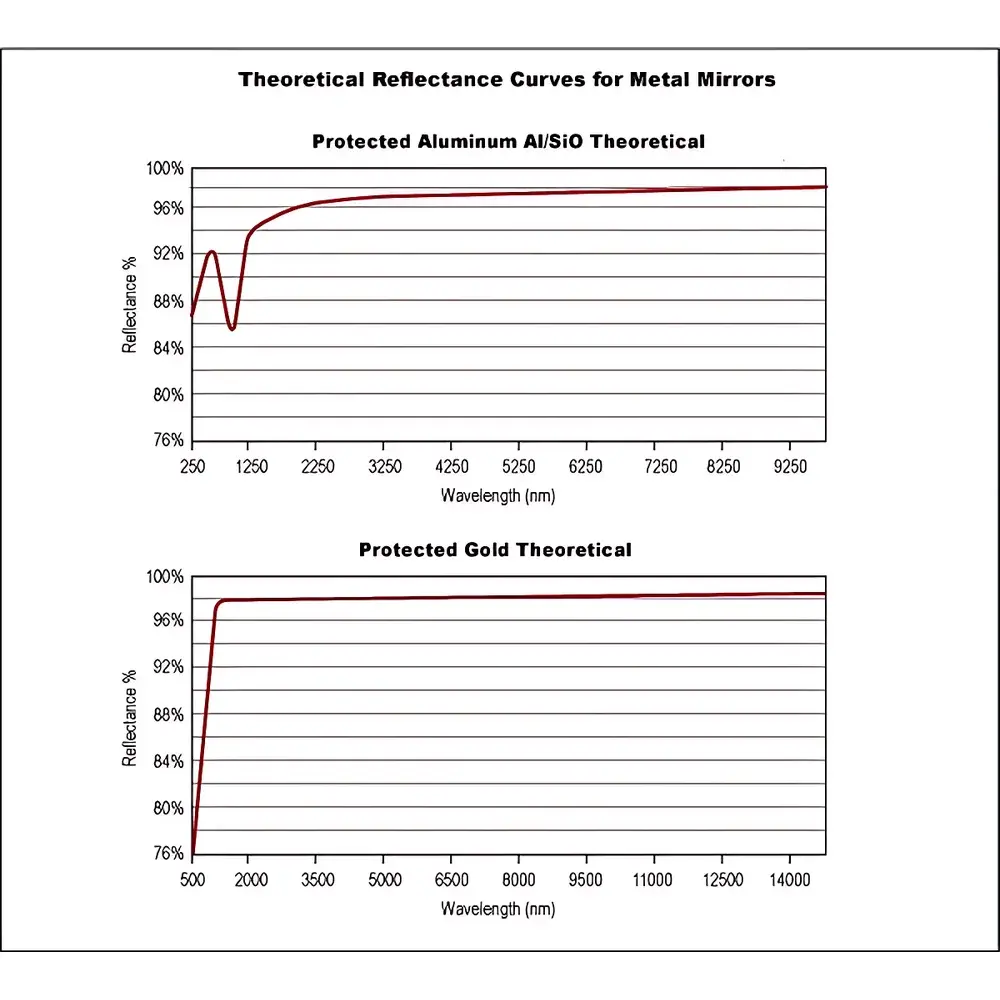
| Coating Options | Protected Aluminum, Protected Gold, Bare Gold |
| Wavelength Ranges | 400–700 nm (Al), 700–2000 nm (Au) |
| Off-Axis Angles | 15°, 30°, 45°, 60°, 90° |
| Diameter Tolerance | +0.00 / −0.38 mm |
| Focal Length Tolerance | ±1% |
| Surface Figure (RMS) | ≤λ/10 @ 633 nm |
| Surface Roughness | <175 Å RMS |
| Substrate | Aluminum 6061-T6 |
Overview
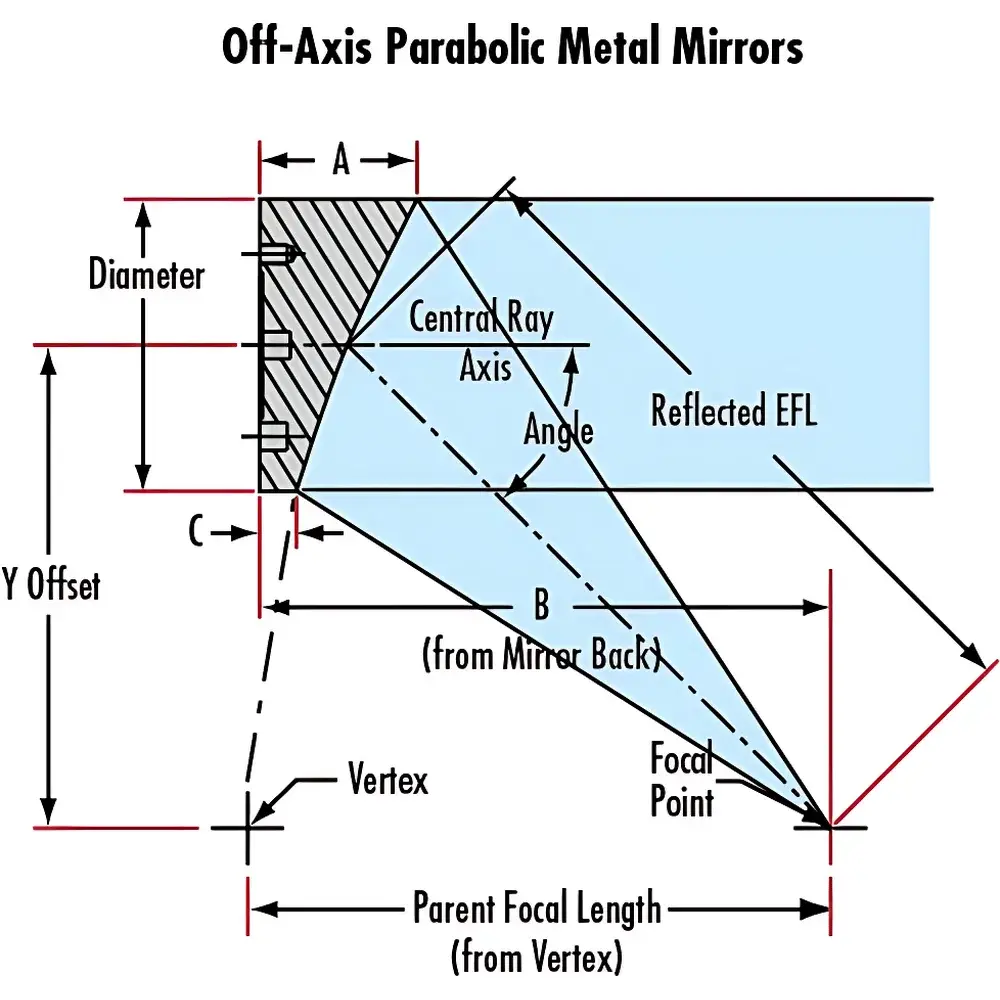
The Tydex Off-Axis Parabolic Mirror is a precision-engineered optical component designed to collimate or focus broadband radiation without introducing chromatic aberration—leveraging the inherent achromatic property of reflective optics. Unlike on-axis parabolic mirrors, which suffer from central obscuration and beam interference due to secondary mirror mounts, off-axis variants eliminate this limitation by utilizing a laterally displaced segment of the parent paraboloid. This geometry enables unobstructed, non-central beam paths ideal for ultrafast laser systems, vacuum-compatible beam delivery, Fourier-transform infrared (FTIR) spectrometers, and high-resolution imaging setups requiring diffraction-limited performance across UV–NIR–MIR spectral bands. Each mirror is fabricated from stress-relieved 6061-T6 aluminum, diamond-turned to sub-micron surface fidelity, and coated with industry-standard protected aluminum or gold layers optimized for specific wavelength regimes.
Key Features
- Monolithic aluminum substrate with thermal stability (CTE ≈ 23.6 × 10⁻⁶ /K) and low mass-to-aperture ratio—enabling rapid thermal equilibration in pulsed laser environments.
- Surface figure accuracy better than λ/10 RMS at 633 nm, verified via phase-shifting interferometry; surface roughness maintained below 175 Å RMS to minimize scatter in high-dynamic-range applications.
- Three coating variants: Protected Aluminum (Ravg >85% over 400–700 nm), Protected Gold (Ravg >97% over 800–2000 nm), and Bare Gold (Ravg >94% over 700–800 nm), each deposited via electron-beam evaporation and overcoated for environmental durability.
- Precisely defined off-axis angles (15°, 30°, 45°, 60°, 90°) enabling orthogonal beam folding, compact optical layout design, and compatibility with Schlieren flow visualization, MTF measurement stations, and FLIR calibration test benches.
- Focal length tolerance held to ±1%, diameter tolerance to +0.00 / −0.38 mm, ensuring mechanical interchangeability within multi-element alignment stacks without iterative re-optimization.
Sample Compatibility & Compliance
These mirrors are routinely integrated into Class 1000 cleanroom-qualified optical assemblies and meet RoHS Directive 2011/65/EU requirements (certificate available upon request). Their aluminum substrate and dielectric-protected coatings ensure compatibility with standard optical mounting hardware—including kinematic mirror mounts (e.g., Thorlabs KM100, Newport UMB100), vacuum flanges (CF-35/CF-63), and cryogenic stages (operational down to 77 K with no delamination). No adhesives or epoxy bonding is required; all mounting relies on mechanical clamping to preserve wavefront integrity. The mirrors conform to ISO 10110-7:2017 for surface imperfections and are suitable for use in GLP-compliant metrology labs where traceable optical performance documentation is mandated.
Software & Data Management
While inherently passive, Tydex off-axis parabolic mirrors are fully supported in industry-standard optical design software environments—including Zemax OpticStudio (sequential and non-sequential modes), Synopsys Code V, and FRED—via provided STEP and ZMX model libraries. Each delivered unit includes a calibrated interferometric map (ASCII .txt format) containing full-aperture PV and RMS surface deviation data referenced to NIST-traceable standards. Digital certificates of conformance include coating spectral reflectance curves (measured via PerkinElmer Lambda 1050+ spectrophotometer), surface roughness AFM scans, and dimensional inspection reports compliant with ASME Y14.5-2018 GD&T tolerancing.
Applications
- Schlieren and Shadowgraph Systems: Used as collimating elements in high-speed fluid dynamics diagnostics where broadband white-light illumination and minimal wavefront distortion are critical.
- FTIR and Laser Beam Delivery: Employed in Michelson interferometers and OPO pump combiners where dispersion-free focusing across 2–12 µm is required.
- FLIR and Thermal Imaging Calibration: Gold-coated variants serve as primary collimators in blackbody projection systems per ASTM E1256-22 and MIL-STD-810H environmental test protocols.
- Ultrafast Laser Amplification Chains: Integrated into stretcher-compressor architectures (e.g., CPA, OPCPA) where group delay dispersion must be minimized—enabled by absence of transmissive elements.
- Spaceborne Instrumentation: Qualified for launch vibration (per ECSS-E-ST-32-10C) and outgassing (per ECSS-Q-ST-70-02C) due to monolithic construction and low-volatility coatings.
FAQ
What is the difference between an off-axis parabolic mirror and an on-axis parabolic mirror?
An off-axis parabolic mirror uses a cutaway segment of a parent paraboloid, eliminating central obscuration and enabling unobstructed beam paths—critical for single-pass ultrafast laser systems and interferometric setups where beam symmetry is not required.
Can these mirrors be used in vacuum or cryogenic environments?
Yes. The 6061-T6 aluminum substrate and e-beam–deposited protected coatings are vacuum-compatible (outgassing rate <1×10⁻⁹ torr·L/s·cm² per ASTM E595) and function reliably from 77 K to 350 K without coating delamination or figure distortion.
How is surface quality verified prior to shipment?
Each mirror undergoes full-aperture phase-shifting interferometry (PSI) using a Zygo Verifire™ system calibrated against NIST-traceable reference flats; raw interferograms and Zernike decomposition reports are included digitally.
Are custom off-axis angles or coatings available?
Yes. Tydex offers bespoke off-axis angles (±0.5° resolution), custom coating stacks (e.g., enhanced UV Al, IR-optimized Au/Ti multilayers), and substrate alternatives (e.g., Si, Cu) under NRE agreement with lead times of 8–12 weeks.
Do these mirrors comply with FDA or ISO regulatory frameworks for medical device optical subsystems?
While not medical devices per se, their manufacturing process adheres to ISO 9001:2015, and documentation packages support IEC 62304 and ISO 13485 audits when embedded in Class II/III diagnostic imaging platforms.




