
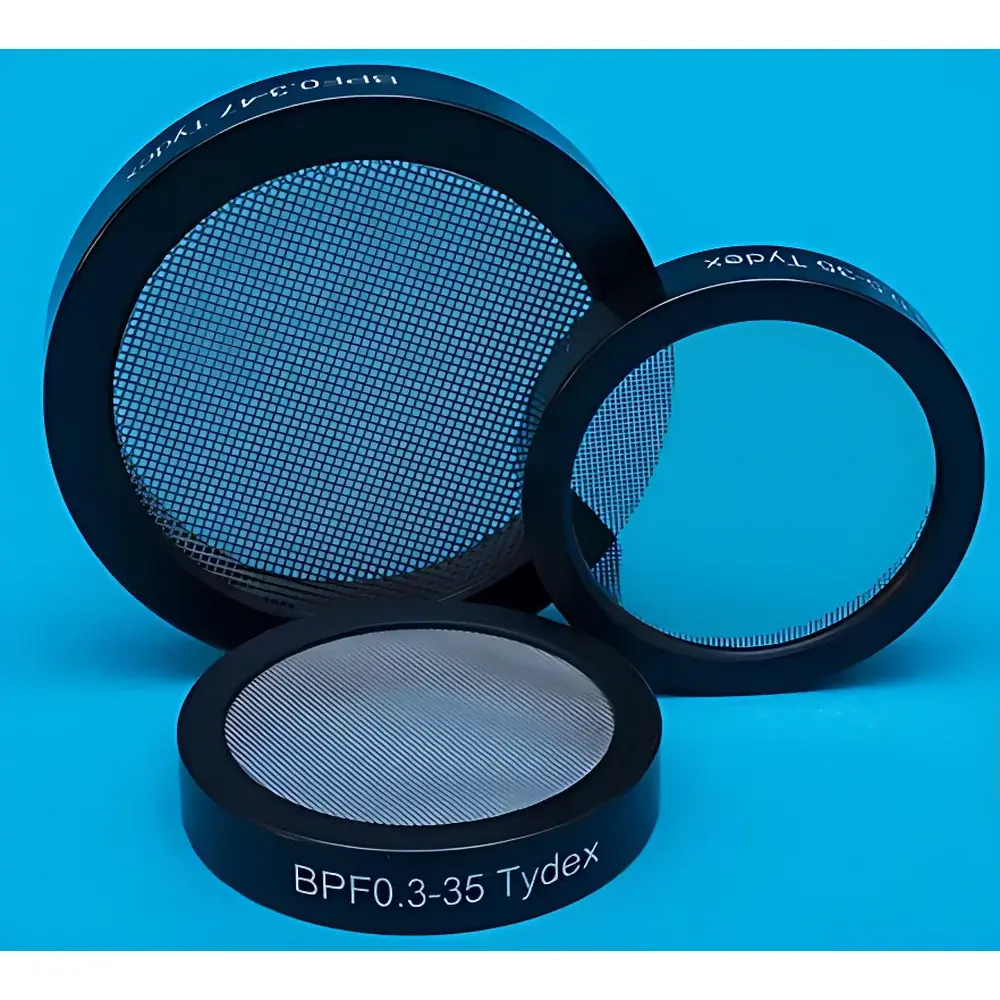
Tydex BPF Series Terahertz Bandpass Filter
| Brand | Tydex |
|---|---|
| Origin | Russia |
| Model | BPF |
| Component Category | Optical Element |
| Spectral Range | 0.1–15 THz (3000–20 µm) |
| Transmission in Passband | 60–90% |
| Rejection in Stopband | <4% |
| Aperture Options | Custom (e.g., BPF-1.0-25, BPF-3.0-12.7) |
| Damage Threshold | 65–100 W/cm² (0.1–15 THz) |
| Construction | Perforated Metal Foil on Rigid Mount |
| Operating Temperature | Cryogenic to Ambient |
| Compliance | Designed for ISO/IEC 17025-aligned optical calibration environments |
Overview
The Tydex BPF Series Terahertz Bandpass Filter is a precision-engineered optical component designed for spectral selection and noise suppression in the 0.1–15 THz range (3000–20 µm). Unlike conventional dielectric interference filters—unsuitable for long-wavelength terahertz radiation—these filters operate on the principle of metallic aperture resonance, where subwavelength periodic hole arrays in high-conductivity metal foils (typically aluminum or copper) generate well-defined transmission peaks via coupled surface plasmon polariton modes and cavity resonance effects. This quasi-optical filtering approach delivers high spectral fidelity without reliance on multilayer thin-film deposition, making it inherently stable across cryogenic temperatures and compatible with ultra-high vacuum (UHV) beamlines. The BPF series addresses critical challenges in THz metrology: eliminating blackbody background, isolating molecular rotational transitions, and enabling narrowband excitation in time-domain spectroscopy (TDS) and continuous-wave (CW) systems.
Key Features
- Passband tunability from 0.1 THz to 15 THz—covering the full low-frequency FIR and THz atmospheric window
- Typical peak transmittance of 60–90% within the designated passband, verified via Fourier-transform infrared (FTIR) spectrometry under collimated illumination
- Stopband attenuation exceeding 14 dB (<4% transmission) at ±20% offset from center frequency, ensuring effective suppression of out-of-band thermal and electronic noise
- Rugged mechanical design: perforated foil mounted in precision-machined aluminum housing with kinematic alignment features (centering pins and reference flats) for repeatable integration into cryostats, interferometers, and focal-plane arrays
- Cryogenically stable performance: no delamination, drift, or hysteresis observed between 4 K and 300 K; validated per ASTM E1980 for low-temperature optical component qualification
- Damage threshold certified at 65–100 W/cm² for CW irradiation across the operational band—enabling use with high-power THz sources including backward-wave oscillators (BWOs) and quantum cascade lasers (QCLs)
Sample Compatibility & Compliance
The BPF filters are compatible with standard optical mounts (e.g., Thorlabs SM1-threaded cages, Kinetic Systems kinematic bases) and integrate seamlessly into both pulsed and CW THz platforms—including TDS systems (e.g., Menlo Systems TeraSmart), heterodyne receivers (e.g., ALMA Band 10 frontend modules), and synchrotron-based beamlines. Each unit is supplied with a traceable calibration certificate indicating measured center frequency, bandwidth (FWHM), and peak transmission at room temperature. Units conform to ISO 10110-7 for surface quality (scratch-dig 60–40) and are manufactured under controlled cleanroom conditions (ISO Class 7). While not FDA-regulated, the design supports GLP-compliant experimental workflows when used in material characterization labs subject to ISO/IEC 17025 accreditation requirements.
Software & Data Management
As a passive optical element, the BPF requires no firmware or driver software. However, its spectral performance data—including measured transmission curves, angular sensitivity profiles (±5° incidence tolerance), and temperature-dependent shift coefficients—are provided in machine-readable ASCII format (.csv) and NIST-compatible .spc files. These datasets integrate directly into common analysis environments such as MATLAB, Python (SciPy/NumPy), and LabVIEW via standard I/O libraries. For users implementing automated wavelength scanning (e.g., motorized filter wheels), Tydex supplies mechanical interface drawings (STEP/IGES) and mounting torque specifications to ensure alignment stability during thermal cycling and vibration testing per MIL-STD-810H.
Applications
- Terahertz Time-Domain Spectroscopy (THz-TDS): Isolating specific absorption lines of pharmaceutical polymorphs, explosives precursors, and semiconductor phonon modes
- Astronomical Instrumentation: Front-end filtering in ground-based (e.g., LMT, NOEMA) and space-borne (e.g., proposed SPICA/SAFARI) heterodyne receivers operating near 1.4 THz (OH lines) and 4.7 THz (CH⁺)
- Cryogenic Sensor Calibration: Defining reference bands for bolometric and hot-electron-bolometer (HEB) detector characterization below 20 K
- Nondestructive Testing (NDT): Enhancing contrast in THz imaging of polymer composites, ceramic coatings, and battery electrode layers by suppressing broadband scattering
- Fundamental Physics Experiments: Mode selection in cavity-enhanced THz spectroscopy of Rydberg atoms and ultracold molecular gases
FAQ
What determines the center frequency of a given BPF unit?
The center frequency is defined by the periodicity, diameter, and depth of the subwavelength apertures etched into the metal foil—geometry is optimized using rigorous coupled-wave analysis (RCWA) simulations prior to fabrication.
Can BPF filters be used at oblique incidence?
Yes, but transmission peak shifts toward lower frequencies with increasing angle; angular tuning curves are supplied for each part number to support system-level alignment planning.
Is custom aperture size or spectral specification available?
Yes—Tydex offers OEM design services for non-standard center frequencies, bandwidths, and mounting configurations, with lead times beginning at 12 weeks post-design freeze.
How is spectral performance verified before shipment?
Each filter undergoes FTIR-based transmission measurement using a Bruker VERTEX 80v spectrometer equipped with a liquid-helium-cooled bolometer detector and gold-coated integrating sphere.
Do BPF filters require anti-reflection coating?
No—metallic aperture filters exhibit negligible Fresnel reflection due to impedance matching with free-space wave impedance; AR coatings are neither necessary nor recommended.



