
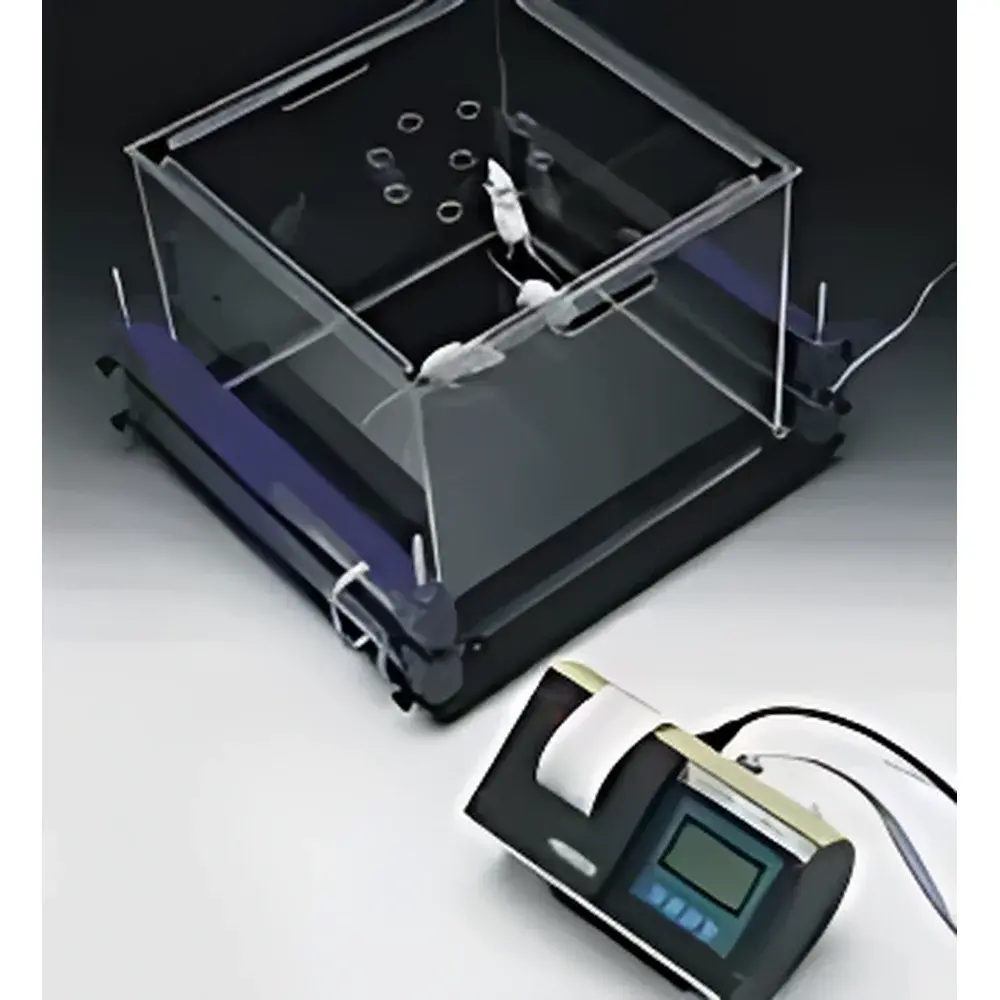
UGO 7530 Automated Reflex Modulation System
| Origin | Italy |
|---|---|
| Manufacturer Type | Authorized Distributor |
| Origin Category | Imported |
| Model | 7530 (Rat) / 7530-M (Mouse) |
| Pricing | Upon Request |
Overview
The UGO 7530 Automated Reflex Modulation System is a precision-engineered behavioral neuroscience platform designed for standardized assessment of conditioned and unconditioned reflex modulation in rodent models. Operating on the principle of Pavlovian and instrumental learning paradigms, the system integrates real-time stimulus delivery with automated behavioral response detection to quantify latency, frequency, and persistence of avoidance behaviors under controlled environmental parameters. It supports core experimental configurations including shuttle-box avoidance, time-limited escape trials, active/passive conflict paradigms, and plus-maze–based spatial discrimination tasks—each implemented via programmable stimulus-response contingencies. The system is engineered for reproducible neuropharmacological and neurobehavioral phenotyping, particularly in studies involving anxiety-related behavior, fear conditioning, sensorimotor gating, and central nervous system drug efficacy evaluation.
Key Features
- Modular hardware architecture supporting both rat (Model 7530) and mouse (Model 7530-M) configurations with species-specific chamber dimensions and stimulus thresholds
- Multi-modal stimulus generation: configurable auditory cues (broadband white noise or tone bursts, 1–12 kHz), visual stimuli (LED-based light pulses, 450–650 nm), and calibrated foot-shock delivery (0.05–2.0 mA, adjustable in 0.05 mA increments)
- Programmable temporal parameters: independent control over stimulus onset delay (0–999 s), duration (10 ms–300 s), inter-trial interval (1–999 s), and shock pulse width (10–500 ms)
- Integrated activity monitoring via high-resolution infrared beam arrays (16-beam per chamber, 3 mm spacing) enabling precise locomotor tracking and entry/exit event logging
- Dual-output data interface: direct RS-232 serial connection to Windows-based acquisition software (UGO BehaviorSuite v4.2) and optional thermal printer module for immediate hard-copy trial logs
- Compliance-ready design: supports GLP-aligned audit trails, user-level access control (admin/operator modes), and timestamped raw data export in CSV and HDF5 formats
Sample Compatibility & Compliance
The UGO 7530 system is validated for use with Sprague-Dawley and Wistar rats (200–500 g) and C57BL/6, BALB/c, and CD-1 mice (18–35 g). Chamber materials comply with ISO 10993-5 (cytotoxicity) and USP Class VI standards for biocompatibility. All electrical stimulation components meet IEC 61000-4-5 surge immunity requirements and are certified to EN 61326-1 for electromagnetic compatibility in laboratory environments. The system adheres to OECD Test Guideline 426 (Neurotoxicity Study) and supports experimental protocols aligned with NIH Guide for the Care and Use of Laboratory Animals and Directive 2010/63/EU on animal welfare.
Software & Data Management
UGO BehaviorSuite v4.2 provides full experimental workflow control—from protocol authoring and real-time session monitoring to post-hoc analysis and statistical reporting. The software implements 21 CFR Part 11–compliant electronic signatures, role-based permissions, and immutable audit logs recording all parameter changes, session starts/stops, and user logins. Raw data files include synchronized timestamps (microsecond resolution), stimulus event markers, beam-break sequences, and shock delivery metadata. Export modules support integration with MATLAB, Python (via pandas/h5py), and commercial statistical platforms (SPSS, GraphPad Prism). Batch analysis tools enable automated calculation of key metrics: escape latency, avoidance rate, freezing duration, and discrimination index (DI).
Applications
- Preclinical evaluation of anxiolytic, anxiogenic, and antipsychotic compounds in conflict-based paradigms
- Assessment of hippocampal- and amygdala-dependent learning deficits in transgenic rodent models
- Quantification of sensorimotor gating disruption (e.g., prepulse inhibition deficits) using acoustic startle + prepulse protocols
- Longitudinal behavioral phenotyping in neurodegenerative disease models (e.g., APP/PS1, MPTP-treated mice)
- Validation of closed-loop neuromodulation interventions where behavioral output triggers real-time stimulation adjustments
- Standardized training protocols for operant conditioning and extinction learning studies
FAQ
Is the 7530 compatible with third-party electrophysiology or optogenetics systems?
Yes—via TTL-compatible trigger outputs and analog voltage inputs, the system can synchronize stimulus delivery with external neural recording or light delivery hardware.
Can protocols be randomized or counterbalanced across sessions?
Yes—BehaviorSuite supports within-subject Latin-square randomization and between-group counterbalancing of stimulus modality order and intensity gradients.
What calibration documentation is provided?
Each unit ships with NIST-traceable calibration certificates for current output (shock generator), photometric output (LED intensity), and acoustic pressure level (dB SPL at cage center).
Does the system support automated scoring of freezing behavior?
Freezing detection is available as an optional add-on module utilizing motion variance algorithms applied to beam-break occupancy patterns, validated against manual observer scoring (intraclass correlation >0.92).
Are firmware updates provided post-purchase?
Yes—UGO offers free lifetime firmware updates via secure download portal; major software releases include backward-compatible data format migration tools.




