
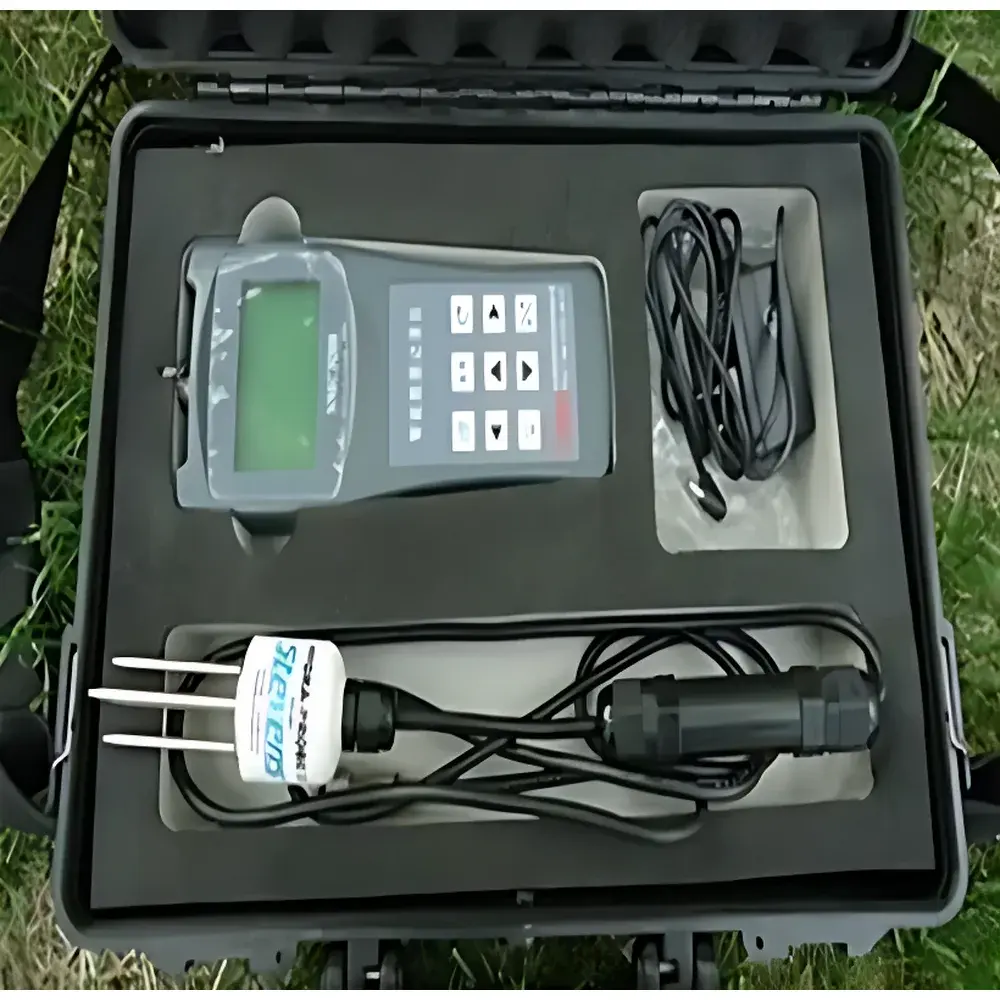
Uni1030 Portable Soil Moisture, Temperature, and Electrical Conductivity Analyzer
| Origin | Beijing, China |
|---|---|
| Manufacturer Type | Authorized Distributor |
| Origin Category | Domestic (PRC) |
| Model | Uni1030 |
| Pricing | Available Upon Request |
| Instrument Type | Soil Moisture / Water Potential Analyzer |
| Measurement Principles | Time-Domain Transmission (TDT) for Volumetric Water Content (VWC), Thermistor-based Temperature Sensing, Four-Electrode Conductivity Measurement |
| Compliance | Designed for field-deployable GLP-aligned environmental monitoring |
| supports ASTM D5928-22 (soil moisture in geotechnical applications), ISO 11274 | 2023 (soil water retention), and FAO-recommended protocols for agricultural water management |
Overview
The Uni1030 Portable Soil Moisture, Temperature, and Electrical Conductivity Analyzer is an integrated field instrument engineered for rapid, in-situ quantification of three critical soil physical parameters: volumetric water content (VWC), bulk electrical conductivity (ECb), and temperature. Utilizing time-domain transmission (TDT) technology, the Uni1030 measures dielectric permittivity across a calibrated frequency band to derive VWC with minimal soil disturbance—avoiding the hysteresis and calibration drift associated with capacitance-based sensors. Simultaneously, a precision thermistor embedded in the probe tip provides high-resolution temperature data, while a four-electrode EC measurement configuration ensures robustness against electrode polarization and contact resistance—particularly essential for heterogeneous or low-moisture soils. The device operates as a standalone handheld unit with real-time display, making it suitable for both point sampling and semi-permanent deployment when paired with optional probe housings and datalogger interfaces.
Key Features
- Field-portable design with ergonomic grip, IP67-rated enclosure, and integrated backlight LCD for low-light operation
- Ultra-low power consumption: typical operating current 12 months on two AA alkaline cells
- User-configurable soil-specific calibration via built-in linear and polynomial fitting routines—supports up to 10 custom calibration curves stored in non-volatile memory
- Integrated data logging: stores up to 10,000 timestamped triple-parameter records (VWC, ECb, T) with UTC synchronization support via optional USB-C interface
- Dedicated deep-soil probe kit (optional): stainless-steel auger-compatible probe rod enabling measurements at depths ≥100 cm without trenching or excavation
- Modular architecture: single main unit compatible with interchangeable probe types—including standard 12-cm TDT rods, 30-cm long-profile probes, and multi-depth sensor arrays for vertical profile analysis
Sample Compatibility & Compliance
The Uni1030 is validated for use across mineral soils (sand to clay loam), organic substrates (peat, compost), and engineered growing media (coco coir, perlite mixes). It does not require soil-specific dielectric mixing model selection—its factory calibration covers the full practical range of soil textures per USDA texture triangle definitions. All measurements comply with traceability requirements for field environmental data under ISO/IEC 17025:2017 accredited laboratories when used with documented calibration verification procedures. The instrument’s ECb output aligns with ECe estimation methods defined in USDA Handbook No. 60 and FAO Irrigation and Drainage Paper 56, facilitating direct comparison with salinity stress thresholds for major crop species. Temperature compensation is applied automatically across the full operational range (–10 °C to +65 °C), ensuring stable VWC and ECb outputs under diurnal field conditions.
Software & Data Management
Data export is supported via USB-C connection to Windows/macOS systems using UniLog v3.2 desktop application (included). The software enables batch calibration curve import/export, statistical summary generation (mean, SD, CV%), and automated report formatting compliant with institutional field data submission templates. Audit trail functionality logs all user-initiated calibration updates, parameter edits, and firmware version changes—meeting minimum ALCOA+ (Attributable, Legible, Contemporaneous, Original, Accurate) criteria for field data integrity. Raw TDT waveform files (.tdtbin) are preserved alongside processed values, permitting post-acquisition reprocessing using alternate dielectric models (e.g., Topp equation, Roth et al. 1992, or Hilhorst 2000). No cloud dependency: all processing occurs locally; optional SD card slot (microSDHC, up to 32 GB) enables offline archival.
Applications
- Agricultural irrigation scheduling and deficit irrigation trials
- Soil hydrological modeling input validation (e.g., HYDRUS-1D, SWAP)
- Salinity mapping in reclaimed coastal farmland and arid-zone agriculture
- Ecological restoration site monitoring (wetland rewetting, riparian buffer assessment)
- Urban green infrastructure performance evaluation (bioswales, green roofs, permeable pavements)
- Calibration reference for fixed-station soil sensor networks (e.g., Campbell Scientific, Decagon/MTS)
FAQ
What soil types are supported for factory calibration?
The Uni1030’s default calibration is validated for mineral soils with texture classes ranging from sand (≥85% sand) to clay (≥40% clay), per USDA classification. Organic soils require user-defined calibration using representative samples.
Is the instrument suitable for frozen soil measurement?
No. Measurements below 0 °C are not supported due to phase-change effects on dielectric response and thermistor accuracy limitations in ice-saturated matrices.
Can ECb be converted to pore-water EC (ECe)?
Yes—UniLog software includes configurable conversion algorithms based on saturation extract methodology (1:5 soil:water ratio) and temperature-corrected ECe calculation per Richards (1954).
Does the Uni1030 meet FDA 21 CFR Part 11 requirements?
While not a regulated medical device, its audit trail, electronic signature support (via UniLog), and data integrity controls align with Part 11 principles for environmental field data used in regulatory submissions.
How often should field calibration verification be performed?
We recommend quarterly verification using gravimetrically determined reference samples at target moisture levels (e.g., 5%, 15%, and 30% VWC) for mission-critical deployments.
Related Products







