
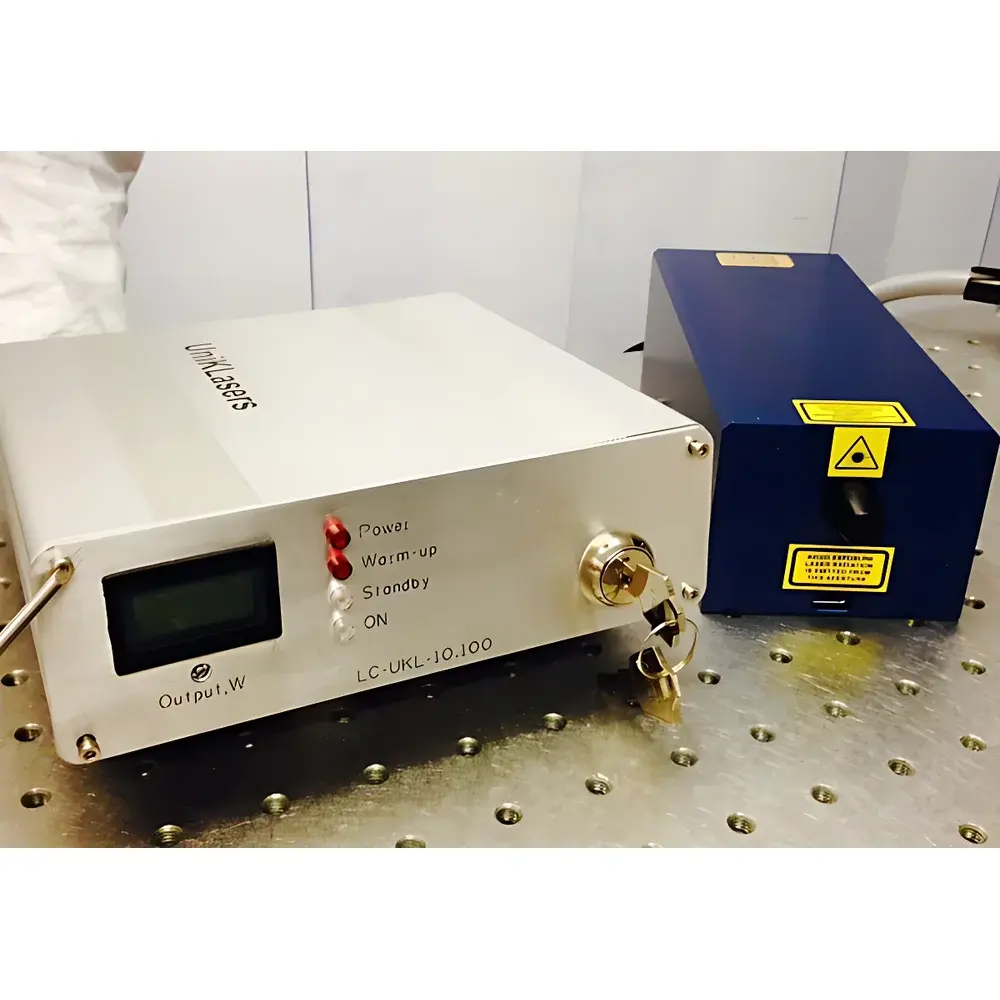
UNIK LASER UV Single-Longitudinal-Mode Solid-State Laser
| Origin | UK |
|---|---|
| Manufacturer Type | Authorized Distributor |
| Origin Category | Imported |
| Model | UNIK LASER UV-SLM Series |
| Core Technology | BRaMMS Patented DPSS Architecture |
| Output Wavelengths | 266 nm, 320 nm, 349 nm, 355 nm |
| Output Power Range | 10–200 mW (UV variants) |
| Beam Quality | TEM₀₀, M² < 1.1 |
| Relative Intensity Noise | < 0.1 % RMS |
| Spectral Linewidth | < 1 MHz |
| Coherence Length | > 100 m |
| Beam Pointing Stability | ≤ 5 µrad/°C |
| Power Supply | Integrated Low-Power Consumption Module |
| Form Factor | Compact Benchtop OEM-Compatible Housing |
Overview
The UNIK LASER UV Single-Longitudinal-Mode (SLM) Solid-State Laser is a precision-engineered continuous-wave (CW) diode-pumped solid-state (DPSS) laser system operating in the ultraviolet spectral region. Leveraging the proprietary BRaMMS (Broadband Resonator with Mode-Selective Monitoring and Stabilization) technology, this laser achieves true single-longitudinal-mode operation—historically unattainable in compact DPSS UV sources—without external cavity feedback or active mode-locking. The system delivers stable, narrow-linewidth emission at discrete wavelengths including 266 nm, 320 nm, 349 nm, and 355 nm, generated via intracavity harmonic generation from Nd:YAG or Nd:YVO₄ gain media. Designed for applications demanding high temporal coherence, low phase noise, and diffraction-limited spatial quality, it serves as a metrology-grade light source in environments where spectral purity and long-term amplitude stability are non-negotiable.
Key Features
- True single-longitudinal-mode output with linewidth < 1 MHz and coherence length exceeding 100 meters—enabling interferometric-grade measurements and high-resolution spectroscopy.
- TEM₀₀ beam profile with M² < 1.1, achieving near-diffraction-limited focusability essential for high-numerical-aperture optical systems and microfabrication.
- Exceptional amplitude stability: relative intensity noise (RIN) < 0.1 % RMS over 10 Hz–10 MHz bandwidth, validated per ISO 11554 for laser beam characterization.
- Thermally robust mechanical design with beam pointing stability ≤ 5 µrad/°C, minimizing realignment requirements in temperature-variable laboratories or integrated OEM platforms.
- Integrated power management architecture delivering >30% wall-plug efficiency for UV DPSS lasers, reducing thermal load and enabling air-cooled operation in compact enclosures.
- OEM-ready form factor with standardized mechanical interfaces (e.g., 30 mm cage system compatibility), TTL/analog modulation inputs, and RS-232/USB communication for automated integration into larger instrumentation stacks.
Sample Compatibility & Compliance
This laser series is compatible with standard UV-transmissive optics (fused silica, CaF₂, MgF₂), quartz cuvettes, and photomultiplier tube (PMT) or CCD-based detection modules used in fluorescence lifetime imaging (FLIM), time-resolved spectroscopy, and confocal microscopy. All units comply with IEC 60825-1:2014 Class 3B/4 laser safety requirements, incorporating interlock-enabled shutter mechanisms, key-switch operation, and embedded emission indicators. Manufacturing adheres to ISO 9001:2015 quality management standards; technical documentation supports GLP/GMP validation protocols, including traceable calibration certificates for output power and wavelength accuracy (NIST-traceable reference spectrometers). While not FDA-cleared as a medical device, the system meets essential performance criteria outlined in ASTM E275 for UV-Vis spectrophotometer source qualification.
Software & Data Management
UNIK LASER provides the UniControl™ SDK—a cross-platform C/C++, Python, and LabVIEW-compatible software development kit—for remote configuration of output power, modulation frequency, and thermal setpoints. Real-time monitoring includes internal photodiode feedback signals, thermistor readings, and pump diode current logs, all timestamped and exportable in CSV or HDF5 format. Audit trails comply with 21 CFR Part 11 requirements when deployed with optional secure user authentication and electronic signature modules. Firmware updates are delivered via signed binary packages verified using SHA-256 hashing, ensuring integrity during field deployment in regulated QC/QA environments.
Applications
- Holography & Interferometry: Long coherence length enables large-depth-of-field digital holographic microscopy and dynamic speckle pattern analysis in material stress testing.
- Biopharmaceutical Instrumentation: Used as excitation sources in capillary electrophoresis–laser-induced fluorescence (CE-LIF) systems and flow cytometers requiring high signal-to-noise ratio at sub-355 nm wavelengths.
- Semiconductor Metrology: Integrated into mask inspection tools and laser-induced defect scattering (LIDS) platforms for sub-100 nm feature resolution on EUV photomasks.
- Raman & Fluorescence Spectroscopy: Enables resonance-enhanced Raman detection of aromatic amino acids and nucleic acid bases with minimal photobleaching due to low RIN and precise wavelength targeting.
- Aerospace Sensor Calibration: Serves as reference sources for UV-sensitive star tracker sensors and atomic clock stabilization loops requiring absolute wavelength stability < ±0.5 pm over 8-hour periods.
FAQ
What distinguishes BRaMMS technology from conventional SLM stabilization methods?
BRaMMS eliminates reliance on external Fabry–Pérot etalons or Pound–Drever–Hall locking by embedding real-time longitudinal mode discrimination directly within the resonator geometry—reducing sensitivity to acoustic vibration and thermal drift while maintaining full CW operation.
Is wavelength tuning available across the UV-SLM product line?
No. Each model is factory-optimized for a fixed fundamental or harmonic wavelength (e.g., 355 nm); fine-tuning capability is intentionally omitted to preserve SLM fidelity and long-term repeatability.
Can these lasers be integrated into vacuum environments?
Yes—OEM versions are available with vacuum-compatible housing materials (316L stainless steel) and feedthrough-rated electrical connectors, supporting pressures down to 10⁻⁶ mbar.
What maintenance intervals are recommended for optimal lifetime?
No scheduled maintenance is required; mean time between failures (MTBF) exceeds 20,000 hours under continuous operation at rated power, per Telcordia GR-468-CORE reliability testing.
Do you provide application-specific beam delivery optics?
Yes—custom collimation, focusing, and fiber-coupling solutions (including UV-grade fused silica fibers with SMA 905 or FC/PC terminations) are available under NRE-supported engineering agreements.



