
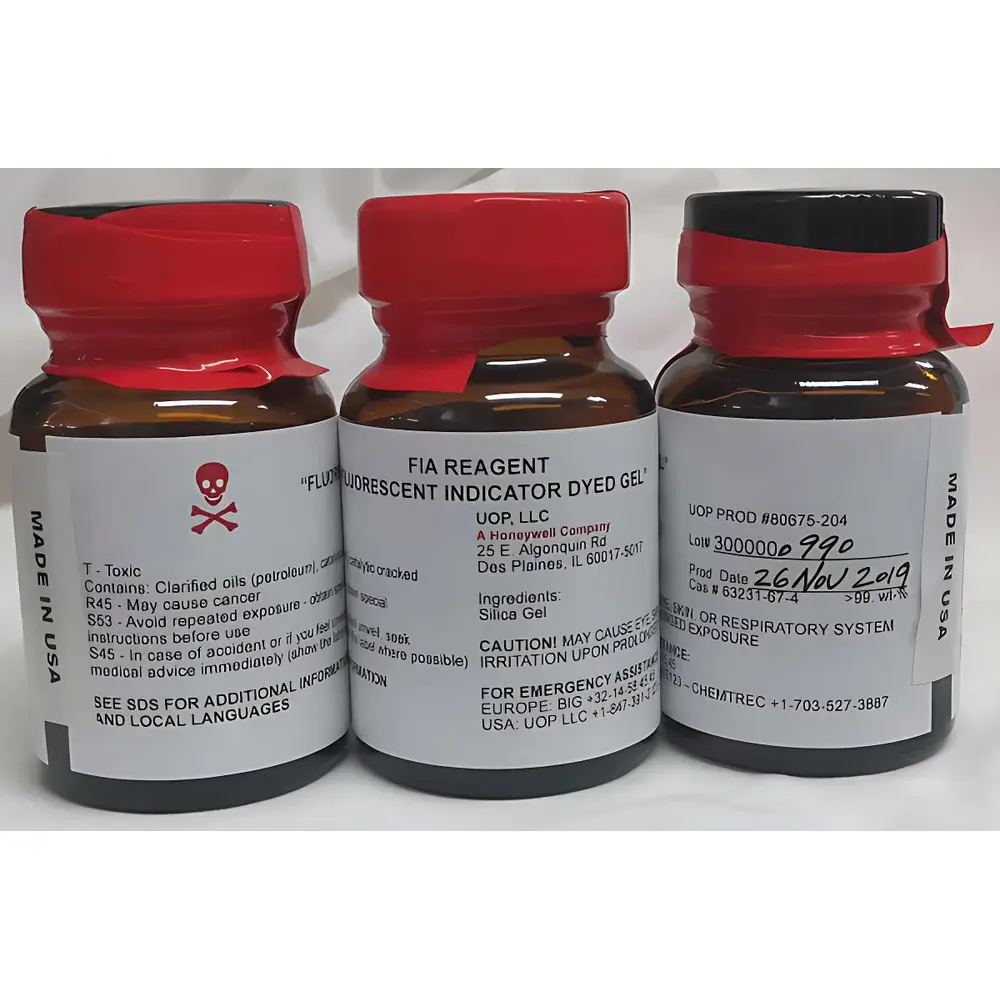
UOP Fluorescent Indicator-Dyed Silica Gel for ASTM D1319 Hydrocarbon Analysis
| Brand | UOP |
|---|---|
| Origin | USA |
| Packaging | Amber Glass Bottle |
| Storage Requirement | Ambient, Under Nitrogen Atmosphere |
| Compliance | ASTM D1319-22, GB/T 11132-2022 |
| Application | Fluorescent Indicator Adsorption Chromatography of Liquid Petroleum Hydrocarbons |
Overview
The UOP Fluorescent Indicator-Dyed Silica Gel is a high-purity, pre-calibrated chromatographic adsorbent engineered specifically for hydrocarbon group-type analysis in liquid petroleum products via the fluorescent indicator adsorption method. As defined in ASTM D1319 (latest revision: D1319-22) and its national equivalent GB/T 11132-2022, this method relies on differential adsorption affinity of paraffinic, naphthenic, olefinic, and aromatic hydrocarbons onto a silica gel matrix impregnated with proprietary fluorescent dyes. Under ultraviolet illumination (typically 254 nm or 365 nm), each hydrocarbon class exhibits distinct fluorescence intensity and color contrast—enabling visual or digital quantification of band lengths along a calibrated adsorption column. The physical consistency, surface activity, pore size distribution, and dye loading uniformity of the silica gel directly govern separation resolution, reproducibility, and method robustness. UOP’s formulation ensures batch-to-batch equivalence in surface silanol density, moisture content (<0.5% w/w), and dye stability—critical parameters for meeting precision requirements outlined in ASTM D1319’s repeatability (R ≤ 0.8 vol%) and reproducibility (RR ≤ 1.5 vol%) criteria.
Key Features
- Manufactured under controlled conditions in the United States to UOP’s proprietary specification, ensuring compliance with ASTM D1319 Annex A1 requirements for silica gel performance validation.
- Dyed with certified fluorescent indicators (primarily anthracene derivatives and substituted coumarins) at optimized concentration to maximize contrast between saturated, olefinic, and aromatic bands without quenching or bleed.
- Supplied in amber glass bottles with nitrogen-purged headspace to prevent photooxidative degradation and dye fading during storage.
- Pre-equilibrated to standardized moisture content (0.1–0.3% w/w), eliminating need for user activation and reducing inter-laboratory variability.
- Validated for use with standard 200 mm × 10 mm i.d. glass adsorption columns; compatible with both manual and semi-automated band-length measurement workflows.
Sample Compatibility & Compliance
This dyed silica gel is validated for use with gasoline, naphthas, reformates, hydrotreated distillates, and other light hydrocarbon streams within the boiling range of 30 °C to 200 °C. It is not suitable for heavy fuel oils, lubricants, or highly polar oxygenated blends (e.g., ethanol-gasoline mixtures), which may cause irreversible adsorption or dye displacement. The product conforms to the material specifications referenced in ASTM D1319 Section 6.1 and GB/T 11132 Clause 5.1. Each lot undergoes certificate-of-analysis verification including BET surface area (500–600 m²/g), average pore diameter (6–8 nm), and fluorescence response uniformity across ≥95% of particles (verified by SEM-EDS mapping). Trace metal content (Fe, Cu, Ni < 1 ppm) is monitored to prevent catalytic side reactions during analysis.
Software & Data Management
While the fluorescent indicator adsorption method is primarily manual or semi-quantitative, modern laboratories integrate digital imaging systems for band length measurement and automated calculation per ASTM D1319 Section 11. UOP-dyed silica gel delivers consistent fluorescence signature profiles compatible with common image analysis platforms (e.g., ImageJ with custom LUTs, Thermo Scientific ChromaCalc, or PetroTest HCA software). All data generated using this material support ALCOA+ principles when captured within validated LIMS or ELN environments. For regulated environments (e.g., refinery QA/QC labs operating under ISO/IEC 17025 or API RP 900), traceability is maintained through lot-specific CoA documentation, including raw material sourcing records and stability testing reports (real-time and accelerated aging at 40 °C/75% RH).
Applications
- Quality control of motor gasoline per ASTM D4814 and EN 228, specifically for olefin and aromatic content reporting required by Tier 3 and Euro 6 specifications.
- Refinery process monitoring of fluid catalytic cracking (FCC) and reformer unit outputs to track hydrocarbon shift trends.
- Research and development of alternative fuels, including alkylate and isomerate blending studies.
- Third-party certification testing for regulatory submissions to EPA, CARB, or national petroleum standards bodies.
- Method verification and reagent qualification during laboratory accreditation audits (e.g., CNAS, UKAS).
FAQ
How should UOP dyed silica gel be stored long-term?
Store unopened bottles at ambient temperature (15–25 °C) in darkness under inert nitrogen atmosphere. Avoid freeze-thaw cycles and exposure to ambient humidity above 40% RH.
Can I reactivate or dry the silica gel if it appears moist?
No. Pre-equilibration is integral to performance. Attempting thermal activation will degrade fluorescent dyes and alter surface chemistry, invalidating ASTM D1319 compliance.
What is the shelf life after opening?
When handled under nitrogen glove box conditions and resealed immediately, usable life is ≥12 months. Frequent air exposure reduces effective lifespan to ≤3 months due to moisture uptake and UV-induced dye decay.
Is this material compliant with FDA or pharmacopeial standards?
No. It is exclusively intended for petroleum hydrocarbon analysis and is not manufactured to USP, EP, or JP monograph requirements for pharmaceutical excipients.
Do you provide lot-specific test reports?
Yes. Each shipment includes a Certificate of Analysis documenting BET surface area, pore size distribution, fluorescence uniformity index, and conformance to ASTM D1319 Appendix X1 reference tests.






