
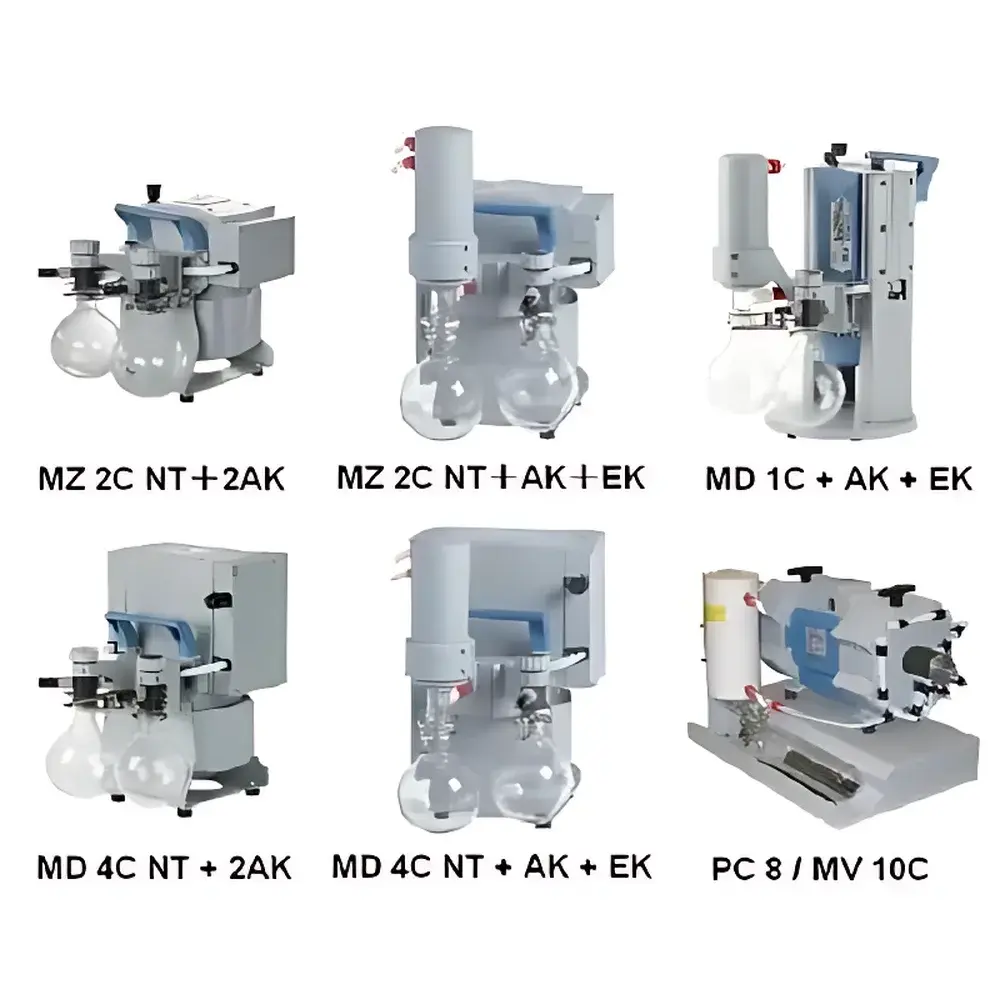
Vacuubrand Chemical Vacuum System with Gas Separation Bottles and Solvent Recovery Units
| Brand | VACUUBRAND® |
|---|---|
| Origin | Germany |
| Pump Types | MZ2C NT, MD1C, MD4C NT, MV10C |
| Configurations | +2AK, +AK+EK, +PC8/MV10C |
| Max. Pumping Speed | 1.3–7.5 m³/h (50/60 Hz) |
| Ultimate Vacuum (abs.) | 0.9–7 mbar |
| Ultimate Vacuum (abs., with gas ballast) | 3–12 mbar |
| Dimensions (L×W×H) | 316×239×198 to 507×367×431 mm |
| Weight | 10.2–31.5 kg |
Overview
The Vacuubrand Chemical Vacuum System is an engineered solution for laboratories requiring robust, chemically resistant vacuum generation in applications involving aggressive vapors, condensable solvents, or particulate-laden gas streams. Built around Vacuubrand’s precision-engineered chemically inert diaphragm pumps—including the MZ2C NT, MD1C, MD4C NT, and high-capacity MV10C series—this system integrates purpose-designed gas separation and solvent recovery components to ensure long-term pump integrity, operator safety, and environmental compliance. Unlike standard vacuum systems, it operates on a dual-protection principle: inlet gas separation prevents liquid carryover and solid ingress into the pump head, while outlet solvent management captures condensable vapors before exhaust—eliminating uncontrolled solvent emissions and minimizing maintenance intervals. The system adheres to fundamental principles of vapor-phase handling in vacuum technology, where differential condensation, gravitational phase separation, and controlled gas ballast operation are leveraged to maintain stable vacuum performance under load. It is particularly suited for rotary evaporation, freeze drying, vacuum filtration, and solvent-intensive synthesis workflows common in pharmaceutical development, fine chemical manufacturing, and academic research laboratories.
Key Features
- Chemically resistant diaphragm pump core (VACUUBRAND® MZ2C NT, MD1C, MD4C NT, or MV10C), constructed with PTFE-coated diaphragms, EPDM or Viton® elastomers, and stainless-steel housings for compatibility with organic solvents, acids, and bases
- Modular configuration options: dual AK gas separation bottles (inlet + outlet), AK + EK combination (inlet separation + outlet condensing recovery), or PC 8 / MV10C integrated atmospheric-load solvent recovery unit
- Gas ballast valve integrated into all base pumps, enabling controlled admission of ambient air to prevent condensate accumulation during operation with high-vapor-pressure solvents
- Passive phase separation design—no moving parts or external power required—ensuring silent, maintenance-free operation of AK bottles and EK cold-finger condensers
- Structural rigidity and vibration-damped mounting minimize transmission of mechanical noise; acoustic enclosure compatibility available for ultra-low-noise lab environments
- CE-marked per EU Machinery Directive 2006/42/EC and Electromagnetic Compatibility Directive 2014/30/EU; RoHS-compliant materials throughout
Sample Compatibility & Compliance
This system is validated for continuous use with common laboratory solvents including acetone, ethanol, ethyl acetate, dichloromethane, toluene, and acetonitrile, as well as aqueous acidic or basic vapors (e.g., HCl, NH₃). The AK gas separation bottle accommodates liquid droplets up to 5 mL per cycle without bypass, while the EK and PC 8 units achieve >95% solvent recovery efficiency under standard rotary evaporator operating conditions (e.g., 40 °C bath, 200 mbar setpoint). All configurations comply with ISO 8573-1:2010 Class 4 compressed air purity requirements for non-oil-lubricated vacuum systems and support GLP/GMP documentation workflows through traceable component serial numbers and factory calibration certificates. While not intrinsically rated for ATEX Zone 1, optional explosion-proof variants (e.g., MZ2C NT-EX) are available upon request for volatile organic compound (VOC)-rich environments.
Software & Data Management
The Vacuubrand Chemical Vacuum System operates as a standalone hardware platform without embedded firmware or digital control interfaces—consistent with its design philosophy of reliability, serviceability, and regulatory transparency. Vacuum level monitoring, pump runtime logging, and solvent recovery volume estimation are performed externally via calibrated pressure transducers (e.g., Piezoresistive or Capacitance Manometers) and mass flow meters compliant with ASTM D3171-22 for vapor-phase quantification. For integration into automated lab networks, analog 0–10 V or 4–20 mA output signals (optional add-on) enable connection to SCADA, LIMS, or ELN platforms supporting IEC 61131-3 or OPC UA protocols. Audit trail functionality—including date/time-stamped pump start/stop events and gas ballast activation logs—is maintained externally in accordance with FDA 21 CFR Part 11 requirements when paired with validated electronic record systems.
Applications
- Rotary evaporation of heat-sensitive compounds under reduced pressure, with real-time solvent capture preventing cross-contamination between batches
- Vacuum-assisted drying of hygroscopic or oxidation-prone APIs in pharmaceutical QC labs, maintaining residual solvent levels below ICH Q3C thresholds
- Lyophilization cycle support in biologics development, where consistent vacuum stability and absence of oil contamination are critical
- Vacuum filtration of corrosive slurries (e.g., metal hydroxide precipitates in wastewater analysis) without pump corrosion or diaphragm degradation
- Distillation and fractional extraction in natural product isolation, where solvent recovery directly impacts process economics and sustainability metrics (e.g., ISO 14040 life-cycle assessment)
FAQ
What vacuum level can be achieved with the gas ballast open?
Ultimate vacuum with gas ballast activated ranges from 3 to 12 mbar (abs.), depending on pump model and ambient humidity—optimized for condensable vapor removal rather than ultimate dryness.
Can the EK solvent trap be used with chlorinated solvents like chloroform?
Yes—EK units feature borosilicate glass construction and PTFE-sealed joints, fully compatible with chlorinated, aromatic, and polar aprotic solvents at temperatures ≤60 °C.
Is routine maintenance required for the AK gas separation bottles?
No scheduled maintenance is needed; however, visual inspection and manual draining of accumulated condensate every 8–12 hours of continuous operation is recommended to maintain separation efficiency.
How does this system compare to oil-sealed rotary vane pumps in terms of lifetime cost of ownership?
Over a 5-year operational horizon, the VACUUBRAND diaphragm-based system typically reduces total cost of ownership by 35–50% due to elimination of oil replacement, filter servicing, and associated downtime—validated in multi-site studies across CRO and API manufacturing facilities.
Are spare parts and technical documentation available globally?
Yes—VACUUBRAND maintains certified distributor networks in 68 countries, with full technical manuals, exploded diagrams, and RoHS/REACH declarations accessible via secure portal with registered lab account credentials.



