
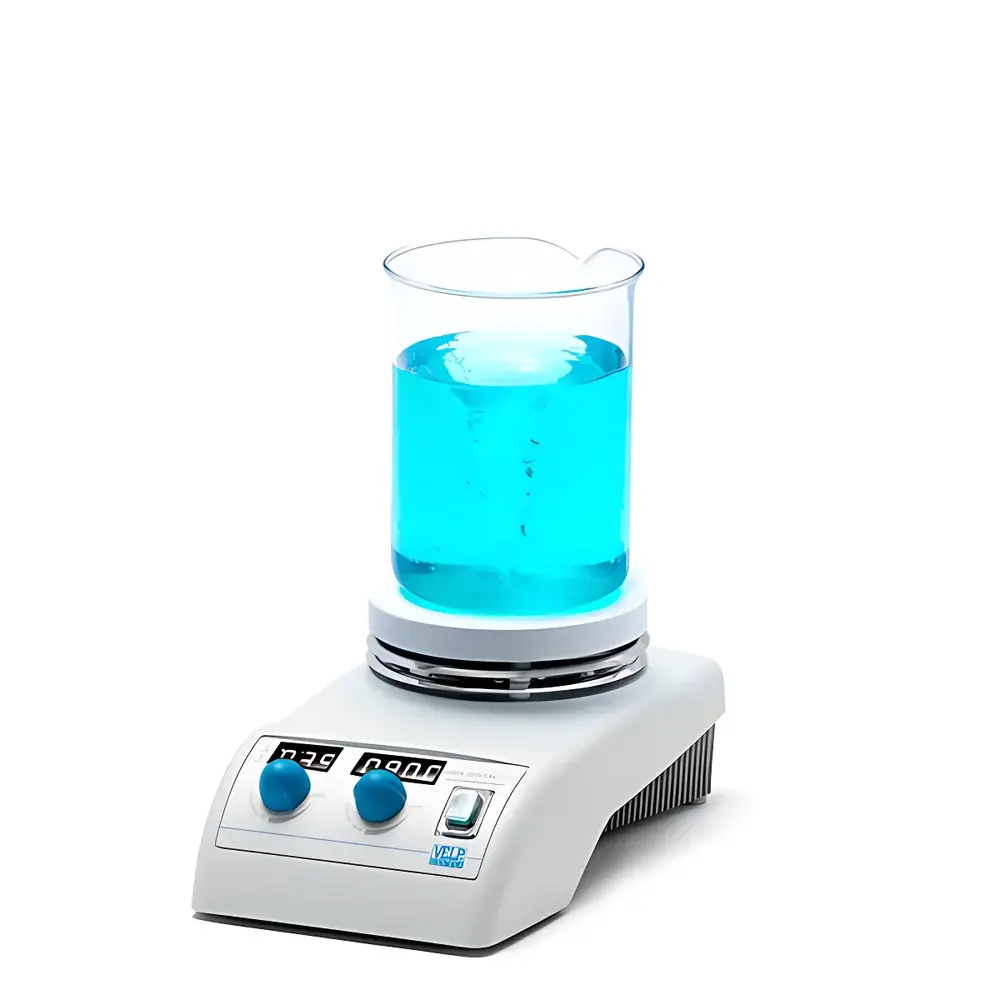
VELP AREX Digital Pro Heating Magnetic Stirrer
| Brand | VELP |
|---|---|
| Origin | Italy |
| Type | Magnetic Stirrer |
| Max. Stirring Volume | 20 L |
| Speed Range | 40–1500 rpm |
| Temperature Range | Ambient to 370 °C |
| Display | Dual Digital LED (Speed & Temp) |
| Temperature Control | External Pt100 Probe (±1.0 °C up to 250 °C) / Integrated VTF Controller (±0.5 °C up to 300 °C) |
| Heating Plate Material | CerAlTop™ (Ceramic-Coated Aluminum) |
| Safety Features | Over-Temp Cutoff, Hot-Plate Warning (Active until <50 °C), Overflow Channel, Low-CG Housing, Tilted Front Panel |
Overview
The VELP AREX Digital Pro Heating Magnetic Stirrer is an engineered solution for precise, reproducible heating and mixing in analytical, pharmaceutical, and industrial R&D laboratories. It operates on the principle of magnetic coupling—where a rotating permanent magnet beneath the heated plate induces synchronous rotation of a magnetic stir bar immersed in the sample—combined with resistive ceramic-aluminum heating technology. Designed for applications demanding thermal stability and speed consistency across variable viscosities, it integrates closed-loop temperature regulation via either external Pt100 sensing or internal VTF (Variable Temperature Feedback) control. Its operational envelope spans ambient temperature to 370 °C on the plate surface, with programmable setpoints and real-time digital feedback, making it suitable for solvent reflux, polymer dissolution, catalyst activation, and extended unattended synthesis protocols.
Key Features
- CerAlTop™ Heating Surface: A proprietary composite of aluminum core and high-purity white ceramic coating delivers exceptional thermal uniformity (<±3 °C across 150 mm diameter at 300 °C), rapid heat-up response, and resistance to chemical etching, abrasion, and thermal shock.
- Dual Precision Control System: Independent left-hand knob for temperature (0–370 °C) and right-hand knob for speed (40–1500 rpm), both backed by digital LED displays showing setpoint and real-time values simultaneously.
- SpeedServo™ Technology: An active feedback loop continuously monitors rotational load and dynamically adjusts motor torque to maintain preset speed within ±2 rpm—even during viscosity shifts or volume changes—ensuring hydrodynamic consistency critical for kinetic studies.
- VTF Digital Temperature Regulation: Internal PID-controlled VTF module achieves ±0.5 °C accuracy up to 300 °C; optional external Pt100 probe enables direct liquid-phase monitoring with ±1.0 °C accuracy up to 250 °C, supporting USP and ISO 17025-compliant workflows.
- Advanced Safety Architecture: Includes programmable maximum temperature limit, persistent “HOT” warning indicator (active until plate cools below 50 °C), integrated overflow channel, pressure-cast chassis preventing ingress from spills, and ergonomic front-panel tilt (12°) for glare-free readability.
Sample Compatibility & Compliance
The AREX Digital Pro accommodates standard laboratory glassware (Erlenmeyer flasks, beakers, round-bottom flasks) up to 20 L volume, provided appropriate stir bar geometry and magnetic coupling distance are maintained. Its ceramic surface resists corrosion from common solvents (e.g., acetone, ethanol, HCl, NaOH) and withstands repeated autoclave-compatible cleaning. The device conforms to IEC 61010-1:2010 for electrical safety in laboratory equipment and meets EMC requirements per EN 61326-1. When used with validated Pt100 probes and audit-trail-enabled software (via optional RS232/USB interface), it supports GLP/GMP environments requiring traceable temperature and speed logging per FDA 21 CFR Part 11.
Software & Data Management
While the AREX Digital Pro operates as a standalone instrument, its RS232 and USB ports enable bidirectional communication with third-party LIMS or custom acquisition platforms. VELP’s optional LabSmart™ software allows remote parameter setting, real-time data streaming (speed, temp, time), and export of timestamped CSV logs. All stored parameters—including safety limits, timer presets, and calibration offsets—are retained after power cycling. Firmware updates preserve configuration integrity and support future compliance enhancements such as electronic signature capture and change-control audit trails.
Applications
- Controlled-temperature synthesis of metal-organic frameworks (MOFs) and coordination polymers
- Viscosity-dependent dissolution testing of solid dosage forms per USP
- Polymerization initiation under inert atmosphere with precise thermal ramping
- Standardized buffer preparation and reagent equilibration for HPLC and ICP-MS workflows
- Accelerated stability studies requiring uninterrupted heating/stirring over 72+ hours
- Calibration of thermocouples and RTDs using traceable Pt100 reference points
FAQ
What is the maximum recommended stirring volume for optimal thermal and mechanical performance?
For consistent temperature homogeneity and stable stir bar rotation, VELP recommends ≤15 L in tall-form vessels and ≤20 L in wide-diameter containers (≥180 mm internal diameter).
Can the unit be operated without an external temperature probe?
Yes—the built-in VTF controller provides accurate surface temperature regulation; however, for process-critical liquid-phase control (e.g., reaction monitoring), use of an external Pt100 probe is strongly advised.
Is the CerAlTop™ surface compatible with strong oxidizers such as nitric acid?
The ceramic coating exhibits excellent resistance to concentrated HNO₃ below 80 °C; prolonged exposure above this temperature may degrade coating integrity and is not recommended.
How does the SpeedServo™ system respond to sudden viscosity increases during polymerization?
It detects torque deviation within 100 ms and modulates drive current to sustain nominal rpm—verified across Newtonian and pseudoplastic fluids with η ranging from 1 to 5000 mPa·s.
Does the unit support timed ramp-and-soak temperature profiles?
No—the AREX Digital Pro implements single-setpoint control only; multi-step thermal programming requires integration with external programmable controllers or LabSmart™-enabled host systems.



