
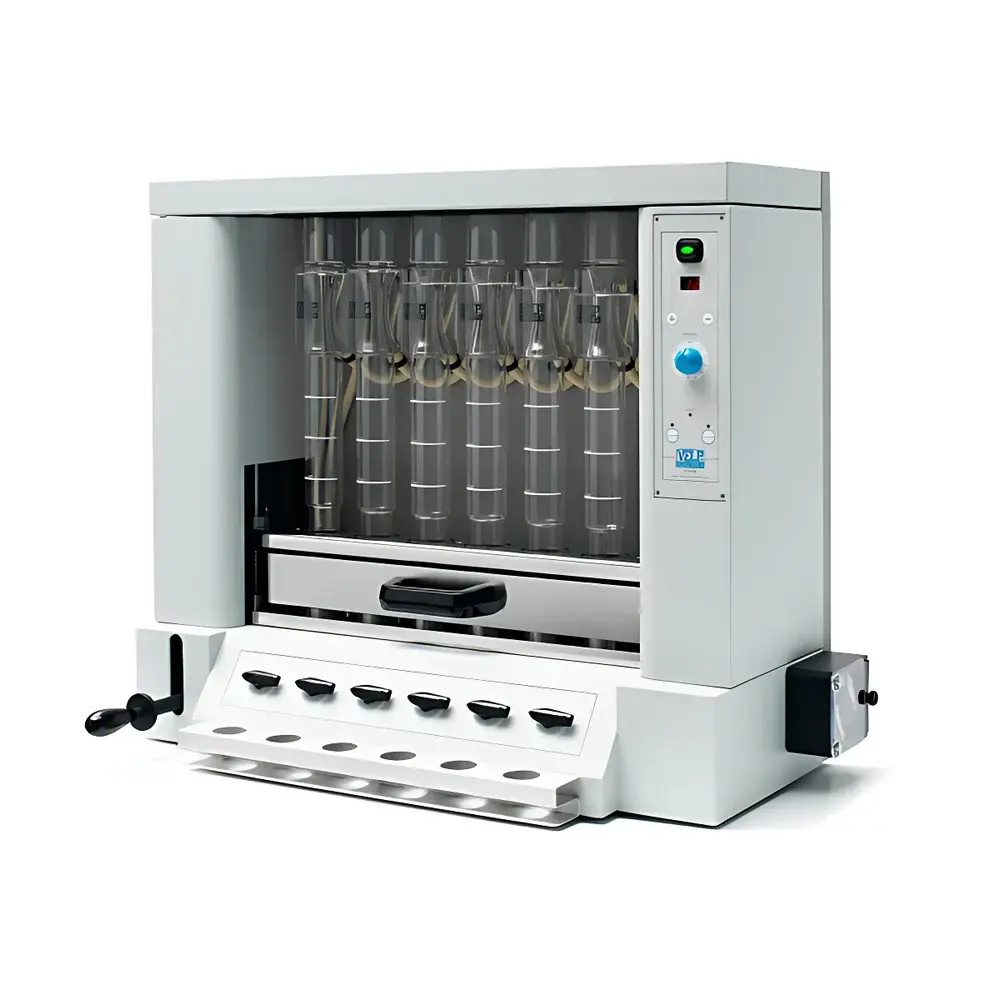
VELP FIWE6/3 Fiber Analyzer
| Brand | VELP |
|---|---|
| Origin | Italy |
| Model | FIWE6/3 |
| Sample Capacity | 6 positions per batch |
| Sample Mass Range | 0.5–3.0 g |
| Repeatability | ≤ ±1% |
| Measurement Range | 0–99% |
| Digestion Time | 0–100 min |
| Backflush Air Pressure | 3–8 bar |
| Backflush Pressure Accuracy | ≤ 1 bar |
| Preheating Unit Temperature Control | Ambient to 370 °C |
| Reagent Preheating | Dual independent 2-position heating zones |
| Fluid Handling | Integrated peristaltic pump for reagent drainage |
| Operation Mode | Single or sequential extraction (boiling, rinsing, filtration) under programmable control |
| Safety | Integrated alarm timer |
| Construction | Epoxy-coated steel frame for chemical and mechanical resistance |
| Valve System | Automated rotary valve for precise solvent routing |
| Fluid Separation | Dedicated inlets/outlets for reagents and cooling water |
| Sample Processing | In-situ digestion—no manual transfer required |
Overview
The VELP FIWE6/3 Fiber Analyzer is a fully automated, benchtop instrument engineered for the quantitative determination of dietary and structural fiber fractions in agricultural, feed, food, and botanical matrices. It implements the standardized sequential detergent extraction methodology—specifically aligned with AOAC Official Methods 978.10, 962.09, and 985.29—as well as ISO 13906, AACC 32-05, and USP protocols for crude fiber (CF), acid detergent fiber (ADF), neutral detergent fiber (NDF), cellulose, hemicellulose, and lignin. The system operates on the principle of controlled thermal-acidic and thermal-alkaline hydrolysis within sealed, temperature-regulated digestion vessels, followed by precise filtration, washing, and gravimetric quantification. Designed for reproducibility and regulatory compliance, the FIWE6/3 eliminates manual handling errors through in-vessel digestion, automated reagent delivery, and programmable multi-step sequences—including boiling, reflux, rinsing, and vacuum-assisted filtration—all executed without sample transfer.
Key Features
- Robust epoxy-coated steel chassis ensures long-term resistance to aggressive reagents (e.g., sulfuric acid, sodium hydroxide, α-amylase solutions) and mechanical wear in high-throughput laboratory environments.
- Six independent digestion positions enable parallel processing of up to six samples per run, supporting throughput requirements in feed mills, contract testing labs, and research institutions.
- Dual-zone reagent preheating system allows simultaneous and independent temperature control of acid and alkali solutions—reducing cycle time and improving thermal consistency across extraction steps.
- Integrated backflush air system (3–8 bar, ±1 bar accuracy) dislodges residual fiber particles from filter crucibles and promotes uniform suspension during digestion, minimizing channeling and enhancing reaction kinetics.
- Automated rotary valve manifold precisely directs reagents, rinse water, and vacuum paths—eliminating cross-contamination and enabling repeatable sequence execution (e.g., NDF → ADF → ADL).
- In-situ digestion architecture prevents sample loss or contamination associated with manual transfer between vessels, directly contributing to ≤ ±1% repeatability across replicate analyses.
- Programmable digestion timer with audible and visual alarm alerts ensures strict adherence to method-defined durations—critical for GLP-compliant reporting and audit readiness.
- Dedicated inlet/outlet manifolds separate reagent supply lines from cooling water circuits, preventing carryover and simplifying maintenance and validation procedures.
Sample Compatibility & Compliance
The FIWE6/3 accommodates solid, semi-solid, and ground particulate samples—including compound feeds, hay, silage, cereal grains, legume forages, distillers’ grains, and botanical extracts—with mass loading flexibility (0.5–3.0 g per crucible). Its operational envelope (ambient to 370 °C) supports both low-temperature enzymatic pretreatment (e.g., α-amylase at 37 °C) and high-temperature acid hydrolysis (e.g., 121 °C autoclave-equivalent reflux). The instrument meets essential design criteria for ISO/IEC 17025-accredited laboratories and is routinely deployed in facilities operating under GMP, FDA 21 CFR Part 11 (when paired with compliant LIMS), and EU Regulation (EC) No 1831/2003 for feed additive evaluation. All fluid pathways are chemically inert (PTFE, borosilicate glass, EPDM), and pressure-rated components comply with PED 2014/68/EU directives.
Software & Data Management
While the FIWE6/3 operates via intuitive front-panel controls with real-time status indicators, it integrates seamlessly with VELP’s optional FIWE Connect software suite for method storage, run logging, and electronic record retention. Software-enabled features include user-access-level management (administrator/operator), full audit trail generation (user ID, timestamp, parameter changes), and export of raw data (mass before/after digestion, temperature profiles, pressure logs) in CSV or PDF formats. When deployed in regulated environments, the system supports 21 CFR Part 11-compliant electronic signatures when interfaced with validated third-party LIMS platforms—ensuring traceability from sample receipt to final report issuance.
Applications
- Feed formulation and quality assurance: Accurate NDF/ADF ratios for ruminant digestibility modeling and ration balancing.
- Forage analysis laboratories: Routine certification of alfalfa, grass hay, and corn silage according to NFTA and NRC guidelines.
- Food ingredient characterization: Quantification of insoluble fiber in whole grains, bran, and functional food matrices.
- Academic and government research: Method development for novel fiber sources (e.g., algae, insect meal, agro-residues) under ASTM D6340 or EN 15495 frameworks.
- Regulatory submissions: Generation of analytically defensible fiber data for EFSA, FDA, or AAFCO registration dossiers.
FAQ
What fiber fractions can the FIWE6/3 quantify?
It determines crude fiber (CF), neutral detergent fiber (NDF), acid detergent fiber (ADF), acid detergent lignin (ADL), cellulose (ADF–ADL), hemicellulose (NDF–ADF), and total dietary fiber (TDF) when combined with enzymatic-gravimetric workflows.
Is the instrument compatible with AOAC 2002.04 for total dietary fiber?
Yes—when used with VELP’s certified enzymatic reagent kits and appropriate filtration accessories, the FIWE6/3 fulfills the hydrolysis, precipitation, and washing steps outlined in AOAC 2002.04 and AOAC 991.43.
Can digestion parameters be customized per sample type?
Absolutely—each of the six positions supports independent programming of temperature ramp rates, hold times, reagent volumes, backflush frequency, and vacuum filtration duration.
How is calibration and performance verification performed?
Users verify system performance using NIST-traceable reference materials (e.g., SRM 1846 for forage fiber); VELP provides documented IQ/OQ protocols aligned with ISO 8466-1 for analytical instrument qualification.
What maintenance is required for long-term reliability?
Routine tasks include periodic inspection of PTFE tubing, rotary valve seals, and crucible integrity; annual verification of temperature and pressure sensors is recommended for GLP/GMP environments.






