
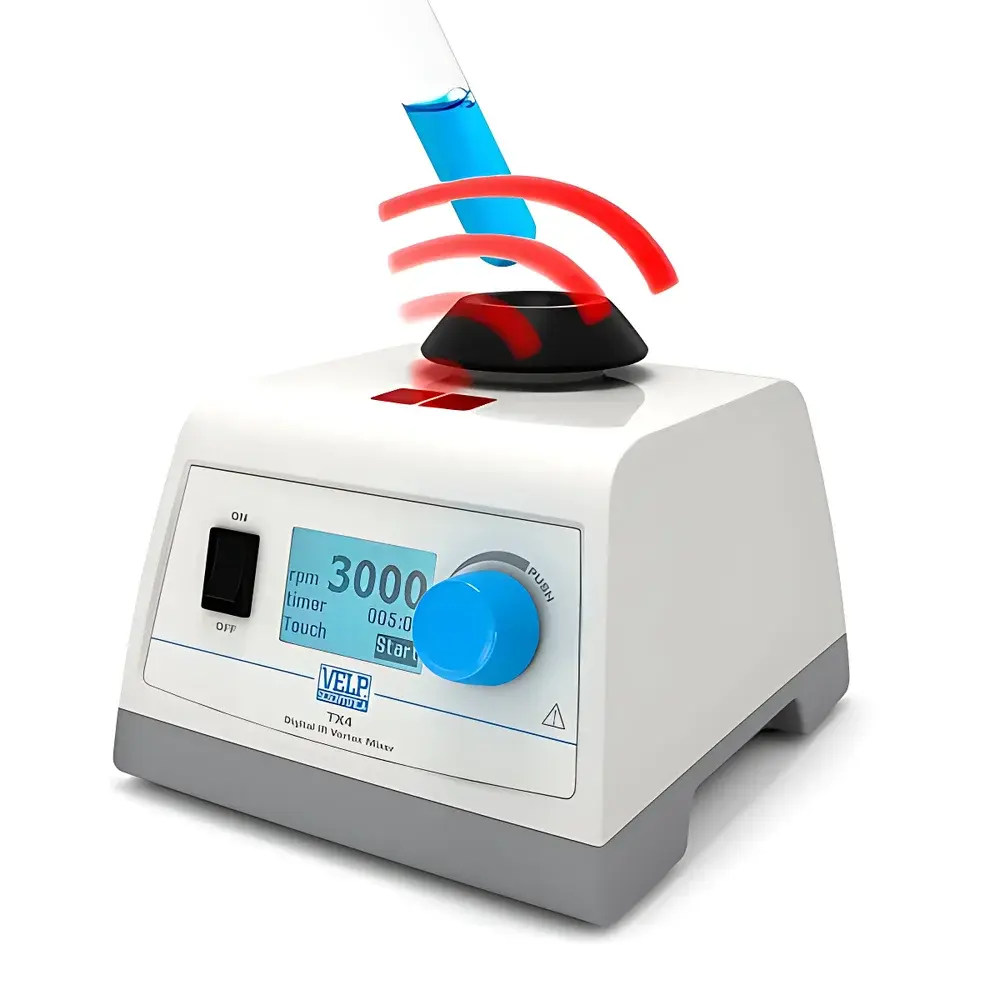
VELP TX4 Infrared Digital Vortex Mixer
| Brand | VELP |
|---|---|
| Origin | Italy |
| Model | TX4 |
| Speed Range | 0–3000 rpm |
| Operating Modes | Continuous & Touch-Activated |
| Motion Type | Circular Orbital |
| Amplitude | 4.5 mm |
| Display | Digital LCD (Large, Backlit) |
| Control Interface | Infrared Sensor (Patented, Contactless Activation) |
| Housing Material | Zinc Alloy |
| Base | Non-Slip Rubber Feet |
| Ingress Protection | IP42 |
| Voltage/Frequency | As per regional model specifications |
| Accessories Compatibility | Tubes (0.2–50 mL), Microplates, Flasks, Vials |
Overview
The VELP TX4 Infrared Digital Vortex Mixer is an engineered solution for precise, reproducible, and ergonomic sample homogenization in analytical, clinical, pharmaceutical, and research laboratories. Utilizing contactless infrared sensing technology — a patented innovation by VELP Scientifica — the instrument initiates orbital mixing automatically upon detection of a tube or vessel placed on the platform, eliminating mechanical pressure requirements inherent to conventional touch-activated vortexers. This optical activation principle enhances operator safety and reduces biomechanical strain associated with repetitive manual triggering, aligning with occupational health guidelines for laboratory ergonomics (ISO 10075-3:2022). The device operates on the principle of circular orbital motion, generating consistent shear forces across heterogeneous liquid-phase samples to achieve rapid and uniform suspension, re-suspension, or dissolution without introducing air bubbles or thermal artifacts typical of high-speed agitation.
Key Features
- Contactless infrared activation: Real-time detection of sample vessels ensures immediate, hands-free start/stop functionality — no physical contact or downward force required.
- Digital speed control: Precise electronic regulation from 0 to 3000 rpm with ±10 rpm repeatability under standard load conditions (e.g., 15 mL conical tube with aqueous solution).
- Extended timing capability: Programmable timer up to 999 minutes and 59 seconds, supporting both single-run and multi-step protocols.
- High-contrast backlit LCD display: Simultaneously shows real-time speed (rpm), elapsed time, and operational mode — optimized for visibility under varied ambient lighting.
- Zinc alloy chassis: Provides dimensional stability, vibration damping, and resistance to mechanical fatigue during prolonged operation.
- IP42-rated enclosure: Protects internal electronics against solid objects ≥1 mm and vertically falling water droplets — suitable for general laboratory environments with incidental splashes.
- Ergonomic base design: Integrated non-slip rubber feet maintain positional integrity on benchtops even during high-amplitude oscillation (4.5 mm peak-to-peak displacement).
Sample Compatibility & Compliance
The TX4 accommodates a broad range of container formats via interchangeable adapters, including microcentrifuge tubes (0.2–2.0 mL), standard test tubes (10–15 mL), culture tubes (up to 50 mL), 96-well microplates, and Erlenmeyer flasks (up to 250 mL). All accessories are constructed from chemically resistant polymers (e.g., PTFE-coated silicone, polypropylene) compatible with common solvents, buffers, and mild acids/bases. The system complies with IEC 61010-1:2010 for electrical safety in laboratory equipment and meets CE marking requirements under the EU Low Voltage and EMC Directives. While not certified for sterile or cleanroom use (ISO 14644), its sealed housing and smooth surfaces facilitate routine decontamination using 70% ethanol or isopropanol wipes — supporting GLP-aligned documentation practices.
Software & Data Management
The TX4 operates as a standalone instrument without proprietary software dependencies. All parameters — speed, duration, and activation status — are locally stored in non-volatile memory and displayed in real time. For laboratories requiring audit trails or electronic records, the device supports integration into validated workflows via external data loggers or LIMS interfaces through analog output signals (0–10 V) available on select configurations. Though not natively 21 CFR Part 11 compliant, its deterministic behavior, fixed parameter set, and absence of user-modifiable firmware enable straightforward qualification (IQ/OQ) under GMP or ISO/IEC 17025 frameworks when deployed within controlled procedural environments.
Applications
- Routine sample preparation prior to HPLC, GC, or spectrophotometric analysis.
- Resuspension of lyophilized reagents, bacterial pellets, or protein precipitates.
- Homogenization of immunoassay reagents, ELISA plate coatings, and cell lysates.
- Standardization of calibration standards and QC reference materials in environmental and food testing labs.
- Supporting ASTM D4052 (density), ISO 1628 (viscosity number), and USP particulate matter testing where uniform dispersion is critical.
FAQ
How does the infrared sensor differ from traditional touch-activated vortex mixers?
The TX4 uses an optical infrared emitter/receiver pair to detect the presence of any opaque or semi-opaque vessel — no mechanical actuation is needed. This eliminates finger fatigue and minimizes cross-contamination risk compared to pressure-based switches.
Can the TX4 be used with deep-well plates or conical-bottom tubes?
Yes, provided appropriate adapters are installed. VELP offers dedicated holders for 96-well deep-well plates (up to 2.2 mL/well) and conical centrifuge tubes (15–50 mL) — all designed to maintain centripetal alignment during orbital motion.
Is speed calibration traceable to national standards?
While the TX4 does not include built-in calibration certification, its speed output is factory-verified using NIST-traceable tachometry. Users may perform periodic verification using an external optical tachometer per ISO/IEC 17025 Clause 6.5.
What maintenance is required for long-term reliability?
No scheduled lubrication or internal servicing is required. Routine cleaning of the platform and adapter surfaces with lint-free cloths and approved disinfectants suffices. Annual verification of infrared sensitivity and speed accuracy is recommended for regulated environments.



