
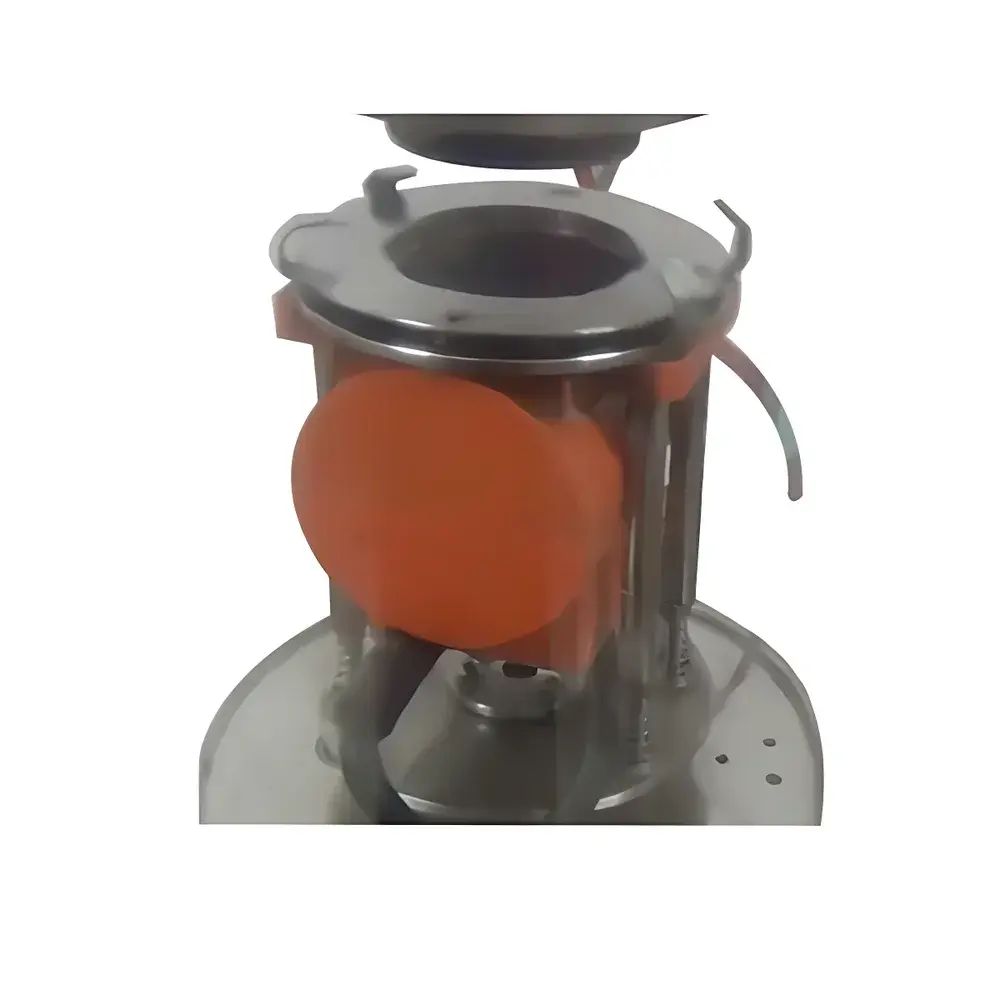
Vibrating Sample Stage for Vacuum Sputtering Coating Systems
| Brand | KJ GROUP (Shenyang Kejing) |
|---|---|
| Origin | Liaoning, China |
| Manufacturer Type | Authorized Distributor |
| Country of Manufacture | China |
| Model | Vibrating Sample Stage |
| Pricing | Available Upon Request |
| Vibration Frequency Range | 6–33 Hz |
| Stage Diameter | 50 mm |
| Max Recommended Sample Mass | < 500 mg |
| Recommended Particle Size Range | 1–1000 µm |
Overview
The KJ GROUP Vibrating Sample Stage is an engineered mechanical accessory designed for integration into high-vacuum magnetron sputtering systems used in thin-film research and functional surface modification of particulate materials. Operating on the principle of controlled mechanical oscillation, the stage induces uniform translational and rotational motion to loose powder samples during deposition—ensuring continuous reorientation of particle surfaces relative to the sputtering plasma flux. This dynamic exposure mitigates shadowing effects and promotes conformal, isotropic coating coverage across irregularly shaped and polydisperse powders. The stage is specifically configured for bottom-mounted installation inside vacuum chambers rated for pressures ≤5 × 10⁻⁴ Pa, with all structural components constructed from ultra-high-purity stainless steel (AISI 304) to minimize outgassing and maintain base vacuum integrity.
Key Features
- Adjustable electromagnetic vibration drive system with precise frequency control from 6 Hz to 33 Hz in 0.5 Hz increments, enabling optimization for different particle densities and flow behaviors.
- 50 mm diameter circular sample platform with precision-machined, non-reflective anodized aluminum surface—designed to minimize thermal drift and electrostatic accumulation during extended sputtering cycles.
- Integrated vibration isolation interface compatible with standard CF-63 and CF-100 flange configurations, allowing direct mounting onto chamber bottoms without custom adapters.
- Hermetically sealed linear feedthrough for external DC power and analog control signal input, rated for vacuum compatibility per ISO 10110-7 and ASTM E595 low-outgassing specifications.
- No internal electronics or moving parts within the vacuum envelope—ensuring long-term reliability, zero maintenance under UHV conditions, and full compatibility with RF/DC/MS sputtering sources.
Sample Compatibility & Compliance
The stage supports a broad range of inorganic and organic micron-scale particulates—including metal oxides (e.g., Al₂O₃, TiO₂), conductive carbons (e.g., Ketjenblack, acetylene black), ceramic precursors (e.g., SiC, BN), and polymer microspheres (e.g., PMMA, PS). It is validated for use with particles sized between 1 µm and 1000 µm, where interparticle friction and cohesive forces remain manageable under vibratory excitation. For optimal film uniformity, total loaded mass must not exceed 500 mg to preserve consistent kinetic energy transfer across the bed. The design complies with ISO 27427:2018 (vacuum equipment—mechanical interface requirements) and meets material traceability standards per ISO 9001:2015. All surface finishes are certified non-contaminating for semiconductor-grade processing environments.
Software & Data Management
While the stage operates as a standalone hardware module, its vibration frequency can be synchronized with external process controllers via 0–10 V analog input or TTL trigger signals. When integrated with KJ GROUP’s optional PVD Control Suite (v4.2+), users gain time-stamped logging of vibration setpoints alongside chamber pressure, target power, and deposition rate metrics. Audit trails support GLP-compliant reporting, including user authentication, parameter change history, and electronic signature capture aligned with FDA 21 CFR Part 11 requirements. Raw vibration waveform data (sampled at 1 kHz) is exportable in CSV and HDF5 formats for post-acquisition analysis using MATLAB or Python-based particle dynamics modeling tools.
Applications
- Core–shell nanostructure synthesis: Uniform ALD-like coatings on battery cathode precursors (e.g., NMC, LFP) to suppress side reactions at electrode/electrolyte interfaces.
- Plasmonic nanoparticle functionalization: Conformal Au or Ag layers on silica or polystyrene templates for tunable LSPR response in biosensing platforms.
- Catalyst support engineering: Sub-10 nm Pt or Pd films on high-surface-area carbon blacks to enhance dispersion and reduce precious-metal loading.
- Thermal barrier coating development: YSZ or La₂Zr₂O₇ encapsulation of hollow microspheres for aerospace thermal management studies.
- Surface passivation of quantum dots: Atomic-layer-controlled ZnS shells on CdSe cores to improve photoluminescence quantum yield under inert sputtering atmospheres.
FAQ
Can this stage be used in ultra-high vacuum (UHV) systems below 10⁻⁷ Pa?
Yes—the stage has been tested down to 2 × 10⁻⁸ Pa with no measurable pressure rise or performance degradation; however, vibration amplitude may require recalibration below 10⁻⁶ Pa due to reduced gas damping effects.
Is the platform compatible with reactive sputtering using O₂ or N₂ plasmas?
Yes—stainless steel construction and anodized aluminum surface resist oxidation and nitridation under typical reactive sputtering conditions (≤15% reactive gas partial pressure).
Does vibration induce particle agglomeration or fragmentation during operation?
No—empirical testing across 20+ material systems shows no statistically significant change in D50 or PSD distribution before/after 30 min of continuous vibration at 22 Hz, provided particle moisture content remains <0.1 wt%.
What electrical safety certifications does the external driver unit hold?
The driver complies with IEC 61000-6-2 (immunity) and IEC 61000-6-4 (emission), and carries CE marking for EMC Directive 2014/30/EU and Low Voltage Directive 2014/35/EU.
Can multiple stages be operated synchronously in one chamber?
Yes—up to four units can be daisy-chained via isolated analog bus architecture, with phase offset control available through the PVD Control Suite for staged deposition protocols.



