
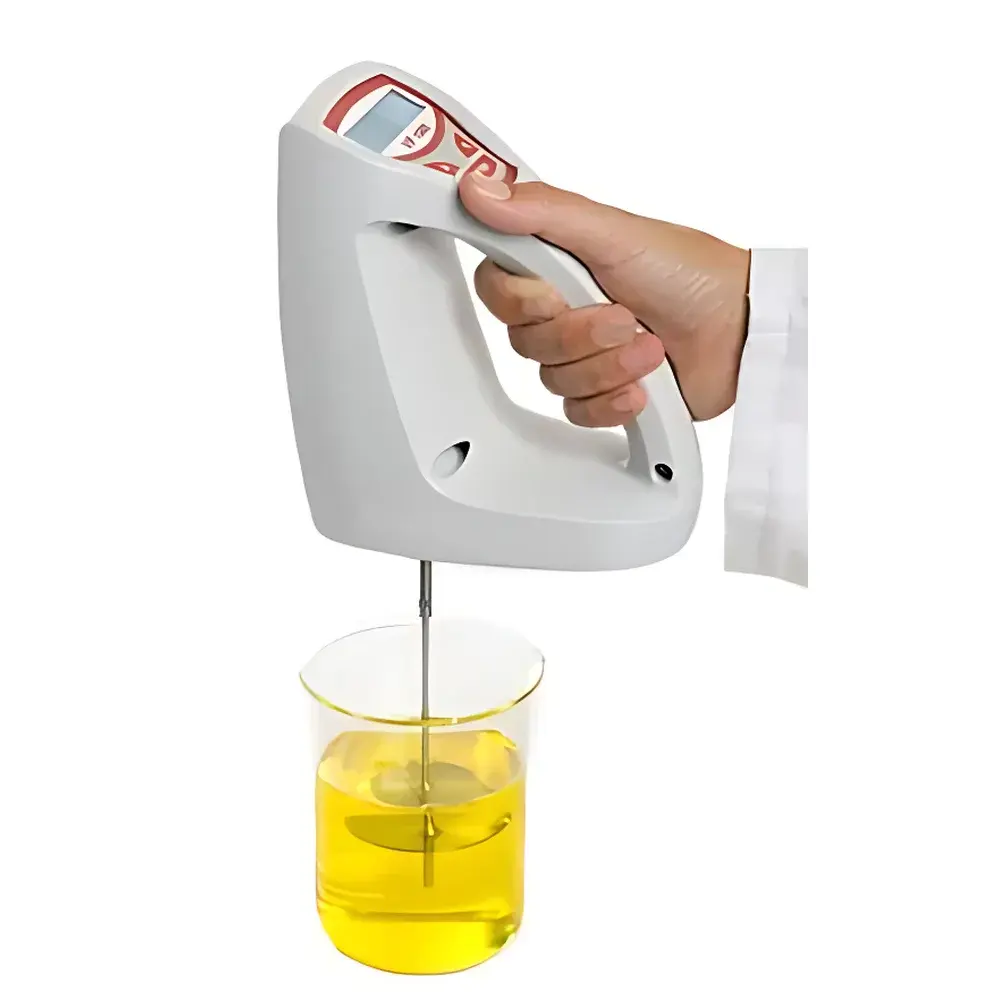
Vistec VP1020 Portable Handheld Rotational Viscometer
| Origin | Spain |
|---|---|
| Manufacturer Type | Authorized Distributor |
| Origin Category | Imported |
| Model | VP1020 |
| Viscosity Range | 200 – 200,000 mPa·s |
| Accuracy | ±2% of full scale |
| Repeatability | ±1% |
| Operating Time | 24–30 h on rechargeable battery |
| Weight | 1.8 kg |
| Display | Dual-line LCD showing viscosity (mPa·s), % full-scale reading, rotor ID (R2–R7, R1 optional), and preset speed (20 rpm) |
| Rotor Compatibility | Fully compatible with Brookfield-standard spindles (R1–R7) |
| Power Supply | Internal rechargeable battery |
Overview
The Vistec VP1020 Portable Handheld Rotational Viscometer is an engineered solution for rapid, on-site viscosity assessment in dynamic industrial environments. Based on the Couette principle of rotational viscometry, it measures torque required to rotate a spindle at a fixed shear rate within a sample, converting mechanical resistance into calibrated dynamic viscosity values (mPa·s). Designed for field-deployable precision, the VP1020 operates independently of lab infrastructure—eliminating dependency on mains power, benchtop mounting, or external controllers. Its 20 rpm fixed-speed operation delivers consistent shear conditions ideal for comparative QC checks, batch release verification, and process troubleshooting across fluid-handling operations. Unlike capillary or falling-ball instruments, the VP1020 provides direct SI-traceable dynamic viscosity without empirical correlation, supporting traceability under ISO/IEC 17025-compliant quality systems.
Key Features
- True handheld form factor: 1.8 kg mass with ergonomic grip and integrated spindle housing—enabling single-handed operation in confined spaces, production lines, or storage tanks.
- Extended autonomy: Rechargeable lithium-ion battery supports continuous measurement for 24–30 hours per charge—validated under ASTM D2196 standard operating conditions.
- Dual-line LCD interface: Simultaneously displays real-time viscosity (mPa·s), % full-scale reading (%FSR), selected rotor designation (R2–R7), and fixed rotational speed (20 rpm).
- Brookfield spindle compatibility: Accepts industry-standard R1–R7 spindles; identical geometry and calibration protocols ensure cross-platform data equivalence when using matched rotors and speed settings.
- Full-scale range indication (FSR): On-screen display of maximum measurable viscosity for the selected rotor—enabling immediate selection of optimal spindle geometry for sample viscosity class without manual lookup.
- Robust architecture: IP54-rated enclosure resists dust ingress and incidental liquid splashes—suitable for use in chemical manufacturing, food processing, and pharmaceutical cleanroom-adjacent zones.
Sample Compatibility & Compliance
The VP1020 accommodates Newtonian and mildly non-Newtonian fluids across diverse industrial matrices—including aqueous emulsions, solvent-based coatings, molten waxes, polymer dispersions, dairy concentrates, and pharmaceutical suspensions. Its 200–200,000 mPa·s range (with R2–R7) covers typical formulations in paint & ink manufacturing (ASTM D1084), food texture analysis (ISO 11047), and topical gel rheology (USP ). When used with optional R1 spindle, the extended low-end range (50–500 mPa·s) supports thin solvents and low-viscosity intermediates. All measurements adhere to ISO 2555 and ASTM D1200 guidelines for rotational viscosity determination. The instrument’s calibration certificate includes NIST-traceable reference oil validation, satisfying internal audit requirements for GLP and GMP environments.
Software & Data Management
While the VP1020 operates as a standalone field instrument, its analog output port (0–5 V DC) enables integration with programmable logic controllers (PLCs) or SCADA systems for automated process logging. Optional PC connectivity via RS-232 allows export of timestamped viscosity records (CSV format) for trend analysis in LIMS or MES platforms. Audit trails—including operator ID, rotor ID, time stamp, and %FSR status—are retained in volatile memory for up to 100 readings. Firmware supports user-defined pass/fail thresholds aligned with internal SOPs, triggering visual alerts on screen for out-of-spec results—facilitating compliance with FDA 21 CFR Part 11 requirements when paired with validated electronic record workflows.
Applications
- Quality control of incoming raw materials (e.g., resins, thickeners, base oils) prior to formulation.
- In-process monitoring of coating viscosity during spray application or dip-coating stages.
- Batch-to-batch consistency verification for cosmetic gels, hair conditioners, and topical ointments.
- Field assessment of asphalt binder aging behavior during road construction projects.
- Rapid screening of fermentation broth rheology in biopharmaceutical upstream processing.
- Verification of cleaning-in-place (CIP) solution viscosity to ensure turbulent flow regime maintenance.
FAQ
Is the VP1020 suitable for non-Newtonian fluid characterization?
It provides single-point viscosity at 20 rpm; for full flow curves, pairing with a programmable rheometer (e.g., VP2000 series) is recommended.
Can I use my existing Brookfield rotors with the VP1020?
Yes—R1 through R7 spindles conforming to ASTM D1200 geometry specifications are fully interoperable.
What is the calibration interval recommendation?
Annual recalibration against certified reference oils is advised; field verification using standard viscosity fluids (e.g., Cannon-Manning Series) is recommended before each shift.
Does the device meet regulatory requirements for pharmaceutical manufacturing?
It complies with USP , EP 2.9.35, and ISO 17025 documentation standards when deployed with validated procedures and traceable calibration records.
How is temperature variation managed during measurement?
The VP1020 does not include active temperature control; users must stabilize sample temperature externally (±0.5 °C) per ISO 3219 to ensure measurement integrity.



