
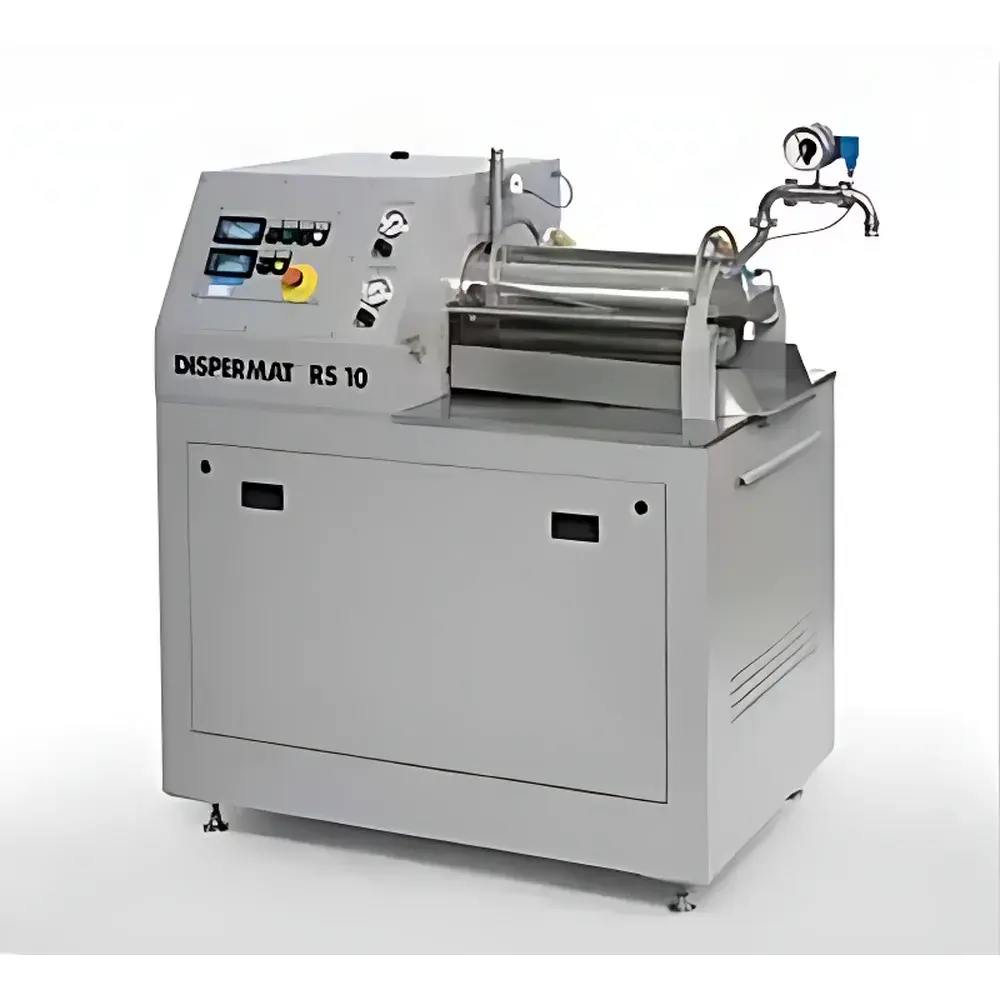
VMA DISPERMAT RS10 Horizontal Laboratory Bead Mill
| Brand | VMA |
|---|---|
| Origin | Germany |
| Model | RS10 |
| Instrument Type | Horizontal Bead Mill |
| Sample Compatibility | Cryogenic Samples |
| Maximum Feed Particle Size | <15 mm |
| Final Particle Size (D90) | <40 µm |
| Minimum Final Particle Size | <10 µm |
| Batch Volume | 10 L |
| Grinding Chamber Volume | 10 L |
| Speed Range | 0–2100 rpm |
| Motor Power | 37 kW |
| Bearing Configuration | Dual Precision Bearings |
| Cooling System | Integrated Circulating Coolant Loop via Grinding Shaft |
| Sealing | Mechanical Seal with Pressure-Regulated Monitoring |
| Safety | Full Interlocked Housing, Dynamic Gap Bead Separation, Rotatable Lid with Positive Locking Mechanism |
| Compliance | CE, ISO 9001, Designed per EN 61000-6-2/6-4 EMC Standards |
Overview
The VMA DISPERMAT RS10 is a high-performance horizontal bead mill engineered for precision wet grinding and dispersion of demanding laboratory-scale formulations. Based on the proven Couette-flow principle, it utilizes high-energy collision and shear forces between grinding media (e.g., glass or ceramic beads) and suspended particles within a horizontally oriented, jacketed grinding chamber. Unlike vertical mills, its horizontal configuration ensures uniform media distribution, minimized sedimentation, and superior thermal management—critical for heat-sensitive materials such as pharmaceutical suspensions, nanocomposites, pigment dispersions, and biological slurries. The RS10 is the mid-capacity variant in VMA’s DISPERMAT RS series (RS5, RS10, RS20), optimized for reproducible batch processing up to 10 L while maintaining sub-40 µm particle size distributions (D90) and enabling final fineness down to <10 µm under controlled conditions.
Key Features
- Horizontally oriented grinding chamber with dual-precision bearing-supported rotor shaft, ensuring mechanical stability and long-term runout accuracy at speeds up to 2100 rpm
- Dynamic gap separation system for efficient retention of grinding media without screen clogging or pressure surges
- Fully interlocked safety housing with position-sensing lid lock and emergency stop integration compliant with EN ISO 13857
- Integrated cooling circuit routed through the hollow grinding shaft and jacketed chamber—capable of maintaining ΔT < 5 °C during extended operation
- Electronically monitored pressure regulation via contact-type pressure gauge, enabling real-time feedback for process consistency and seal integrity verification
- Mechanical double-lip seal assembly with integrated suction siphon cooling reservoir for continuous lubrication and thermal buffering
- Rotatable, tool-free access lid with positive sealing clamps—reducing cleaning and maintenance downtime by >40% compared to fixed-lid designs
Sample Compatibility & Compliance
The RS10 accommodates both ambient and cryogenically pre-cooled feedstocks, supporting temperature-sensitive matrices including polymer emulsions, enzyme-loaded liposomes, and thermolabile active pharmaceutical ingredients (APIs). Its wet-grinding architecture eliminates dry attrition risks and enables stable colloidal dispersion formation. All wetted parts are constructed from corrosion-resistant stainless steel (1.4404 / AISI 316L) and chemically inert elastomers certified to USP Class VI and FDA 21 CFR 177.2600. The system conforms to CE Machinery Directive 2006/42/EC, electromagnetic compatibility per EN 61000-6-2 (immunity) and EN 61000-6-4 (emission), and quality management requirements of ISO 9001:2015. Documentation packages support GLP/GMP audit readiness, including full traceability of calibration records, seal replacement logs, and preventive maintenance schedules.
Software & Data Management
While the RS10 operates via analog-digital hybrid control (rotary speed potentiometer + pressure contact switch), it integrates seamlessly with external SCADA or LIMS platforms via 4–20 mA analog output signals for rotational speed, chamber pressure, and coolant inlet/outlet temperatures. Optional digital interface modules (RS485 Modbus RTU) enable remote parameter setting, runtime logging, and event-triggered data capture—including timestamped start/stop sequences, overpressure alarms, and thermal deviation alerts. All operational metadata is exportable in CSV format for trend analysis, batch reconciliation, and regulatory submission (e.g., FDA 21 CFR Part 11-compliant systems when paired with validated electronic signature software).
Applications
- Pharmaceutical R&D: Nanosuspension development for poorly water-soluble APIs, achieving narrow PDI (<0.2) and enhanced dissolution kinetics
- Coatings & Inks: Stabilized pigment dispersion in aqueous and solvent-based vehicles, reducing flocculation and improving color strength
- Advanced Materials: Exfoliation of 2D nanomaterials (e.g., graphene oxide, MXenes) and homogenous incorporation into polymer matrices
- Food Science: Emulsion stabilization of functional ingredients (e.g., curcumin, omega-3 oils) with improved bioavailability and shelf-life
- Academic Research: Controlled top-down nanoparticle synthesis where crystallinity, phase purity, and surface chemistry must be preserved
FAQ
What grinding media are recommended for the RS10?
Glass beads (density ~2.5 g/cm³, diameter 0.3–1.0 mm) are standard for general-purpose dispersion; zirconia or yttria-stabilized zirconia beads (density ~6.0 g/cm³) are preferred for ultrafine grinding (<20 µm) or abrasive formulations.
Is the RS10 suitable for GMP environments?
Yes—when equipped with optional validation documentation (IQ/OQ protocols), calibrated pressure and temperature transducers, and integrated audit-trail-capable controllers, it meets core requirements for pharmaceutical process equipment qualification.
How often should the mechanical seal be inspected?
Under normal operation (≤8 hrs/day, aqueous media), inspection is recommended every 500 operating hours; frequency increases to every 200 hours for organic solvents or abrasive slurries.
Can the RS10 operate continuously?
It is rated for intermittent duty (S3 duty cycle: 60% ED); continuous operation requires customized cooling capacity upgrades and thermal monitoring integration.
What is the minimum batch volume for reliable media fluidization?
For consistent energy transfer and avoidance of dead zones, the minimum effective batch volume is 30% of chamber volume—i.e., ≥3 L for the RS10.



