
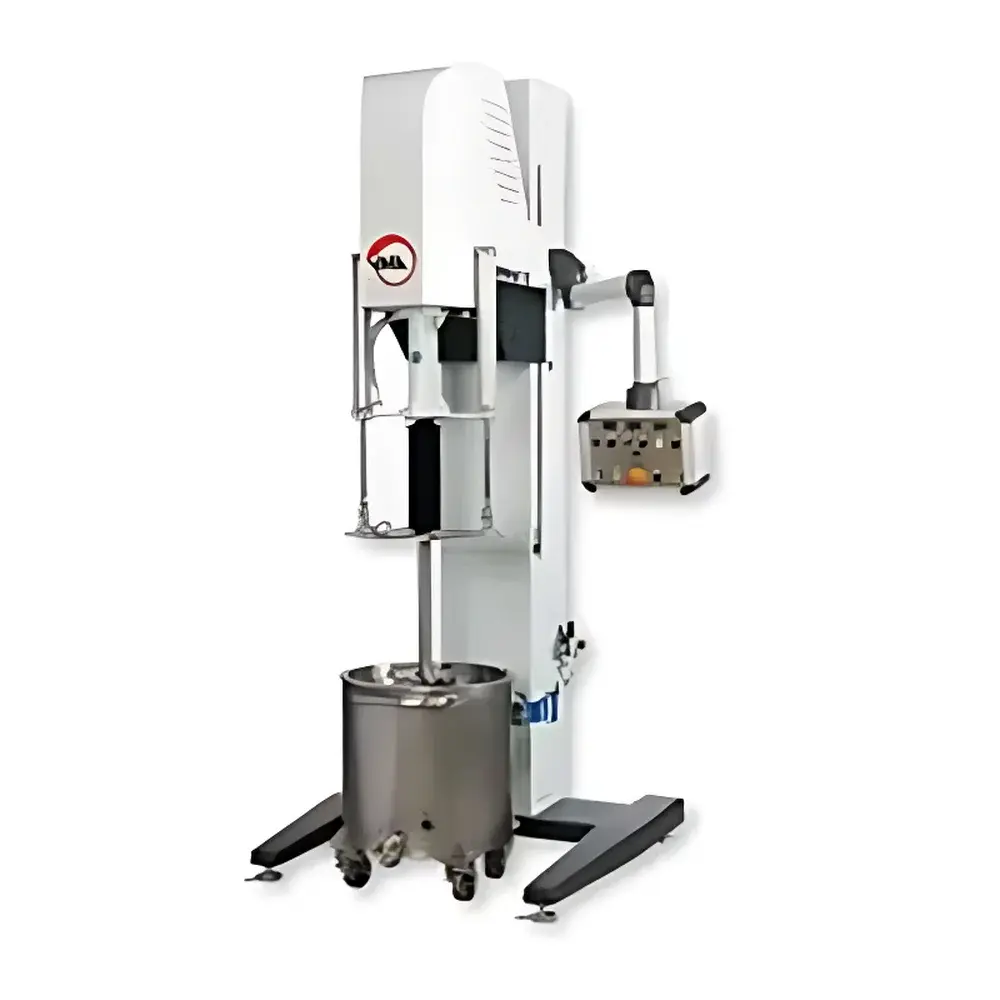
VMA DISPERMAT SC1000 High-Power Industrial Dispersion Mixer
| Brand | VMA |
|---|---|
| Origin | Germany |
| Model | SC1000 |
| Power Output | 45/55 kW |
| Maximum Batch Capacity | 500–2000 L |
| Compliance | ATEX Zone 0/1/2 (optional), Vacuum Integration Capable, PLC-Controlled Operation |
| Safety System | Load-Sensing Tension Band with Interlocked Start Enable |
| Control Interface | Touchscreen HMI with Programmable Parameters (RPM, Time, Temperature, Current Monitoring) |
Overview
The VMA DISPERMAT SC1000 is a high-power, industrial-grade dispersion mixer engineered for reproducible, scalable, and process-secure dispersion of pigments, fillers, resins, and other functional additives in liquid media—primarily coatings, inks, adhesives, and advanced composite formulations. Operating on the principle of high-shear rotor-stator hydrodynamic dispersion, the SC1000 delivers controlled energy input across large batch volumes (500–2000 L), enabling deagglomeration, wetting, and uniform particle distribution without excessive heat generation or mechanical degradation. Its robust cast-iron frame, precision-machined dispersing discs, and dynamically balanced drive train ensure long-term operational stability under continuous duty cycles. Designed and manufactured in Germany, the SC1000 adheres to DIN EN ISO 9001 quality management standards and integrates seamlessly into GMP-aligned pilot and production-scale laboratories where traceability, repeatability, and operator safety are non-negotiable.
Key Features
- High-power dual-mode motor delivering 45 kW (standard) or 55 kW (high-torque configuration), optimized for viscous and thixotropic systems up to 15,000 mPa·s
- Electronically commutated (EC) motor with closed-loop speed control, maintaining ±0.5% RPM accuracy across full torque range (0–1800 rpm)
- Load-sensing tension band clamping system with integrated pressure transducer—machine start is interlocked until secure vessel fixation is verified
- Modular system architecture supporting optional ATEX-certified explosion protection (Zone 0/1/2), vacuum-assisted degassing (≤10 mbar absolute), and PLC-based automation (Siemens S7 or Allen-Bradley compatible)
- Ergonomic height-adjustable cantilever arm with digital position encoder, enabling precise vertical positioning of the dispersing disc relative to vessel geometry and liquid level
- IP54-rated touchscreen HMI with multi-user access levels, real-time monitoring of torque, current draw, temperature (via optional Pt100 probe), and elapsed processing time
Sample Compatibility & Compliance
The DISPERMAT SC1000 accommodates a broad spectrum of formulation chemistries—including waterborne, solvent-borne, UV-curable, and high-solids coating systems—as well as ceramic slurries, battery electrode pastes, and pharmaceutical suspensions. Its stainless-steel wetted parts (AISI 316L standard) resist corrosion from acidic, alkaline, and halogenated solvents. The system supports compliance with multiple regulatory frameworks: ATEX 2014/34/EU for explosive atmospheres; ISO 13849-1 for functional safety of control systems; and FDA 21 CFR Part 11 when paired with validated software modules that provide electronic signatures, audit trails, and data integrity controls. All mechanical and electrical design conforms to CE marking requirements under the Machinery Directive 2006/42/EC and Low Voltage Directive 2014/35/EU.
Software & Data Management
The SC1000’s embedded control firmware enables full recipe management, including up to 255 programmable protocols with stepwise RPM ramps, dwell times, and conditional logic (e.g., “hold at 1200 rpm until torque stabilizes within ±3% for 60 s”). Process data—including RPM, torque (% of max), current (A), temperature (°C), and time stamps—is logged at 10 Hz and exportable via USB or Ethernet (Modbus TCP or OPC UA) to LIMS or MES platforms. Optional VMA ProcessLog software provides GxP-compliant data archiving, user authentication, electronic signature capture, and automated report generation aligned with ALCOA+ principles (Attributable, Legible, Contemporaneous, Original, Accurate, Complete, Consistent, Enduring, Available).
Applications
- Development and scale-up of architectural, automotive, and coil coatings requiring narrow particle size distribution (PSD) and minimal gel content
- Preparation of conductive inks and graphene dispersions for printed electronics, where agglomerate removal directly impacts film conductivity
- Formulation of high-performance sealants and structural adhesives demanding homogeneous filler dispersion for consistent rheology and bond strength
- Production of cathode/anode slurries for lithium-ion battery R&D, where carbon black or NMC dispersion uniformity governs electrode porosity and cycle life
- Stabilization of nanoscale pigment dispersions for inkjet inks, where optical density and nozzle clogging resistance depend critically on primary particle liberation
FAQ
What batch volume ranges does the SC1000 support, and how is scalability ensured across different vessel geometries?
The SC1000 operates effectively between 500 L and 2000 L, with optimal performance achieved when vessel diameter-to-height ratio falls within 0.8–1.4. Scalability is maintained through dimensionless power number (NP) and Reynolds number (Re) correlation—process parameters are translated using geometric similarity and constant tip speed (15–25 m/s), ensuring equivalent shear history across scales.
Can the SC1000 be integrated into an existing automation infrastructure?
Yes—the unit features standard industrial communication protocols (Modbus TCP, Profibus DP, and optional OPC UA), allowing direct integration with PLCs, SCADA systems, or centralized lab automation platforms without proprietary middleware.
Is validation documentation available for GMP environments?
VMA supplies IQ/OQ documentation templates compliant with ASTM E2500 and ISPE GAMP5 guidelines. Full qualification support—including sensor calibration certificates, FAT/SAT reports, and 21 CFR Part 11 readiness assessment—is available upon request.
What maintenance intervals are recommended for continuous operation?
Routine inspection of belt tension, bearing lubrication (grease refill every 2000 operating hours), and dispersing disc wear measurement is advised quarterly. Motor and drive electronics require no scheduled maintenance but benefit from annual thermal imaging and vibration analysis per ISO 10816-3.
Related Products



