
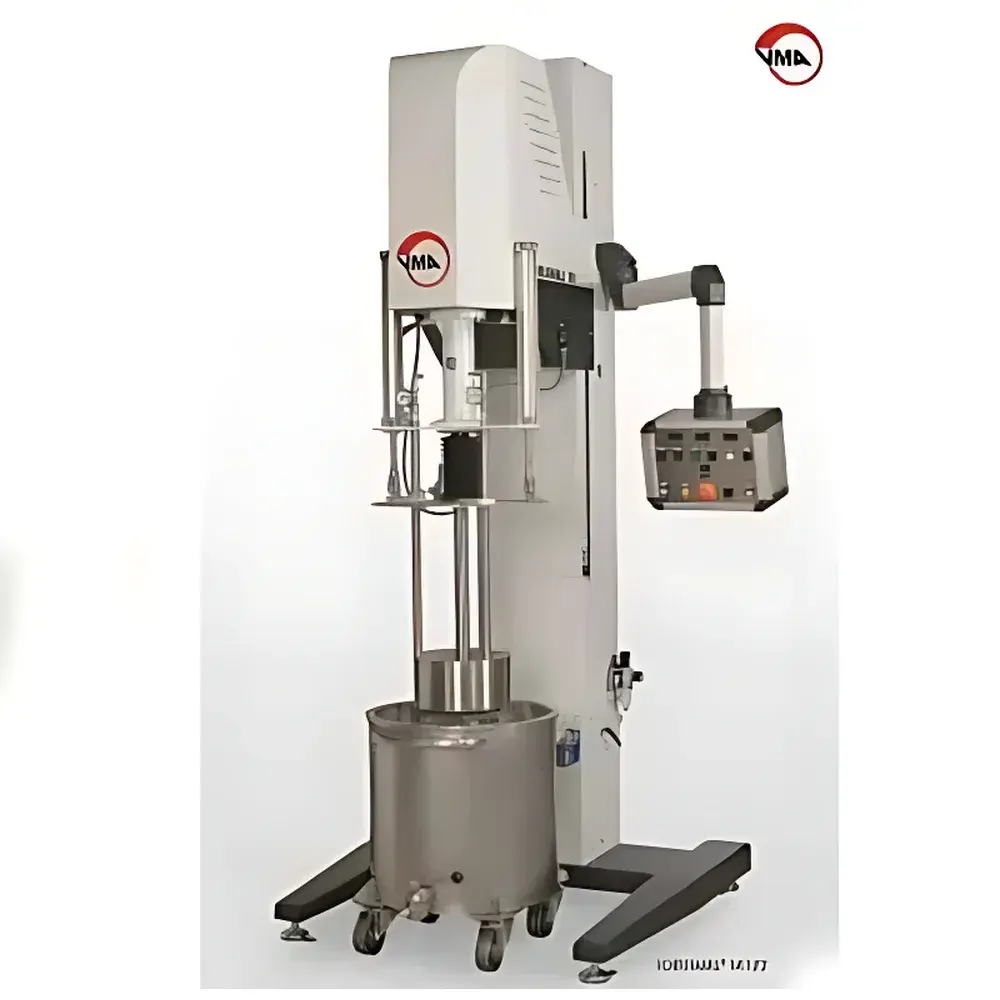
VMA Torusmill SK1000 Laboratory Paint Disperser
| Brand | VMA |
|---|---|
| Origin | Germany |
| Model | SK1000 |
| Type | Basket-Type Bead Mill (Laboratory-Scale) |
| Power Output | 45–55 kW |
| Usable Vessel Capacity | 500–2000 L |
| Digital Process Monitoring | Rotational Speed (rpm), Motor Current (A), Material Temperature (°C) |
Overview
The VMA Torusmill SK1000 is a high-performance, laboratory-scale basket-type bead mill engineered for the controlled dispersion, deagglomeration, and wet grinding of pigment systems, coatings, inks, adhesives, and other high-viscosity suspensions. Unlike conventional rotor-stator homogenizers or simple stirrer-based dispersers, the SK1000 operates on the principle of dynamic media milling: a high-speed, patented pump impeller circulates slurry through a stationary, perforated grinding basket filled with ceramic or zirconia beads. This closed-loop circulation ensures uniform energy input, narrow residence time distribution, and reproducible particle size reduction down to sub-micron levels—critical for color strength, gloss consistency, and long-term colloidal stability in coating formulations.
Key Features
- Modular basket design with optional single-wall or dual-wall configuration—enabling precise thermal control via jacketed cooling/heating circuits integrated into the grinding basket itself
- ATEX-compliant vacuum-capable variants available for processing solvent-based or low-flashpoint formulations under inert or reduced-pressure conditions
- Digital process interface with real-time display of rotational speed (0–3000 rpm), motor current draw (A), and inline material temperature (±0.5 °C resolution)
- Hydraulically actuated clamping system rated for vessels up to 2000 L, ensuring secure sealing and vibration-damped operation across variable fill levels
- High-efficiency pump impeller geometry optimized for laminar-to-turbulent transition control, minimizing bead attrition while maximizing throughput and shear homogeneity
- Tool-free basket exchange mechanism supporting rapid changeover between bead sizes (0.3–2.0 mm) and materials (ZrO₂, SiC, Al₂O₃) without disassembly of drive components
Sample Compatibility & Compliance
The SK1000 accommodates non-Newtonian and thixotropic systems with viscosities ranging from 100 mPa·s to >50,000 mPa·s (measured at 25 °C, 10 s⁻¹). It is routinely deployed in R&D laboratories validating ASTM D1210 (Hegman fineness of grind), ISO 787-24 (dispersion quality of pigments), and ISO 15197 (coating stability assessment). The unit complies with EU Machinery Directive 2006/42/EC, EMC Directive 2014/30/EU, and carries CE marking. Optional ATEX Zone 1/21 certification (II 2G Ex db IIB T4 Gb / II 2D Ex tb IIIC T135°C Db) is provided for explosive atmospheres. All firmware and operational logs meet GLP audit requirements, with timestamped parameter logging traceable to NIST-traceable calibration sources.
Software & Data Management
The integrated control module supports RS485 Modbus RTU and Ethernet/IP protocols for integration into centralized lab automation networks. Process parameters—including speed ramp profiles, dwell times per dispersion stage, and thermal setpoints—are programmable via a password-protected HMI. Raw sensor data (rpm, A, °C) are logged at 1 Hz resolution and exportable as CSV or XML for post-processing in MATLAB, JMP, or LIMS platforms. Audit trail functionality satisfies FDA 21 CFR Part 11 requirements, including electronic signatures, user access levels (admin/operator/technician), and immutable event logging of all parameter changes and emergency stops.
Applications
- Development and scale-up of waterborne and solventborne architectural and industrial coatings
- Rheology modifier dispersion and nano-pigment stabilization for automotive basecoats
- Pre-formulation studies of UV-curable resins requiring low-heat, oxygen-sensitive milling
- Quality-by-Design (QbD) mapping of critical process parameters (CPPs) such as bead loading, circulation rate, and ΔTmax
- Accelerated stability testing of dispersion systems using thermal cycling protocols within the dual-wall basket
- Reference method validation against commercial production mills (e.g., VMA Getzmann KDL series) via geometric and kinematic similarity analysis
FAQ
What bead materials are compatible with the SK1000?
Zirconium dioxide (Y-TZP), silicon carbide, and stabilized alumina beads ranging from 0.3 mm to 2.0 mm diameter are supported. Bead selection must consider density mismatch, chemical resistance, and target d90 reduction—guidance is provided in VMA Technical Bulletin TB-SK-07.
Can the SK1000 be operated under nitrogen blanketing?
Yes—ATEX-certified vacuum versions include gas purge ports and pressure-relief interlocks compatible with continuous nitrogen sparging during dispersion cycles.
Is remote monitoring supported out-of-the-box?
Standard Ethernet/IP enables OPC UA server integration; VMA offers optional cloud telemetry via the VMA Connect Gateway (IEC 62443-3-3 compliant) with TLS 1.2 encryption and role-based dashboard access.
What maintenance intervals are recommended for the pump impeller and basket seals?
Impeller inspection every 500 operating hours; ceramic basket gasket replacement every 1,200 hours or after 30 abrasive batches—documented in Maintenance Log Sheet ML-SK1000 Rev. 4.2.
Does the SK1000 support automated cleaning-in-place (CIP)?
Not natively—but the open-loop circulation path and quick-release basket mount allow integration with third-party CIP skids using validated detergent flow rates and temperature profiles per ISO 14644-1 Class 7 cleanroom protocols.



