
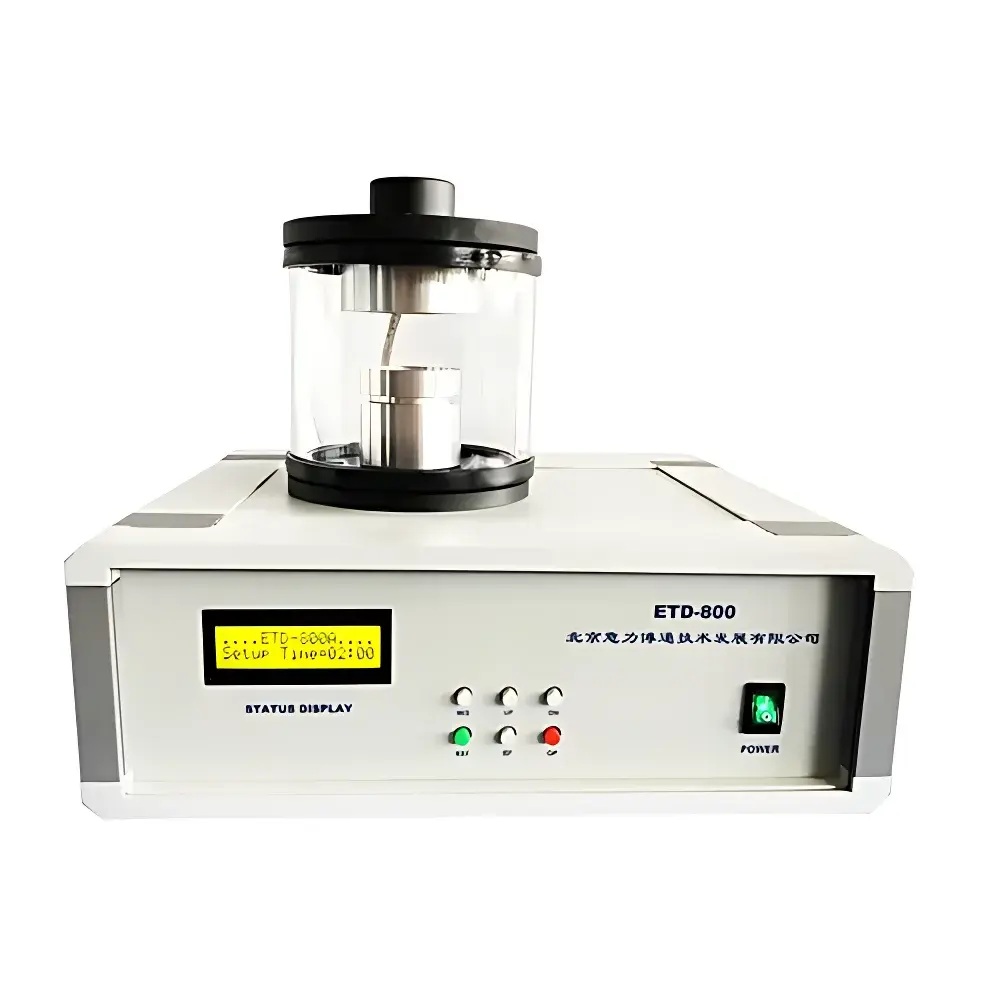
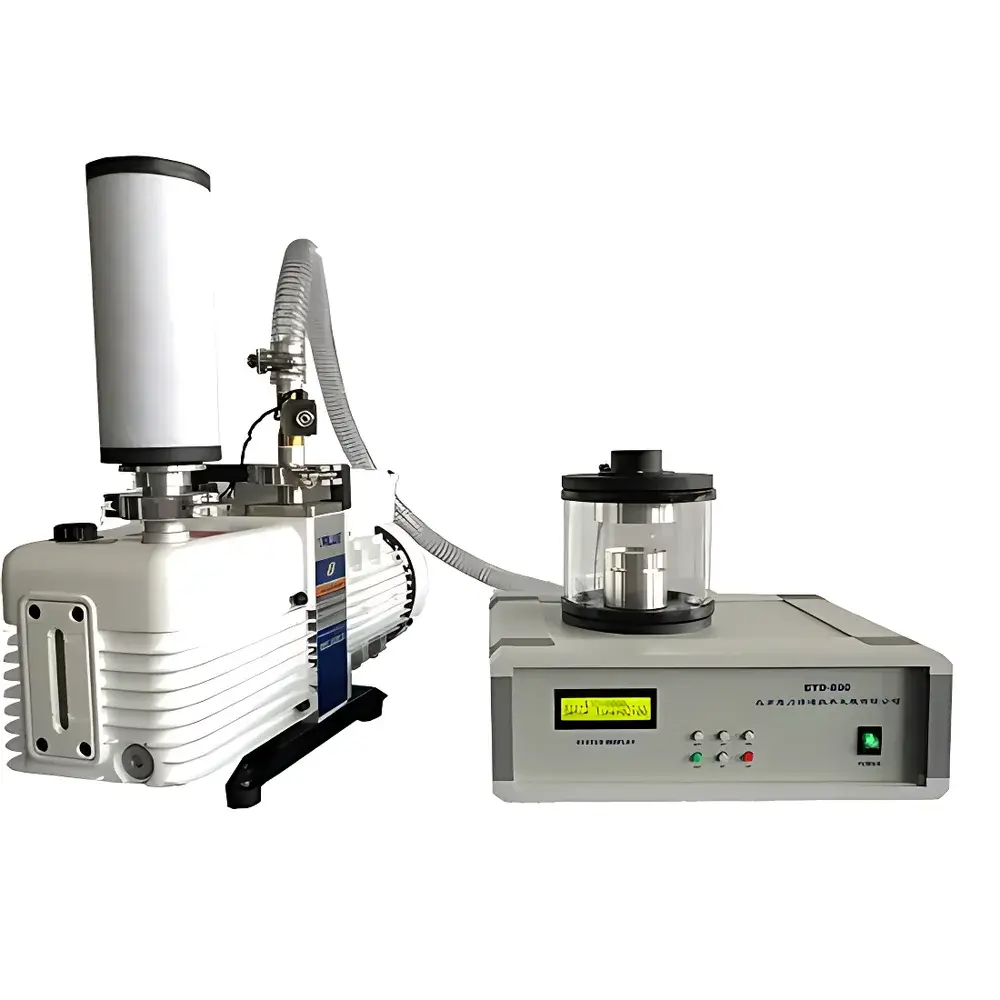
VPI ETD-800 Fully Automated Ion Sputter Coater
| Brand | VPI |
|---|---|
| Model | ETD-800 |
| Target Material | Au (standard), optional Pt, Ag, Cr, Al, Cu |
| Target Diameter | 50 mm |
| Chamber Dimensions | Ø100 mm × 100 mm (H) |
| Sample Stage Diameter | 50 mm |
| Sputtering Gas | Air (ambient air used as sputtering medium) |
| Control Mode | Fully Automatic |
| Vacuum System | Integrated single-stage rotary vane pump (1 L/s) |
| Maximum DC Bias Voltage | −1200 V |
| Timer Range | 0–3600 s (digital, ±1 s resolution) |
| Chamber Material | Borosilicate glass |
| Power Supply | 220 V AC, 50 Hz (optional 110 V configuration available) |
| Unit Dimensions | 310 mm × 260 mm × 115 mm (W × D × H) |
Overview
The VPI ETD-800 Fully Automated Ion Sputter Coater is a compact, benchtop plasma sputtering system engineered for high-precision conductive coating of non-conductive and beam-sensitive specimens prior to scanning electron microscopy (SEM) analysis. It operates on the principle of DC magnetron sputtering—where a high-voltage negative bias applied to a metallic target (e.g., Au, Pt, or Cr) ionizes ambient air molecules within a low-pressure environment, accelerating ions toward the target surface to eject atomic clusters that condense uniformly onto the sample. Unlike inert-gas-dependent systems, the ETD-800 utilizes ambient air as both the sputtering medium and process gas, eliminating the need for external gas cylinders while maintaining stable plasma ignition and reproducible film nucleation. Its optimized chamber geometry (Ø100 mm × 100 mm), combined with a centrally aligned 50 mm-diameter sample stage and symmetrical electrode configuration, ensures radial uniformity in coating thickness (<±5% variation across standard 25 mm SEM stubs) and minimal thermal load—critical for preserving ultrastructure in biological, polymeric, and nanoscale materials.
Key Features
- Fully automated operation: One-button start sequence initiates vacuum pumping, pressure stabilization, sputtering initiation, time-controlled deposition, and venting—requiring no manual intervention.
- Digital precision timer: Programmable from 1 to 3600 seconds with ±1-second repeatability, enabling consistent control over nominal film thickness (e.g., 2–10 nm Au layers typical for FE-SEM).
- Modular target compatibility: Standard 50 mm-diameter, 0.1 mm-thick Au target; interchangeable with Pt, Ag, Cr, Al, or Cu targets (all 50 mm diameter) to tailor grain size, conductivity, and X-ray transparency per application requirements.
- Integrated safety architecture: Real-time vacuum interlock prevents high-voltage activation below safe operating pressure (~5–15 Pa), mitigating arcing risk and ensuring long-term electrode integrity.
- Borosilicate glass chamber: Chemically inert, optically transparent, and thermally stable—facilitates visual process monitoring and simplifies cleaning between runs without solvent exposure risks.
- Compact footprint (310 × 260 × 115 mm): Designed for space-constrained laboratories; compatible with standard fume hoods and glovebox integration via optional vacuum port adapters.
Sample Compatibility & Compliance
The ETD-800 accommodates a broad range of specimen types including hydrated biological tissues (e.g., freeze-fractured cells), insulating polymers (e.g., PMMA, PDMS), ceramic powders, geological thin sections, and semiconductor wafers up to 50 mm in diameter. Its low-energy sputtering regime minimizes surface damage and charging artifacts, making it suitable for beam-sensitive samples where conventional high-power coaters induce carbon contamination or topographic distortion. The system complies with IEC 61000-6-3 (EMC emission limits) and meets mechanical safety requirements per ISO 13857. While not certified to GLP or GMP standards out-of-the-box, its repeatable timing, vacuum logging capability (via optional RS232/USB interface), and traceable parameter settings support audit-ready workflows under ISO/IEC 17025-accredited SEM labs.
Software & Data Management
The ETD-800 operates via embedded firmware with no external PC dependency. All operational parameters—including sputtering duration, voltage setpoint, and pump-down status—are displayed on a high-contrast LCD interface with backlighting. For laboratories requiring electronic recordkeeping, an optional communication module enables serial data export (ASCII format) of timestamped run logs—including start time, duration, final chamber pressure, and target type—to third-party LIMS or ELN platforms. Firmware supports user-defined presets (up to 8 profiles), each storing target material, time, and voltage configuration—enabling rapid method recall without reprogramming. Audit trails are maintained locally via non-volatile memory with overwrite protection for the last 100 runs.
Applications
- FE-SEM sample preparation: Ultrafine Au or Pt coatings (2–5 nm) yield sub-5 nm grain sizes essential for high-resolution secondary electron imaging and low-kV contrast optimization.
- EDS and WDS microanalysis: Thin Cr or C coatings reduce substrate fluorescence while maintaining X-ray transmission efficiency for quantitative elemental mapping.
- Charge dissipation in insulators: Uniform Al or Cu films (5–15 nm) provide low-resistance pathways for charge drainage during extended dwell-time mapping or EBSD acquisition.
- TEM grid support film enhancement: Sputtered Au/Pd layers improve mechanical stability of carbon films during ion milling or FIB lift-out procedures.
- Materials science prototyping: Rapid screening of sputter-deposited interfacial layers on novel 2D materials, MOFs, or perovskite thin films under ambient-air conditions.
FAQ
Can the ETD-800 operate with argon or other inert gases?
No—the system is specifically engineered for air-based sputtering. Introducing external gases requires hardware modifications (gas inlet valve, flow controller, pressure regulation) not supported by the base configuration.
What is the typical coating thickness achievable with the ETD-800?
Thickness depends on sputtering time, target material, and chamber pressure. Using Au at −1200 V and 10 Pa, 60 s yields ~3 nm; 180 s yields ~9 nm (measured by TEM cross-section or quartz crystal microbalance calibration).
Is the glass chamber resistant to acid vapors during post-coating etching steps?
Borosilicate glass offers moderate resistance to dilute HCl or acetic acid but is incompatible with HF, hot concentrated HNO₃, or aqua regia. Cleaning should be performed with isopropanol or ethanol only.
Does the ETD-800 meet FDA 21 CFR Part 11 requirements for electronic signatures?
Not natively—no user authentication, electronic signature, or audit trail encryption is implemented. Integration with validated third-party software may extend compliance in regulated environments.
How often does the vacuum pump oil require replacement?
Under normal usage (≤10 cycles/day), oil replacement is recommended every 6 months or after 500 hours of cumulative pump runtime, per manufacturer specifications for the integrated 1 L/s rotary vane pump.



