
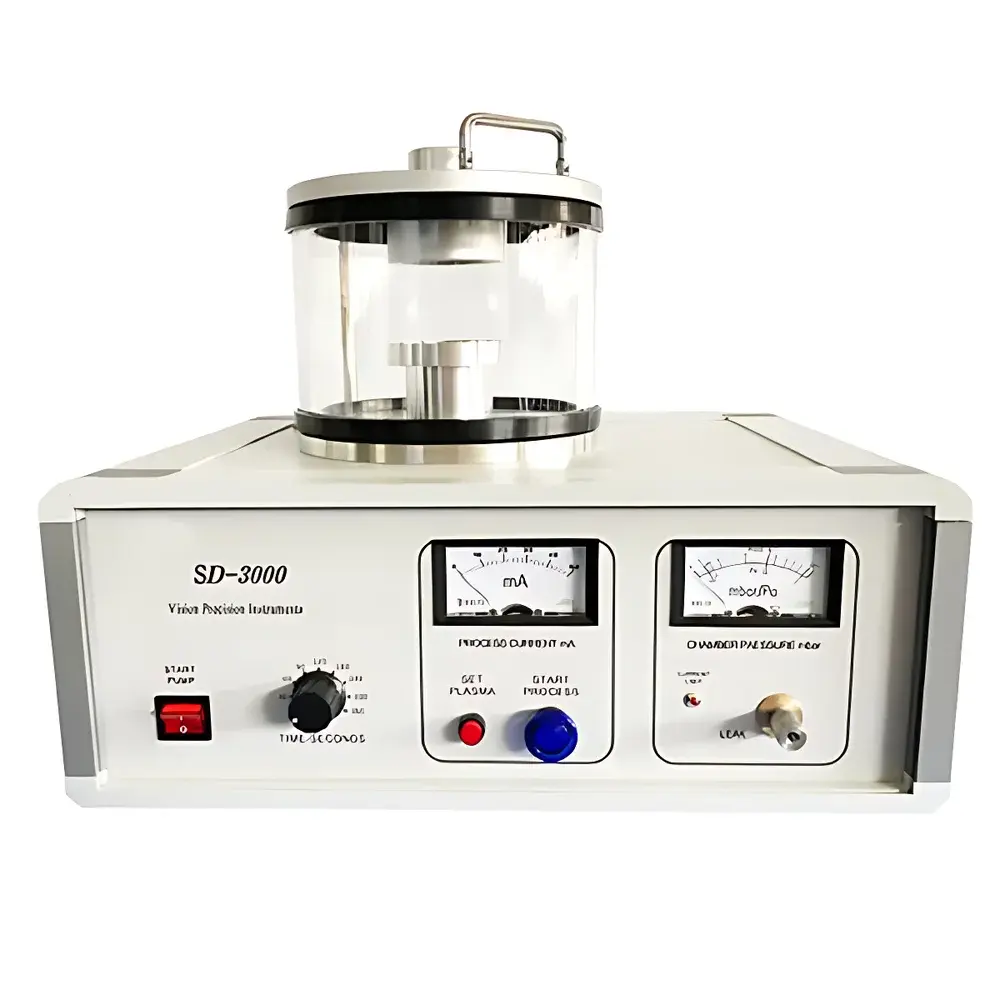
VPI SD-3000 Manual Ion Sputter Coater
| Brand | VPI (BoYuan Micro-Nano) |
|---|---|
| Origin | Beijing, China |
| Model | SD-3000 |
| Target Material (Standard) | Au (50 mm × 0.1 mm thickness) |
| Optional Targets | Ag, Pt, Ir, Cu |
| Sputtering Gases | Ar, N₂, and other inert/reactive gases |
| Chamber Dimensions | Ø150 mm × 120 mm (H) |
| Sample Stage Diameter | 50 mm |
| Maximum Sputtering Voltage | –2800 V DC |
| Max Sputtering Current | 50 mA |
| Ultimate Vacuum | ≤ 4 × 10⁻² mbar |
| Timer Range | 1–360 s |
| Vacuum Pump | VRD-8 rotary vane pump (2 L/s) |
| Control Method | Manual analog interface with CPU-assisted timing and interlock logic |
| Compliance | Designed for GLP-aligned sample prep workflows in SEM labs |
Overview
The VPI SD-3000 Manual Ion Sputter Coater is a benchtop physical vapor deposition (PVD) system engineered for high-reproducibility conductive coating of non-conductive or beam-sensitive specimens prior to scanning electron microscopy (SEM) analysis. It operates on the principle of direct-current (DC) magnetron sputtering: argon ions—accelerated by a high-voltage negative bias applied to a metallic target—are directed onto the target surface, ejecting atoms that subsequently condense as a uniform, nanoscale conductive film on substrates placed on the grounded sample stage. Unlike thermal evaporation, sputtering produces coatings with superior adhesion, lower grain size, and higher structural integrity—critical for preserving fine surface topography and enabling stable, low-noise secondary electron emission during high-magnification SEM imaging. The SD-3000 is purpose-built for academic and industrial laboratories engaged in electrode characterization, semiconductor interface studies, and biological ultrastructural analysis where precise control over film thickness, grain morphology, and interfacial bonding is essential.
Key Features
- Manual analog control interface with tactile rotary timers and dual analog meters—vacuum pressure (0–100 mbar range) and sputtering current (0–50 mA)—enabling intuitive real-time process monitoring without software dependency.
- Dual-gas micro-leak valve (compatible with φ3 mm tubing) supports flexible gas selection (Ar, N₂, or custom mixtures), facilitating both pure metal films and reactive sputtering for nitride-based coatings.
- Robust borosilicate glass vacuum chamber (Ø160 mm × 120 mm H) with front-loading design and O-ring sealed viewport ensures optical clarity and rapid sample exchange while maintaining structural stability under repeated vacuum cycling.
- Integrated safety architecture includes vacuum interlock protection (prevents high-voltage activation below safe pressure thresholds) and overcurrent cutoff, meeting IEC 61010-1 requirements for laboratory electrical equipment.
- Modular target mounting system accepts standard Ø50 mm disc targets (Au, Pt, Ag, Ir, Cu), allowing rapid material switching without tooling—enabling comparative studies across conductive, catalytic, or corrosion-resistant coatings.
- High-voltage DC power supply (–2800 V) combined with optimized magnetic field geometry delivers consistent ion flux density, resulting in sub-5 nm grain size and <5% thickness variation across 50 mm diameter substrates.
Sample Compatibility & Compliance
The SD-3000 accommodates a broad spectrum of specimen types: insulating ceramics, polymers, biological tissues (e.g., freeze-dried plant sections, insect cuticles), and fragile nanostructured electrodes. Its low-energy sputtering regime minimizes thermal and kinetic damage to beam-sensitive samples—critical for preserving native morphology in cryo-SEM workflows. All operational parameters—including sputtering time, current, gas composition, and base pressure—are manually recordable and traceable, supporting documentation requirements under ISO/IEC 17025 and ASTM E1558 (Standard Guide for Preparation of Specimens for SEM). While not certified for regulated GMP environments, its repeatable process envelope and mechanical reliability make it suitable for method development and QC sample preparation aligned with GLP principles.
Software & Data Management
The SD-3000 operates without proprietary software; all functions are hardware-controlled via front-panel analog components. This architecture eliminates driver dependencies, OS compatibility constraints, and cybersecurity vulnerabilities associated with embedded firmware. Process parameters are logged manually in lab notebooks or integrated into LIMS via standardized templates. For laboratories requiring electronic audit trails, external data loggers can be connected to the analog meter outputs (0–5 V scaling) to capture vacuum decay curves and current transients—enabling retrospective validation of coating consistency per USP Analytical Instrument Qualification guidelines.
Applications
- Preparation of non-conductive specimens for high-resolution SEM imaging—eliminating charging artifacts and enhancing signal-to-noise ratio.
- Fabrication of working electrodes for electrochemical impedance spectroscopy (EIS) and cyclic voltammetry, where interfacial adhesion directly influences charge-transfer kinetics.
- Deposition of ultrathin reference layers (e.g., Au/Pt bilayers) on TEM grids for calibration and contrast enhancement.
- Rapid prototyping of conductive pathways on flexible polymer substrates for organic electronics research.
- Surface functionalization of MEMS devices prior to FIB-SEM cross-sectioning to prevent Ga⁺ ion-induced redeposition.
FAQ
What vacuum level is required before initiating sputtering?
A base pressure ≤ 4 × 10⁻² mbar must be achieved using the included VRD-8 rotary vane pump. Lower pressures reduce gas-phase scattering and improve film density.
Can nitrogen be used instead of argon for sputtering?
Yes—the micro-leak valve supports N₂ and other inert or reactive gases; however, nitrogen may form nitrides with certain targets (e.g., Ti, Cr), altering film stoichiometry and conductivity.
Is the SD-3000 compatible with cryo-SEM sample holders?
The Ø50 mm sample stage accepts standard stubs and pin-type cryo-mounts; however, direct cryogenic operation is not supported due to thermal contraction mismatches in the glass chamber.
How often should the target be replaced?
Target lifetime depends on sputtering duration and current; typical Au targets last ~150–200 minutes at 30 mA. Visual inspection for crater depth >0.3 mm indicates replacement necessity.
Does the system support automated process scripting?
No—the SD-3000 is strictly manual; automation requires integration with external PLCs or third-party vacuum controllers via analog I/O interfaces.



