
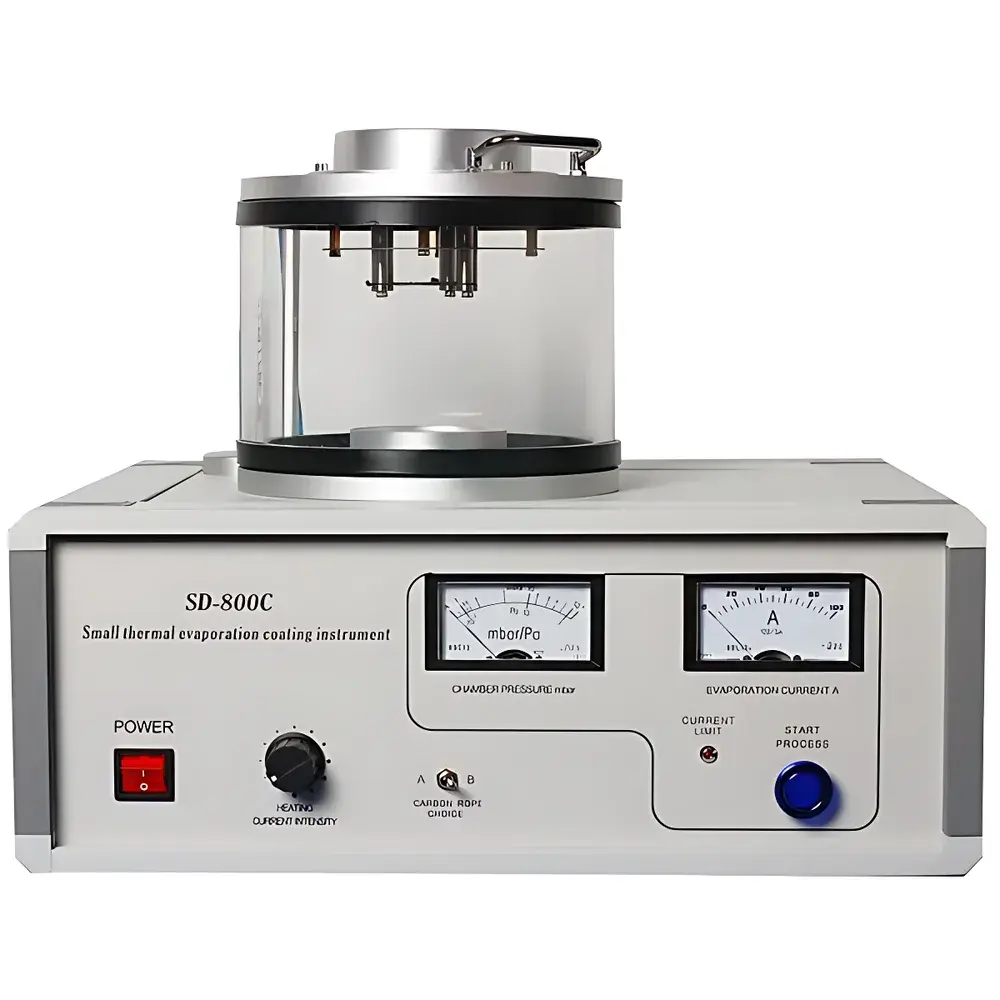
VPI SD-800C Thermal Evaporation Coater
| Brand | VPI (BoYuan Micro-Nano) |
|---|---|
| Origin | Beijing, China |
| Model | SD-800C |
| Target Material | Carbon Fiber |
| Target Diameter | 5 mm |
| Chamber Dimensions (ID) | 170 mm × 130 mm (D × H) |
| Sample Stage Diameter | 70 mm |
| Operating Vacuum | 4 × 10⁻² mbar |
| Evaporation Voltage | 0–30 V AC |
| Evaporation Current | 0–100 A |
| Deposition Time Range | 0–1 s |
| Vacuum Pump | 2 L/min Two-Stage Rotary Vane Pump (Feiyue VRD-8) |
| Chamber Material | Borosilicate Glass |
| Power Supply | AC, 220 V, 50 Hz |
| External Dimensions | 340 mm × 390 mm × 300 mm (W × D × H) |
| Control Mode | Manual |
Overview
The VPI SD-800C Thermal Evaporation Coater is a compact, manually operated benchtop system engineered for high-fidelity carbon coating of electron microscopy specimens. It operates on the principle of resistive thermal evaporation: a high-purity carbon fiber filament is resistively heated under controlled vacuum to generate a directional flux of carbon atoms, which condense uniformly onto substrates placed in line-of-sight above the source. Unlike sputter deposition, thermal evaporation produces ultra-thin, low-stress, amorphous carbon films with sub-nanometer grain size (<1 nm), making it especially suitable for high-resolution imaging and analytical techniques where minimal beam scattering and topographic masking are critical — including field emission scanning electron microscopy (FE-SEM), transmission electron microscopy (TEM), electron backscatter diffraction (EBSD), and energy-dispersive X-ray spectroscopy (EDS). The SD-800C is not designed for metal or oxide evaporation; its optimized architecture — including dual independent carbon filament selection (A/B mode), precise current regulation, and short-duration pulse control — ensures reproducible, contamination-free carbon layers without substrate heating or charging artifacts.
Key Features
- Manually operated interface with analog voltage and current controls, enabling intuitive, real-time adjustment of evaporation intensity and duration (0–1 s increments).
- Dual-carbon-filament configuration: two separately selectable 5 mm-diameter carbon fiber sources allow rapid switching between filaments to extend operational lifetime and maintain consistent deposition quality.
- Borosilicate glass vacuum chamber (170 mm × 130 mm internal diameter × height) provides optical visibility, chemical inertness, and thermal stability during repeated cycling.
- Integrated vacuum interlock circuit prevents filament energization below safe operating pressure (4 × 10⁻² mbar), eliminating arcing risk and protecting both filament integrity and electrical components.
- Compact footprint (340 mm × 390 mm × 300 mm) and self-contained design facilitate integration into shared microscopy labs, gloveboxes, or cleanroom-adjacent preparation areas.
- Equipped with a dedicated 2 L/min two-stage rotary vane pump (Feiyue VRD-8), pre-configured for stable base pressure attainment within ≤5 minutes after chamber sealing.
Sample Compatibility & Compliance
The SD-800C accommodates standard SEM stubs (up to 70 mm diameter), TEM grids, silicon wafers, and brittle or beam-sensitive biological specimens mounted on conductive substrates. Its low-energy, non-ionic deposition mechanism avoids surface damage, charging, or preferential crystallite growth commonly observed with magnetron sputtering. While the instrument itself does not carry CE, UL, or FDA certification, its operational parameters align with widely adopted laboratory safety and quality practices: vacuum interlocks meet IEC 61000-6-2 EMC immunity requirements for lab environments; borosilicate chamber material complies with ISO 3585 for laboratory glassware; and manual operation supports full traceability under GLP-compliant documentation protocols when paired with logbook-based process records. For regulated environments (e.g., ISO 17025-accredited labs), users may implement supplementary audit trails via external time-stamped video recording or digital workflow logs.
Software & Data Management
The SD-800C operates without embedded firmware or proprietary software — a deliberate design choice to maximize reliability, minimize maintenance overhead, and ensure long-term operability without vendor lock-in or license expiration. All process parameters (voltage, current, time) are set and monitored via front-panel analog dials and analog meters, providing direct physical feedback without latency or calibration drift. This analog architecture eliminates cybersecurity vulnerabilities associated with networked controllers and satisfies institutional IT policies restricting IoT device connectivity in core instrumentation zones. Users retain full procedural autonomy: deposition recipes are documented externally (e.g., in LIMS or electronic lab notebooks), and repeatability is ensured through standardized operator training and SOP adherence rather than software-defined presets.
Applications
- Conductive carbon coating of non-conductive specimens prior to FE-SEM imaging to prevent charging and improve secondary electron yield.
- Ultrathin support film fabrication on TEM grids for cryo-EM or beam-sensitive nanomaterial characterization.
- Carbon replication for EBSD pattern fidelity, where isotropic, non-crystalline coatings preserve crystallographic contrast without diffraction interference.
- Preparation of reference standards for X-ray microanalysis (EDS/WDS), where carbon’s low atomic number minimizes background continuum and absorption edge interference.
- Routine maintenance coating of electron gun apertures and Faraday cups to restore conductivity and reduce hydrocarbon buildup.
FAQ
Can the SD-800C be used for metal evaporation (e.g., Au, Pt, Cr)?
No. The SD-800C is specifically configured for carbon fiber evaporation only. Its power supply, filament geometry, and thermal management are not rated for higher-melting-point metals or reactive materials.
What vacuum level is required before initiating evaporation?
A base pressure of ≤4 × 10⁻² mbar must be achieved and verified using the integrated analog vacuum gauge prior to applying current to the filament.
Is the carbon film thickness controllable?
Yes — thickness is governed by evaporation current, duration, source-to-substrate distance, and chamber pressure. Typical depositions range from 2–10 nm; precise quantification requires in situ quartz crystal monitoring (not included, but compatible with third-party QCM modules).
Does the instrument require water cooling or compressed air?
No. The SD-800C relies solely on passive convection cooling and operates without auxiliary utilities, simplifying installation and reducing infrastructure dependencies.
How often should the carbon filament be replaced?
Filament lifetime depends on usage frequency and current settings; under typical SEM prep conditions (≤80 A, ≤0.8 s pulses), each 5 mm filament supports ≥200–300 depositions before visible thinning or breakage occurs.



