
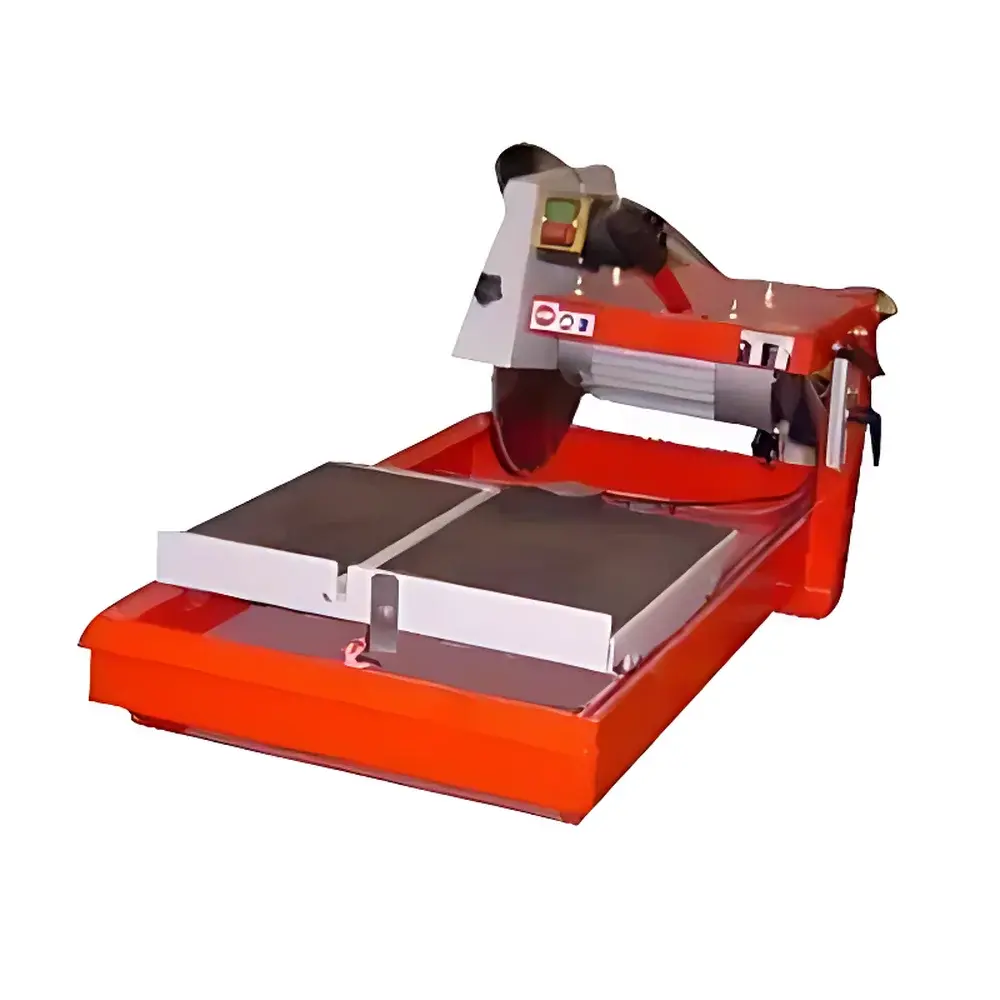
W0503 Diamond Rock Core Saw (France-imported Benchtop Radial Cutting System)
| Origin | France |
|---|---|
| Manufacturer Type | Authorized Distributor |
| Origin Category | Imported |
| Model | W0503 |
| Pricing | Available Upon Request |
| Blade Diameter | 350 mm |
| Max Cutting Depth | 100 mm |
| Max Core Length | 300 mm |
| Coolant Compatibility | Water or Oil |
| Power Supply | 220/380 V AC, 50 Hz, 3 HP |
| Weight | 82 kg |
| Dimensions | 1120 × 620 × 710 mm |
Overview
The W0503 Diamond Rock Core Saw is a precision-engineered benchtop radial cutting system designed for geoscience laboratories, core logging facilities, and petroleum research centers requiring consistent, low-damage sectioning of cylindrical rock core specimens. Utilizing a fixed-axis diamond-impregnated blade rotating at controlled peripheral velocity, the instrument performs orthogonal radial cuts—either bisecting intact cores into hemicylindrical halves or trimming irregular outer surfaces to expose planar, representative cross-sections. Its mechanical architecture follows classical sawing kinematics: the specimen remains stationary in a linearly actuated vise while the blade descends vertically along a guided rail; this configuration minimizes lateral vibration, preserves core integrity, and ensures repeatable cut geometry critical for subsequent petrographic analysis, porosity measurement, or thin-section preparation. Built to meet international standards for laboratory safety and mechanical stability (IEC 61000-6-2/6-4, EN 60204-1), the system operates within ISO 17025-compliant workflows where traceability of sample preparation steps is essential.
Key Features
- 350 mm diameter diamond blade with segmented rim design optimized for heterogeneous silicate and carbonate matrices—enabling clean, low-friction cuts with minimal thermal cracking or microfracturing.
- Motor-driven linear feed mechanism featuring precision-ground ball-bearing rails and calibrated micrometer-scale advancement control (0.1 mm resolution) for reproducible depth-of-cut positioning.
- Integrated blade guard assembly compliant with EN 13218:2002—fully enclosing the active cutting zone during operation while permitting unobstructed visual monitoring via polycarbonate viewport.
- Dual-mode coolant delivery system supporting both aqueous and oil-based media, with adjustable flow rate (0–3 L/min) and integrated level sensor to prevent dry-running conditions.
- Stainless-steel coolant recovery tray with sloped floor and drain port, facilitating closed-loop recirculation when paired with optional filtration unit (not included).
- Ergonomic front-panel controls including emergency stop button, blade start/stop toggle, coolant on/off switch, and status LED indicators for motor load and coolant level.
Sample Compatibility & Compliance
The W0503 accommodates standard NQ, HQ, BQ, and PQ-sized core diameters (up to Ø102 mm) and accepts specimens up to 300 mm in length. Its rigid cast-iron base and reinforced steel frame ensure dimensional stability under repeated loading, minimizing deflection-induced kerf deviation. The system complies with ASTM D5430–22 (“Standard Practice for Preparation of Rock Core Specimens for Laboratory Testing”) and supports GLP-aligned documentation through external logbook integration. All electrical components conform to CE marking requirements, and the coolant reservoir meets EU Directive 2014/30/EU (EMC) and 2014/35/EU (LVD). No hazardous substances are used in structural components per RoHS 2011/65/EU.
Software & Data Management
While the W0503 operates as a standalone electromechanical tool without embedded firmware or digital interface, it is fully compatible with laboratory information management systems (LIMS) via manual entry protocols. Each unit ships with a factory calibration certificate documenting blade runout (<0.05 mm TIR), motor no-load speed consistency (±2% across three consecutive cycles), and coolant flow linearity verification. For audit readiness, users may record operational parameters—including core ID, cut orientation (axial/radial), coolant type, blade usage hours, and operator signature—in standardized SOP templates aligned with ISO/IEC 17025:2017 Clause 7.5.2 (Control of Technical Records).
Applications
- Bisecting exploration drill cores for visual lithological description and point-count mineralogical analysis.
- Preparing flat, parallel faces on irregular core ends prior to ultrasonic velocity or resistivity testing.
- Trimming weathered or fractured rinds from sedimentary or metamorphic samples to isolate fresh interior material.
- Generating transverse slices for X-ray computed tomography (CT) scanning, ensuring optimal signal-to-noise ratio by eliminating edge artifacts.
- Supporting reservoir characterization workflows in accordance with API RP 40 and ISO 14688-1:2018 (Geotechnical investigation and testing).
FAQ
Is the W0503 suitable for cutting non-rock materials such as concrete or ceramic tiles?
Yes—its mechanical design and diamond blade compatibility allow safe operation on hardened cementitious composites and sintered ceramics, provided feed rates are reduced by 30% and coolant flow increased to manage elevated abrasive wear.
Does the system include blade replacement tools or alignment jigs?
A comprehensive maintenance kit—including blade wrenches, arbor nut socket, and concentricity gauge—is supplied with each unit per EN 848-3:2017 Annex A.
Can the machine be integrated into an automated sample prep line?
While not natively equipped with PLC I/O or Ethernet ports, the W0503’s discrete control signals (e.g., start/stop, coolant enable) can be interfaced via optional relay module (part no. W0503-RM1) for sequential integration with robotic core handlers.
What is the recommended maintenance interval for the ball-bearing feed mechanism?
Lubrication of the linear rail bearings is required every 200 operating hours using ISO VG 68 synthetic grease; full inspection and torque verification of all structural fasteners are advised quarterly.
Is operator training provided upon installation?
Yes—certified field engineers conduct on-site commissioning, including hands-on operation, safety protocol review, and SOP customization support aligned with your lab’s ISO/IEC 17025 scope.
Related Products



