
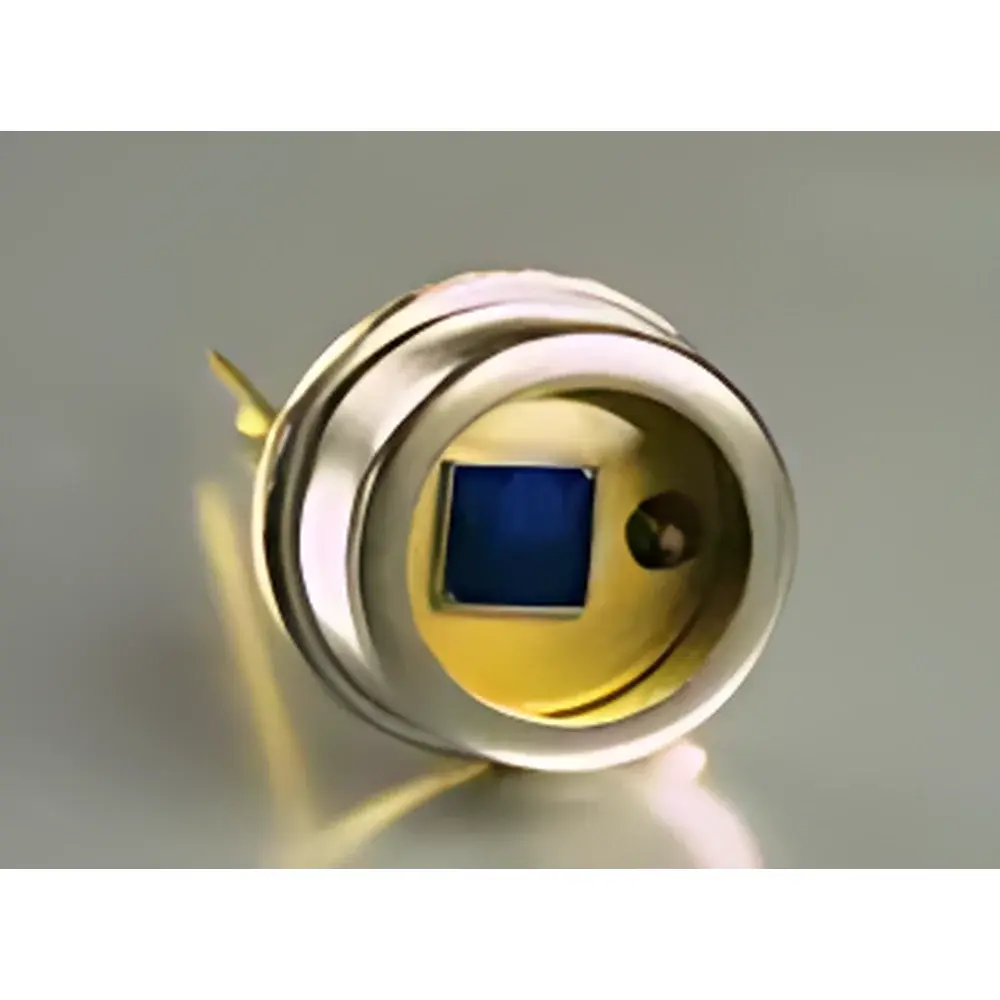
Wavelength-Sensitive Detector (WS) by First Sensor
| Brand | First Sensor |
|---|---|
| Model | newopto |
| Type | Wavelength-Sensitive Photodiode Array |
| Principle | Depth-Dependent Absorption in Silicon |
| Dark Current | ≤10 nA (typ.) |
| Rise Time (Diode 1) | ≤10 ns |
| Rise Time (Diode 2) | ≤10,000 ns |
| Package Options | TO-5, TO-5i, PCBA |
| Operating Voltage | 0–5 V |
| Load Resistor | 1 kΩ |
| Spectral Range | 400–1100 nm |
| Compliance | RoHS, CE |
Overview
The Wavelength-Sensitive Detector (WS) series—engineered by First Sensor and distributed under the newopto designation—is a monolithic silicon photodiode device designed for passive, self-referencing wavelength discrimination without external optical filters or dispersive elements. Its operational principle relies on the wavelength-dependent absorption depth of photons in crystalline silicon: shorter wavelengths (e.g., 400–600 nm) are absorbed near the surface, while longer wavelengths (e.g., 800–1100 nm) penetrate deeper into the substrate. By integrating two orthogonally oriented p–n junctions within a single silicon chip—one shallow and one deep—the WS detector generates two photocurrents with distinct spectral responsivity profiles. The ratio of these currents serves as a robust, temperature-stable metric for estimating incident monochromatic wavelength, making it especially suitable for compact, real-time spectroscopic monitoring in OEM instrumentation, laser line verification, and fiber-optic sensor systems.
Key Features
- Monolithic silicon architecture with dual-depth p–n junctions enabling intrinsic wavelength discrimination
- No moving parts, no gratings, no interference filters—minimal optical alignment required
- Fast response from shallow junction (≤10 ns rise time) coupled with high-sensitivity deep junction (≤10,000 ns)
- Low dark current (≤10 nA at room temperature), supporting high signal-to-noise operation in low-light conditions
- Multiple package configurations: hermetically sealed TO-5 and TO-5i metal cans for environmental stability, and flexible PCBA variants for embedded integration
- Compatible with standard 0–5 V biasing and 1 kΩ load resistor configuration—designed for direct interfacing with analog front-ends and ADCs
- RoHS-compliant and CE-marked, meeting essential requirements for industrial and laboratory deployment in the EU
Sample Compatibility & Compliance
The WS detector is optimized for collimated or moderately focused monochromatic light sources, including laser diodes (e.g., 405 nm, 532 nm, 635 nm, 785 nm, 980 nm), LED-based narrowband emitters, and filtered lamp outputs. It is not intended for broadband or polychromatic illumination, where spectral deconvolution would require calibration against known reference lines. Device-level compliance includes adherence to IEC 60747-5-2 for optoelectronic semiconductor devices and conformity with Directive 2011/65/EU (RoHS 2). While not certified to ISO/IEC 17025, its stable responsivity ratio enables traceable calibration protocols when used with NIST-traceable laser standards. For regulated environments (e.g., medical or pharmaceutical QA/QC), users may implement internal GLP-aligned calibration logs and periodic verification per ASTM E275 for photometric system validation.
Software & Data Management
The WS detector operates in analog mode and does not include onboard firmware or digital interfaces. Integration requires external signal conditioning—including transimpedance amplification, differential subtraction, and ratiometric computation—typically implemented via custom PCB design or modular data acquisition systems (e.g., National Instruments USB-6211, Keysight 34972A). Reference LabVIEW and Python (NumPy/SciPy) libraries are available from newopto’s technical support portal for ratio-based wavelength estimation, temperature compensation, and nonlinearity correction using third-order polynomial fits. All calibration datasets—including spectral response curves and junction-specific quantum efficiency maps—are provided in CSV and HDF5 formats, supporting audit-ready documentation under FDA 21 CFR Part 11 when paired with electronic lab notebook (ELN) systems featuring signature capture and change tracking.
Applications
- Laser wavelength monitoring in diode-pumped solid-state (DPSS) and fiber laser systems
- Compact spectrometer modules for portable process analyzers in chemical and pharmaceutical manufacturing
- Wavelength-locking feedback sensors in tunable external cavity diode lasers (ECDLs)
- Quality assurance of optical filters and dichroic coatings via transmission peak verification
- Embedded diagnostics in optical coherence tomography (OCT) light sources
- Calibration transfer standards between metrology labs and production test benches
FAQ
Is the WS detector suitable for measuring broadband spectra?
No—it is engineered exclusively for monochromatic or quasi-monochromatic inputs. Broadband illumination yields ambiguous current ratios due to overlapping spectral contributions.
What is the recommended operating temperature range?
–20 °C to +70 °C ambient; performance drift is minimized below ±0.02 nm/°C when using ratiometric readout with matched junctions.
Can the TO-5i variant be soldered directly onto a PCB?
Yes—the TO-5i package features insulated leads compatible with standard reflow soldering profiles (J-STD-020 compliant), unlike the conductive TO-5 can.
Does First Sensor provide factory calibration certificates?
Calibration data sheets (including responsivity vs. wavelength at 25 °C and dark current histograms) are supplied with each batch; full NIST-traceable certification is available upon request with lead-time extension.
How is long-term stability verified in continuous operation?
Accelerated life testing per JEDEC JESD22-A108 shows <0.5% responsivity shift after 10,000 hours at 60 °C and 85% RH, supporting reliability requirements in Class I industrial equipment.






