
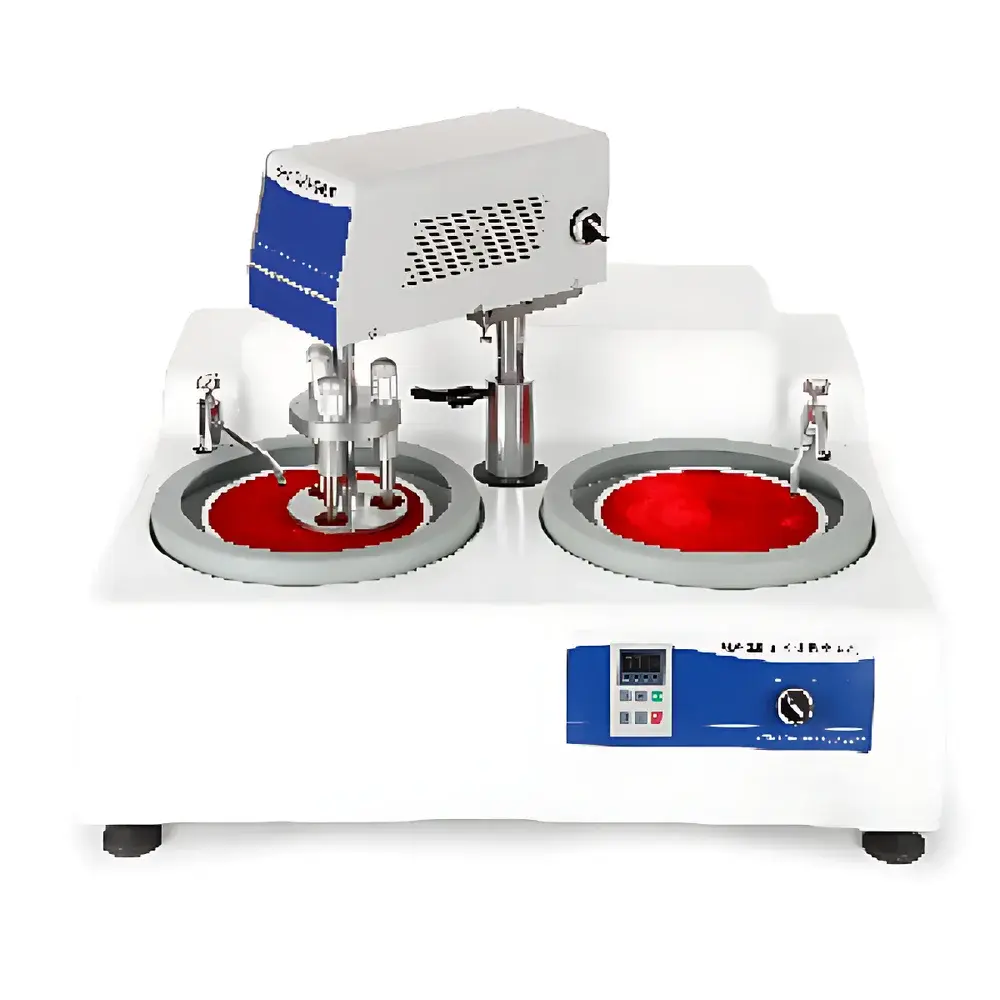
WEIYEE MP-2B+MPT-1 Dual-Disc Semi-Automatic Grinding and Polishing System
| Brand | WEIYEE |
|---|---|
| Origin | Guangdong, China |
| Manufacturer Type | Authorized Distributor |
| Country of Origin | China |
| Model | MP-2B + MPT-1 |
| Disc Diameter | 230 mm (9") |
| Number of Grinding/Polishing Discs | 2 |
| Speed Range | 50–1000 rpm (infinitely variable) |
| Sample Capacity | Up to 4 specimens simultaneously |
| Pressure Control | Adjustable mechanical load system |
| Power Supply | 220 V AC |
Overview
The WEIYEE MP-2B+MPT-1 is a dual-disc semi-automatic grinding and polishing system engineered for reproducible, controlled sample preparation in metallurgical, ceramic, geological, and advanced materials laboratories. It operates on the principle of planar mechanical abrasion—utilizing precisely regulated rotational motion, adjustable normal force, and sequential abrasive media (e.g., silicon carbide papers, diamond suspensions, and colloidal silica) to achieve flat, scratch-free, and artifact-minimized specimen surfaces. Unlike fully manual systems, the MP-2B+MPT-1 integrates independent speed control per disc and synchronized pressure application via calibrated mechanical loading arms, enabling standardized preparation protocols across multiple specimens. Its design conforms to ASTM E3, ISO 14577, and GB/T 13298—standards governing metallographic specimen preparation—and supports both rough grinding and final polishing stages within a single platform.
Key Features
- Dual 230 mm (9″) grinding/polishing discs operating independently with infinitely variable speed control (50–1000 rpm), allowing optimization for coarse grinding (low torque, high speed) and fine polishing (high torque, low speed) on separate stations.
- Simultaneous processing of up to four standard 30 mm or 40 mm diameter specimens using interchangeable specimen holders with spring-loaded clamping—ensuring uniform pressure distribution and minimizing edge rounding.
- Mechanically adjustable pressure system with calibrated load scale (range: 10–50 N per specimen), enabling repeatable force application compliant with ASTM E3 Annex A1 requirements for load-controlled preparation.
- Robust cast-iron base and precision-machined aluminum disc spindles ensure minimal runout (<0.05 mm TIR) and long-term dimensional stability under continuous operation.
- Integrated splash guard, coolant channeling trough, and quick-release disc mounting facilitate safe, efficient, and contamination-controlled operation during wet grinding and polishing procedures.
- CE-compliant electrical architecture with thermal overload protection, emergency stop button, and IP54-rated motor housing for laboratory-grade safety and durability.
Sample Compatibility & Compliance
The MP-2B+MPT-1 accommodates a broad spectrum of rigid, solid-phase specimens including ferrous and non-ferrous metals, sintered ceramics, cemented carbides, geological thin sections, and composite laminates. Specimen thickness range: 1–30 mm; maximum specimen height: 45 mm. The system supports standard consumables—230 mm adhesive-backed grinding papers (P80–P2500), diamond-impregnated polishing cloths (15–1 µm), and oxide-based final polishing suspensions. All operational parameters (speed, dwell time, pressure sequence) are documented manually or integrated into lab notebooks per GLP requirements. While the unit itself is not FDA 21 CFR Part 11-certified (as it lacks electronic audit trail functionality), its output surfaces meet surface integrity criteria specified in ISO 643 (steel microstructure), ASTM E112 (grain size analysis), and USP (pharmaceutical excipient particle morphology verification).
Software & Data Management
As a semi-automatic mechanical system, the MP-2B+MPT-1 does not include embedded firmware or digital control software. Process parameters—including rotational speed, applied load, and timing—are set manually via analog dials and mechanical timers. Users maintain traceability through standardized log sheets aligned with internal SOPs. For laboratories requiring digital documentation, the system is compatible with external time-lapse imaging rigs and third-party metrology software (e.g., ImageJ with MetalMaster plugin, Olympus Stream) for post-prep surface evaluation. Optional accessories include programmable digital timers (0.1–99 min resolution) and USB-connected load calibration kits traceable to NIM (National Institute of Metrology, China).
Applications
- Preparation of cross-sectional samples for SEM-EDS, EBSD, and TEM lamella extraction where subsurface deformation layer thickness must remain below 0.5 µm.
- Routine quality control of sintered tungsten carbide inserts in cutting tool manufacturing, per ISO 4506 hardness testing prerequisites.
- Geological petrographic thin section production requiring optical clarity and absence of relief artifacts in quartz-feldspar matrixes.
- Failure analysis of welded joints in pressure vessel steels, supporting ASTM E344 root-cause assessment workflows.
- Research-scale polishing of transparent conductive oxides (e.g., ITO, AZO) prior to sheet resistance and Hall effect measurements.
FAQ
Is the MP-2B+MPT-1 suitable for automated protocol recall or multi-step sequences?
No—it is a semi-automatic system with manual parameter adjustment; no onboard memory or step-programming capability.
Can the system accommodate non-standard disc sizes or custom fixtures?
Only 230 mm (9″) discs are mechanically supported; custom specimen holders require OEM-approved adapters to maintain concentricity and load symmetry.
What maintenance intervals are recommended for optimal performance?
Lubrication of spindle bearings every 500 operating hours; inspection of belt tension and disc flatness quarterly; replacement of rubber drive belts every 18 months under typical lab usage.
Does the unit comply with ISO/IEC 17025 calibration requirements?
The base unit is not a measuring instrument; however, optional speed and load calibration certificates (traceable to CNAS-accredited labs) can be supplied upon request.
Is coolant recycling or filtration integration possible?
Yes—the built-in coolant trough interfaces with standard 12–19 mm ID tubing and is compatible with inline magnetic filters and polypropylene sediment traps.



