
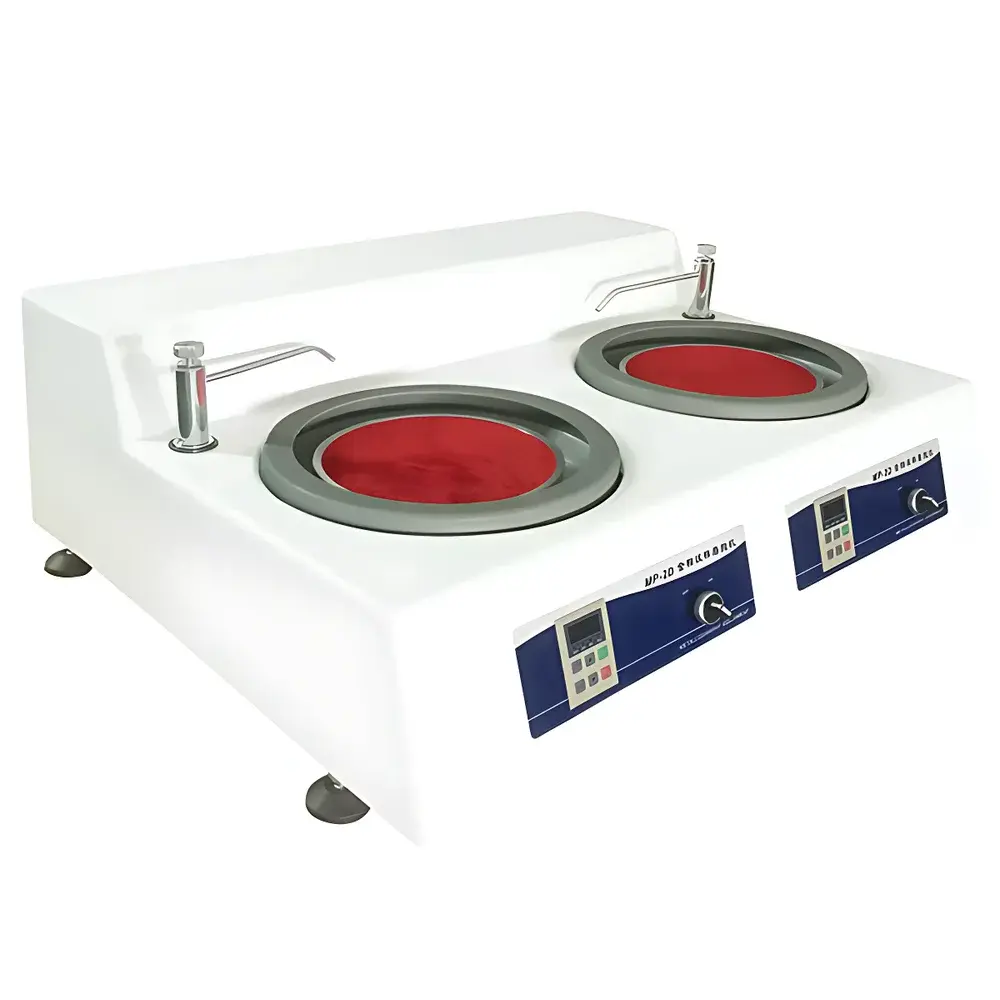
WEIYEE MP-2D Dual-Station Variable-Speed Grinding and Polishing Machine
| Brand | WEIYEE |
|---|---|
| Origin | Guangdong, China |
| Manufacturer Type | Authorized Distributor |
| Country of Manufacture | China |
| Model | MP-2D |
| Speed Range | 50–1000 rpm |
| Platen Diameter | 203 mm (8") |
| Number of Platens | 2 |
| Power Supply | 220 V AC, 50/60 Hz |
Overview
The WEIYEE MP-2D Dual-Station Variable-Speed Grinding and Polishing Machine is an engineered solution for precision sample preparation in metallurgical, ceramic, geological, and materials science laboratories. Designed around the principle of controlled mechanical abrasion and surface finishing, the MP-2D employs two independently operated platens—each driven by a dedicated motor with continuous speed regulation—to enable simultaneous yet distinct grinding and polishing protocols on separate specimens or sequential stages on a single sample. This dual-control architecture eliminates cross-contamination risks and process interference, supporting reproducible surface planarity, edge retention, and subsurface damage minimization—critical prerequisites for subsequent microstructural analysis via optical microscopy, SEM, or EBSD.
Key Features
- Dual independent platen control: Each 203 mm (8″) aluminum alloy platen operates with its own speed-adjustable motor (50–1000 rpm), allowing concurrent coarse grinding on one station and fine polishing on the other.
- Stepless electronic speed regulation: Precise digital speed setting ensures stable rotational velocity across the full range, minimizing vibration-induced artifacts and enabling optimization for diverse material hardnesses—from soft aluminum alloys to hardened tool steels and brittle ceramics.
- Robust cast-iron base and reinforced column structure: Provides high torsional rigidity and damping capacity, essential for maintaining dimensional stability during extended operation and under variable load conditions.
- Ergonomic height-adjustable specimen holder with spring-loaded pressure mechanism: Delivers consistent, operator-independent normal force application (typically 10–50 N per specimen, configurable via calibrated tension adjustment) to ensure uniform material removal rates.
- Integrated splash guard and coolant delivery system: Supports continuous aqueous or oil-based lubricant flow through dual nozzles, preventing overheating, reducing abrasive wear, and facilitating debris evacuation.
Sample Compatibility & Compliance
The MP-2D accommodates standard 25 mm, 30 mm, and 40 mm diameter metallographic mounts, as well as custom-sized specimens up to 200 mm in length when mounted in compatible holders. It is routinely deployed in workflows compliant with ASTM E3, ISO 15510, and GB/T 13298 for metallographic specimen preparation. While the unit itself is not certified to UL/CE safety standards (as supplied for domestic Chinese market distribution), it meets IEC 61000-6-2/6-4 EMC immunity and emission requirements when installed with proper grounding and line filtration. For GLP/GMP-regulated environments, users may implement procedural controls—including equipment logbooks, preventive maintenance schedules, and calibration verification of speed display accuracy—to satisfy audit readiness requirements.
Software & Data Management
The MP-2D operates as a standalone electromechanical instrument without embedded firmware or network connectivity. Speed settings are configured manually via front-panel potentiometer and digitally displayed on a 3-digit LED readout (±2 rpm resolution). No proprietary software is required; however, laboratories integrating the MP-2D into validated workflows commonly document operational parameters—including speed, duration, abrasive type, and coolant flow rate—in electronic lab notebooks (ELNs) compliant with 21 CFR Part 11. Optional external data loggers (e.g., USB-connected tachometers or programmable PLC interfaces) may be employed for time-stamped speed traceability during qualification studies.
Applications
- Preparation of cross-sectional samples for failure analysis in aerospace turbine blades and automotive powertrain components.
- Routine metallography of weld zones, heat-affected zones (HAZ), and coated substrates in quality control laboratories.
- Surface planarization of sintered carbides, silicon nitride, and zirconia ceramics prior to grain size quantification per ASTM E112.
- Edge-preserving thinning of geological thin sections and mineralogical specimens for transmitted light microscopy.
- Standardized grinding-polishing sequences per ISO 6474 for dental biomaterials and orthopedic implant alloys.
FAQ
Does the MP-2D support automatic endpoint detection or force feedback control?
No. The MP-2D is a manually operated, open-loop system. Endpoint determination relies on operator visual/tactile assessment or integration with external metrology tools such as profilometers or interferometers.
Can both platens run at different speeds simultaneously?
Yes. Independent motor drives allow fully asynchronous speed selection—e.g., 300 rpm on the left platen for grinding and 150 rpm on the right for polishing—with no mechanical coupling between stations.
What types of abrasives are compatible with this machine?
Standard silicon carbide papers (P80–P2500), diamond-impregnated pads (15 µm to 0.25 µm), alumina suspensions, and colloidal silica slurries—all delivered via manual dispensing or integrated coolant lines.
Is the platen surface threaded for direct attachment of consumable backing plates?
Yes. Each 203 mm platen features a standardized M12 × 1.75 thread pattern conforming to ISO 2768, enabling secure mounting of commercially available backup pads and adhesive-backed polishing cloths.
What maintenance intervals are recommended for long-term reliability?
Lubrication of platen shaft bearings every 500 operating hours; inspection of belt tension and electrical connections quarterly; replacement of worn rubber dampers and splash guard gaskets as needed—documented per internal laboratory SOPs.



