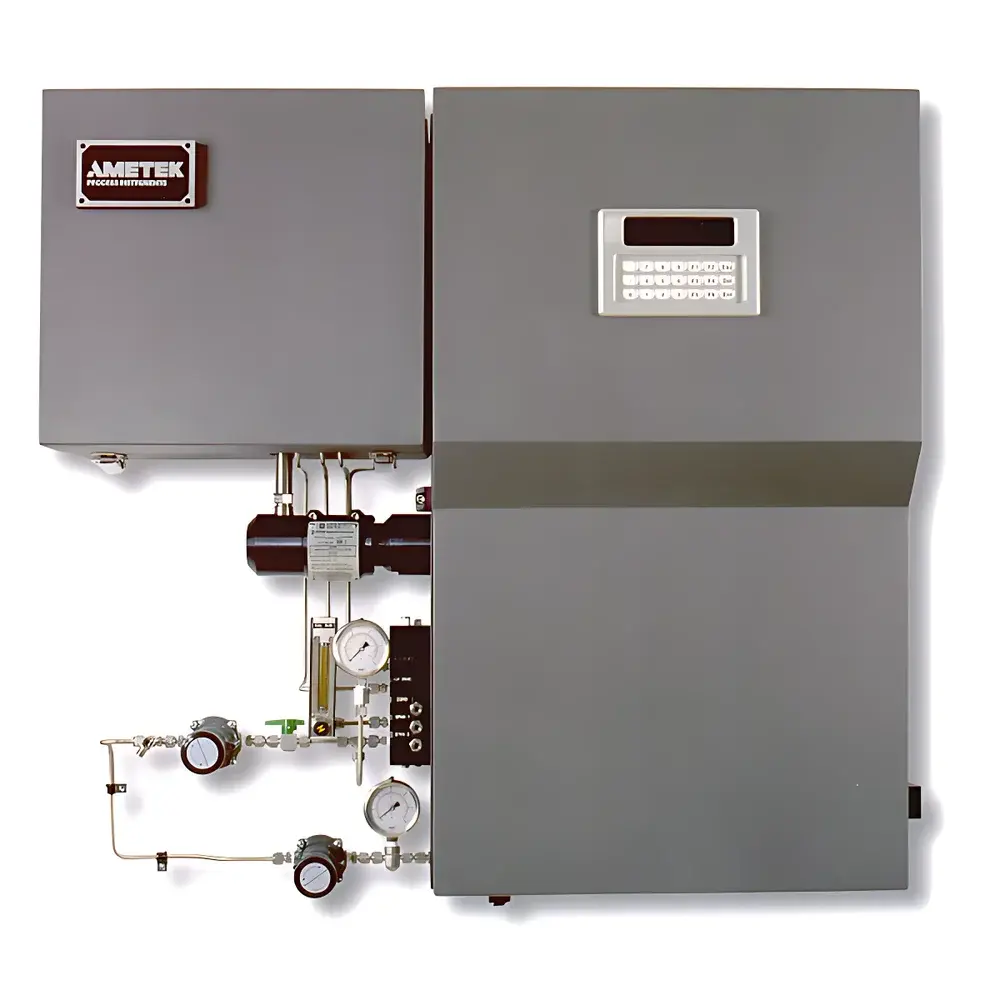
Western Research 919 Hot-Wet Gas Analyzer
| Brand | PROCESS INSTRUMENTS |
|---|---|
| Origin | Canada |
| Manufacturer Type | Authorized Distributor |
| Origin Category | Imported |
| Model | 919 |
| Pricing | Upon Request |
Overview
The Western Research 919 Hot-Wet Gas Analyzer is a field-deployable, extractive continuous emission monitoring system (CEMS) engineered for real-time, in-situ measurement of key acidic and reactive gases in industrial flue gas streams under hot-wet conditions. Unlike cooled-dry extractive systems requiring extensive sample conditioning, the 919 maintains the sample line and optical path at elevated temperatures (typically >180 °C) to prevent condensation, adsorption, and chemical interconversion—critical for accurate quantification of water-soluble and reactive species such as H₂S, SO₂, NO, NOₓ (NO + NO₂), NH₃, and Cl₂. The analyzer employs dual-beam, non-dispersive ultraviolet (NDUV) and near-infrared (NIR) absorption spectroscopy with thermoelectrically stabilized light sources and high-resolution photodiode arrays. Its optical design minimizes cross-sensitivity through spectral deconvolution algorithms calibrated against NIST-traceable gas standards, enabling stable operation in high-humidity (up to 100% RH), particulate-laden, and corrosive environments typical of waste incineration, sulfur recovery units (SRUs), coal-fired boilers, and chemical process off-gas streams.
Key Features
- Hot-wet sampling architecture with heated sample probe, filter, and transport line (maintained ≥180 °C) to preserve gas-phase integrity and eliminate aqueous-phase artifacts
- Dual-wavelength NDUV/NIR optical engine supporting simultaneous multi-gas detection without moving parts or consumables
- Integrated thermoelectric cooling for detector stability and long-term baseline drift <0.5% FS/week
- Self-diagnostic optics with automatic zero/span verification using internal reference cells and pulsed LED validation
- IP65-rated, explosion-proof (optional Class I, Div 1) enclosure rated for outdoor mounting and ambient operation from –20 °C to +50 °C
- Modular gas cell design with configurable pathlength (1–5 m) to optimize sensitivity for low-ppm or high-% volume applications
Sample Compatibility & Compliance
The 919 is validated for use with flue gases containing up to 20% v/v water vapor, ≤50 mg/m³ total suspended particulates (TSP), and acid dew points up to 140 °C. It meets EN 15267-3 (QAL1 certified per EN 14181) for CEMS performance verification and supports compliance reporting under EPA Methods 6C, 7E, and 10 for SO₂, NOₓ, and CO (when configured with optional CO channel). All firmware and calibration protocols are designed to satisfy data integrity requirements of ISO 17025-accredited laboratories and support audit trails compliant with FDA 21 CFR Part 11 when integrated with validated SCADA or DCS platforms.
Software & Data Management
The embedded Linux-based firmware provides local configuration via web interface (HTTPS/TLS 1.2) and supports Modbus TCP, Profibus DP, and OPC UA (PubSub over UDP) for seamless integration into plant-wide automation networks. Data logging occurs at user-selectable intervals (1–60 seconds) with onboard storage for ≥30 days of second-level resolution. Calibration history, diagnostic logs, and spectral raw data are exportable in CSV and HDF5 formats. Optional cloud-connectivity module enables remote diagnostics, over-the-air firmware updates, and secure TLS-encrypted data forwarding to central environmental data management systems (EDMS) aligned with EU IED and US Clean Air Act Title V reporting frameworks.
Applications
- Continuous monitoring of SO₂ and NOₓ emissions from municipal solid waste (MSW) and hazardous waste incinerators
- H₂S and NH₃ quantification in Claus tail-gas treatment units and amine regeneration off-gas
- Cl₂ monitoring in chlor-alkali plant stack emissions and PVC production vent streams
- Process optimization and catalyst health assessment in fluid catalytic cracking (FCC) and selective catalytic reduction (SCR) systems
- Compliance verification for permits issued under EU Industrial Emissions Directive (IED) and US EPA NSPS Subpart Db/Dbb
FAQ
Does the 919 require external sample conditioning or dilution?**
No—its hot-wet design eliminates the need for chillers, permeation dryers, or dilution systems, reducing maintenance points and improving measurement fidelity for condensable gases.
Can it measure NO₂ independently from NO?**
Yes—the NDUV spectral resolution (≤1.5 nm FWHM) allows deconvolution of NO (226 nm) and NO₂ (350–450 nm) absorption bands; NOₓ is reported as the sum, with individual species available as separate channels.
What calibration standards are required for routine QAL2 verification?**
Certified gas mixtures traceable to NIST or equivalent national metrology institutes (e.g., SO₂ in N₂, NH₃ in air), delivered via dynamic dilution calibrator meeting EN 15267-3 Annex B requirements.
Is the analyzer compatible with existing CEMS data acquisition systems?**
Yes—it outputs analog 4–20 mA signals for primary gases and supports digital protocols including Modbus TCP and OPC UA for full metadata exchange, including diagnostic status and spectral QA flags.
How often is preventative maintenance recommended?**
Optical alignment and lamp intensity verification every 6 months; heated filter replacement every 3–6 months depending on particulate loading; full QAL3 verification annually per EN 14181.