
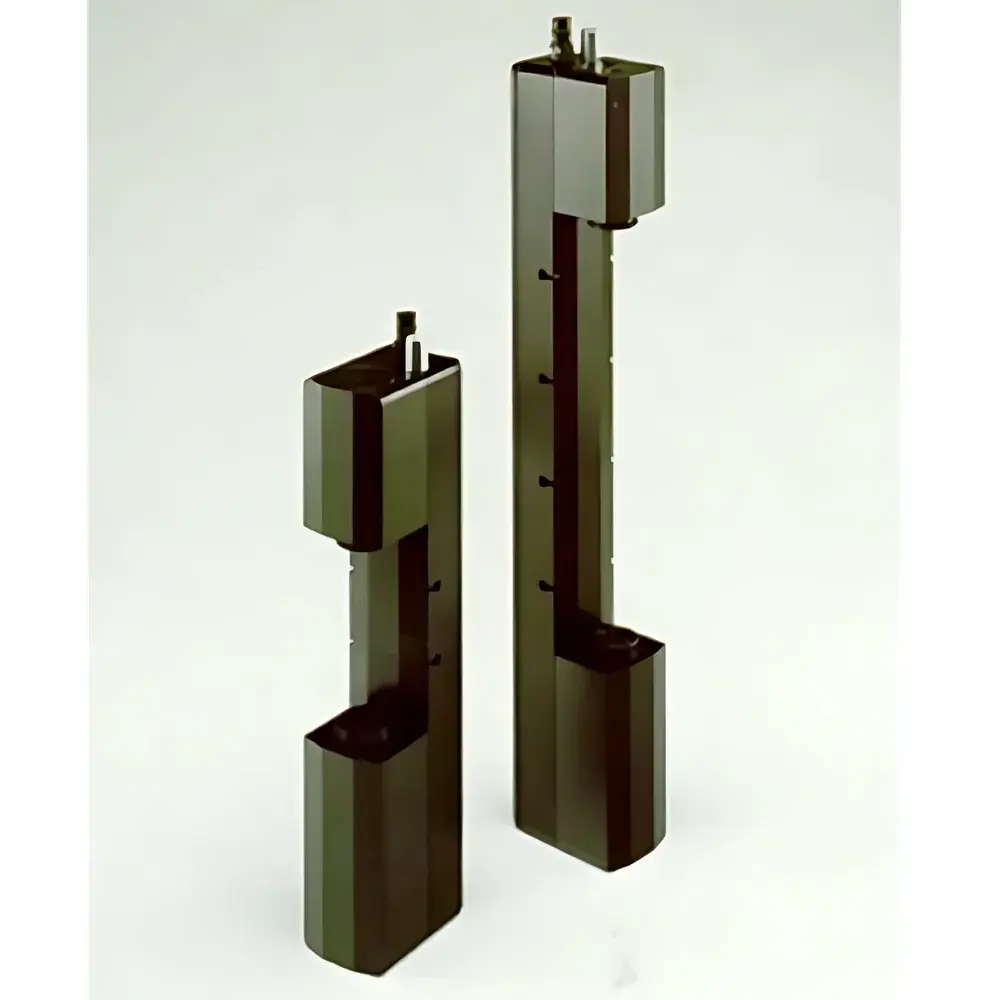
WET Labs C-Star Transmissometer
| Brand | WET Labs |
|---|---|
| Origin | USA |
| Model | C-Star |
| Wavelength Options | 370 nm, 470 nm, 532 nm, or 650 nm |
| Path Length | 10 cm or 25 cm |
| Receiver Acceptance Angle | 1° |
| Spectral Bandwidth | 10–12 nm (370 nm), 20 nm (470/532/650 nm) |
| Accuracy | ±0.003 m⁻¹ @ 1 Hz |
| Operating Temperature | −2 to 40 °C |
| Pressure Rating | 600 m (plastic housing), 6000 m (aluminum housing) |
| Dimensions (25 cm path) | 47 × 6.4 × 9.3 cm |
| Dimensions (10 cm path) | 29.2 × 6.4 × 9.3 cm |
| Dry Weight | 2.2 kg (plastic), 3.6 kg (aluminum) |
| In-Water Weight | 0.9 kg (plastic), 2.7 kg (aluminum) |
| Input Voltage | 7.5–15 VDC |
| Sampling Rate | 8 Hz |
| Output Interface | RS-232 |
Overview
The WET Labs C-Star Transmissometer is a high-precision, submersible optical instrument engineered for quantitative measurement of beam attenuation coefficient (c) in natural aquatic environments. Based on the fundamental principle of narrow-beam collimated light transmission, the C-Star emits monochromatic light at user-selectable wavelengths—370 nm, 470 nm, 532 nm, or 650 nm—through a precisely defined optical path (10 cm or 25 cm) and detects the attenuated signal via a low-noise photodiode with a 1° field-of-view acceptance angle. Its design adheres to the standard definition of c(λ) = −ln(I/I₀)/L, where I₀ is incident intensity, I is transmitted intensity, and L is path length. This physically rigorous approach ensures traceable, SI-aligned attenuation data essential for oceanographic calibration, water clarity assessment, and validation of satellite-derived remote sensing products. The instrument’s robust mechanical architecture—available in pressure-rated plastic (600 m) or deep-ocean aluminum (6000 m) housings—enables deployment from profiling floats, moorings, AUVs, and towed bodies across coastal, shelf, and abyssal regimes.
Key Features
- Four factory-calibrated wavelength options optimized for distinct biogeochemical applications: 370 nm for CDOM-dominated absorption, 470 nm for chlorophyll-a estimation, 532 nm for general turbidity and particle scattering, and 650 nm for sediment-laden or highly scattering waters.
- Narrow spectral bandwidth (10–12 nm at 370 nm; 20 nm at other wavelengths) minimizes spectral contamination and improves discrimination between optically active constituents.
- High temporal resolution with an 8 Hz sampling rate supports dynamic process studies—including internal wave modulation, phytoplankton patch dynamics, and resuspension events—without aliasing.
- RS-232 serial output provides direct, low-latency digital telemetry compatible with industry-standard data loggers (e.g., Sea-Bird Electronics SBE, RBR, Teledyne Webb) and real-time telemetry systems.
- Thermally stabilized optical bench and factory traceable NIST-calibrated reference standards ensure long-term measurement stability and inter-instrument comparability under varying thermal gradients (−2 to 40 °C).
- Modular mechanical design allows rapid field interchange of optical path lengths (10 cm or 25 cm) to balance sensitivity (longer path) and spatial resolution (shorter path) per mission requirements.
Sample Compatibility & Compliance
The C-Star operates in situ without sample extraction, eliminating artifacts associated with filtration, preservation, or container effects. It is compatible with seawater, freshwater, estuarine brackish mixtures, and glacial runoff—provided suspended particulate matter remains within its dynamic optical range (typical c(λ) measurement range: 0.001–5.0 m⁻¹). All units are calibrated against certified reference materials traceable to NIST SRM 2036 (attenuation standards). The instrument complies with ISO 10253:2021 (water quality — optical sensors for in situ measurement of beam attenuation), and its pressure housings meet ASTM D3311-22 (standard specification for underwater electrical connectors) and IEC 60529 IP68 ingress protection requirements. Aluminum-housed units satisfy NATO STANAG 4297 for deep-sea operational reliability.
Software & Data Management
Raw RS-232 output is ASCII-formatted with configurable baud rates (default 19200 bps), packet structure, and metadata tagging (including timestamp, temperature, and instrument ID). WET Labs provides the open-source C-Star Utility Suite (Windows/macOS/Linux), which enables real-time visualization, batch calibration application, and conversion to standardized netCDF-4 files compliant with CF-1.8 conventions. Data export supports integration into NOAA’s IOOS SensorML framework and NASA’s Ocean Color Level 1/2 processing pipelines. Audit trails, calibration history, and firmware version logging are embedded in each data packet—supporting GLP-compliant workflows and FDA 21 CFR Part 11–aligned data integrity protocols when deployed in regulated environmental monitoring programs.
Applications
- Ocean color algorithm development and vicarious calibration of satellite sensors (e.g., VIIRS, OLCI, PACE) via match-up analysis.
- Time-series monitoring of Secchi depth, diffuse attenuation coefficient (Kd), and inherent optical properties (IOPs) in long-term observatories (e.g., OceanSITES, EMSO).
- Validation of biogeochemical model outputs related to phytoplankton carbon fixation, particulate organic carbon flux, and light availability for benthic ecosystems.
- Turbidity and sediment transport quantification in dredging impact assessments, river plume tracking, and coral reef resilience studies.
- Integration into autonomous platforms—including Argo floats equipped with Bio-Argo extensions and deep-profiling gliders—for synoptic, basin-scale IOP mapping.
FAQ
What wavelength should I select for chlorophyll-a estimation in coastal waters?
For optimal sensitivity to phytoplankton pigment absorption in mesotrophic to eutrophic coastal environments, 470 nm is the recommended wavelength—consistent with standard OC3/OC4 satellite algorithms and in situ protocols described in IOCCG Report No. 5.
Can the C-Star be deployed on a mooring for year-long unattended operation?
Yes—when powered via stable 7.5–15 VDC supply and housed in aluminum, the C-Star supports continuous operation up to 6000 m depth with verified thermal drift <0.0005 m⁻¹/°C over its full operating range.
Is temperature compensation applied internally?
No—the C-Star outputs raw voltage and temperature readings separately; post-deployment correction for temperature-dependent detector responsivity and refractive index effects is performed during data processing using documented coefficients provided in the calibration certificate.
How is calibration traceability maintained across field deployments?
Each unit ships with a NIST-traceable calibration sheet referencing SRM 2036, and users are advised to perform pre- and post-cruise air/water checks using certified neutral density filters per ISO 17025-accredited procedures.
Does the RS-232 interface support Modbus or SDI-12 protocols?
No—the C-Star uses a proprietary ASCII protocol; however, third-party protocol converters (e.g., Campbell Scientific TDR, Onset HOBO UX90) can translate RS-232 output to Modbus RTU or SDI-12 for integration into legacy SCADA or environmental station networks.







