
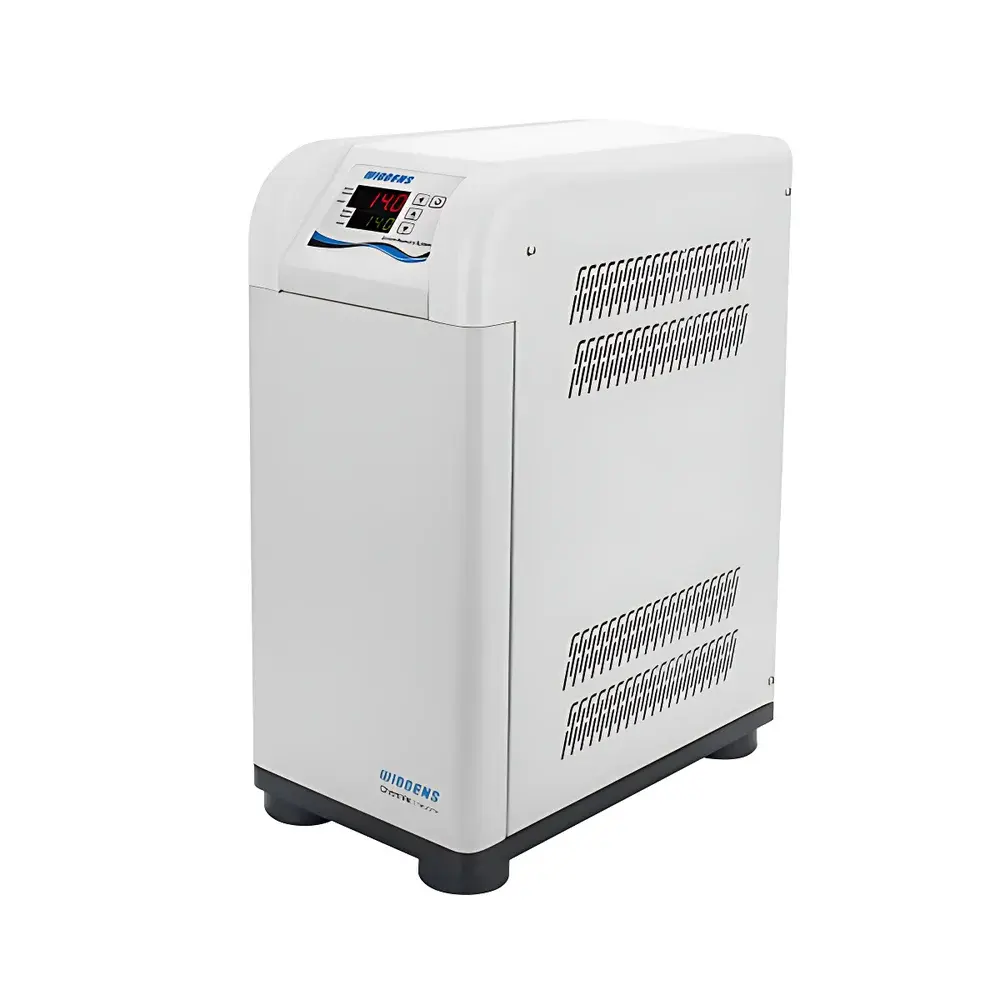
WIGGENS C920ZEF Corrosion-Resistant Variable-Frequency Diaphragm Vacuum Pump System
| Brand | WIGGENS |
|---|---|
| Origin | Germany |
| Model | C920ZEF |
| Pump Type | Diaphragm Vacuum Pump |
| Ultimate Vacuum | < 8 mbar |
| Pumping Speed | 75 L/min |
| Motor Power | 400 W |
| Dimensions (W×D×H) | 220 × 400 × 495 mm |
| Weight | 25 kg |
| Vacuum Setpoint Range | 0.1–1000 mbar |
| Pressure Resolution | 0.1 mbar |
| Max Motor Speed | 1380 rpm |
| Inlet/Outlet Port Size | 10 mm |
| Noise Level | 50 dB(A) |
| IP Rating | IP20 |
Overview
The WIGGENS C920ZEF Corrosion-Resistant Variable-Frequency Diaphragm Vacuum Pump System is an engineered solution for laboratories and industrial process environments requiring precise, stable, and chemically inert vacuum generation. Unlike conventional fixed-speed diaphragm pumps or oil-lubricated rotary vane systems, the C920ZEF employs a digitally controlled, brushless DC motor coupled with an integrated intelligent controller to deliver dynamic vacuum regulation via real-time variable-frequency drive (VFD) modulation. Its core operating principle relies on positive displacement via PTFE-coated elastomeric diaphragms, ensuring zero oil contamination and intrinsic resistance to aggressive vapors and condensates. Designed for continuous duty in demanding chemical, pharmaceutical, and petrochemical workflows, the system achieves ultimate vacuum levels below 8 mbar while maintaining high volumetric throughput (75 L/min), making it suitable for large-scale evaporation, distillation, and filtration applications where both pressure stability and material compatibility are critical.
Key Features
- Integrated VFD controller with AI-enhanced auto-tuning PID algorithm—dynamically adjusts proportional-integral-derivative parameters based on real-time load, temperature, and gas composition to minimize pressure overshoot and drift
- Full PTFE wetted path—including diaphragms, valves, inlet/outlet manifolds, and gas handling chambers—providing exceptional resistance to halogenated solvents, strong acids (e.g., HCl, HNO₃), bases, and organic vapors
- Hermetically sealed dual-chamber architecture: gas-exposed components are physically isolated from motor, bearings, and drive electronics, extending service life and eliminating cross-contamination risks
- Oil-free, water-free operation—eliminates disposal of spent pump oil and consumption of cooling water, aligning with ISO 14001 environmental management requirements
- Thermal protection circuitry with automatic restart: monitors internal housing temperature and initiates safe shutdown above threshold; resumes operation only after thermal equilibrium is restored
- Compact footprint (220 × 400 × 495 mm) and lightweight design (25 kg) enable benchtop integration or mobile cart mounting without structural reinforcement
- Low acoustic signature (≤50 dB[A]) ensures compliance with occupational noise exposure limits per EU Directive 2003/10/EC
Sample Compatibility & Compliance
The C920ZEF is validated for use with corrosive and condensable process gases encountered in routine laboratory operations—including chlorinated hydrocarbons (e.g., CH₂Cl₂, CCl₄), sulfur-containing compounds (e.g., H₂S, SO₂), nitrogen oxides, and concentrated aqueous acid/base vapors. Its PTFE construction meets ASTM D543-20 standards for resistance to chemical immersion and vapor exposure. The system conforms to IEC 61000-6-3 (EMC emission limits) and IEC 61000-6-2 (immunity to electrostatic discharge and RF fields). While not intrinsically rated for hazardous area use (ATEX/IECEx), its IP20 enclosure provides basic protection against solid ingress per IEC 60529 and is suitable for controlled indoor laboratory environments compliant with GLP and GMP Annex 11 documentation integrity expectations.
Software & Data Management
The embedded microcontroller supports analog (0–10 V) and digital (RS-485 Modbus RTU) interfaces for integration into centralized lab automation networks. Vacuum setpoints, actual pressure readings, motor RPM, runtime hours, and thermal status are accessible via front-panel OLED display or external SCADA/HMI platforms. Audit-trail-capable data logging (optional SD card module) records timestamped pressure profiles at user-defined intervals (1 s to 60 min), supporting FDA 21 CFR Part 11 compliance when paired with validated electronic signature workflows. No proprietary software installation is required—configuration is performed via intuitive menu navigation or standard Modbus register mapping.
Applications
- Large-volume rotary evaporation (≥5 L flasks) under controlled sub-10 mbar conditions
- Multi-port parallel vacuum filtration of aggressive reaction mixtures in API synthesis
- Continuous vacuum concentration of acidic digestates in environmental testing labs (EPA Method 3010A)
- High-throughput solid-phase extraction (SPE) manifolds handling fluorinated analytes
- Process-scale vacuum drying of hygroscopic pharmaceutical intermediates (ICH Q5C)
- Support vacuum for glovebox purging and solvent recovery loops in semiconductor cleanrooms
FAQ
Is the C920ZEF certified for use in explosion-hazardous zones?
No. It carries an IP20 rating and is intended for general laboratory use in non-classified areas only.
Can the pump handle saturated solvent vapors without performance degradation?
Yes—its dual-stage design and PTFE-coated condensate traps enable reliable operation with intermittent liquid carryover common in rotary evaporation and distillation.
What maintenance intervals are recommended for extended service life?
Diaphragm replacement is advised every 6,000–8,000 operating hours under typical chemical load; valve kits every 12 months; no lubrication or oil changes required.
Does the system support remote start/stop and pressure ramping via LabVIEW or Python?
Yes—Modbus RTU protocol enables native integration with NI LabVIEW, Python (pymodbus), and MATLAB via standard RS-485 adapters.
How does the auto-tuning PID differ from conventional fixed-parameter controllers?
It performs iterative closed-loop identification during initial commissioning and adapts PID gains continuously during operation using fuzzy logic inference, reducing steady-state error to ±0.3 mbar across 0.1–1000 mbar range.
Related Products



