
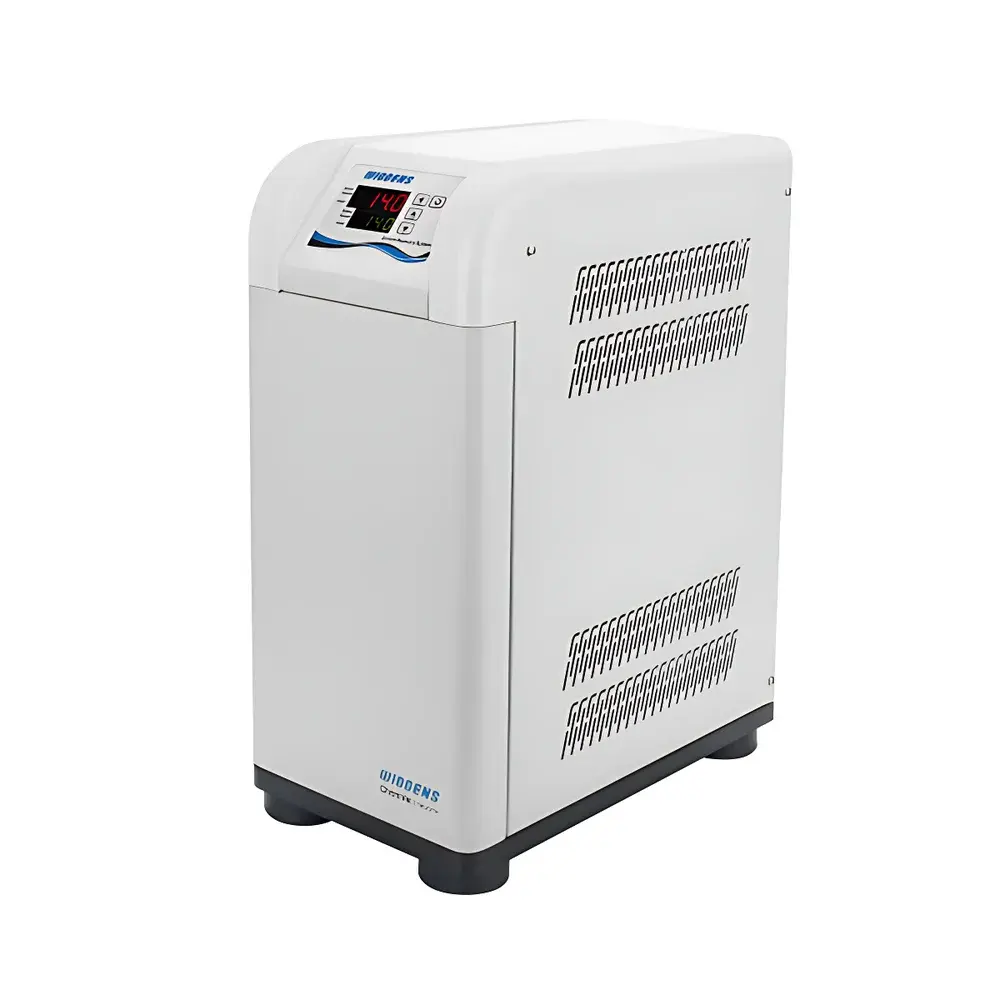
WIGGENS C960TEF Corrosion-Resistant Variable-Frequency Diaphragm Vacuum Pump System
| Brand | WIGGENS |
|---|---|
| Origin | Switzerland |
| Model | C960TEF |
| Pump Type | Diaphragm Vacuum Pump |
| Ultimate Vacuum | < 2 mbar |
| Pumping Speed | 60 L/min |
| Motor Power | 400 W |
| Dimensions (W×D×H) | 220 × 400 × 495 mm |
| Weight | 25 kg |
| Vacuum Setpoint Range | 0.1–1000 mbar |
| Pressure Resolution | 0.1 mbar |
| Motor Speed | 1380 rpm |
| Noise Level | 50 dB(A) |
| IP Rating | IP20 |
| Electrical Supply | 220–240 V / 50 Hz |
Overview
The WIGGENS C960TEF Corrosion-Resistant Variable-Frequency Diaphragm Vacuum Pump System is an engineered solution for laboratories and industrial R&D environments requiring precise, stable, and chemically inert vacuum control. Unlike conventional fixed-speed or basic PID-controlled diaphragm pumps, the C960TEF integrates a fully adaptive AI-driven PID auto-tuning algorithm within its embedded controller—enabling real-time optimization of motor speed in response to dynamic process loads, gas composition, and condensate formation. This eliminates pressure overshoot, oscillation, and drift commonly observed in legacy variable-frequency systems where PID parameters remain static. The pump operates on a dual-stage diaphragm principle, generating vacuum through positive displacement without oil lubrication, thereby eliminating hydrocarbon contamination risks and avoiding wastewater discharge associated with water-ring pumps. Its sealed, isolated drive chamber physically separates mechanical components from the gas path—enhancing long-term reliability in aggressive chemical workflows.
Key Features
- AI-enhanced PID auto-tuning: Controller dynamically adjusts proportional, integral, and derivative coefficients based on real-time vacuum load characteristics—ensuring repeatable setpoint accuracy within ±0.1 mbar across varying gas compositions and condensation rates.
- Full PTFE-wetted path: All gas-contact surfaces—including diaphragms, valves, inlet/outlet manifolds, and internal chambers—are constructed from virgin polytetrafluoroethylene (PTFE), providing exceptional resistance to halogenated solvents, strong acids (e.g., HCl, HNO₃), alkalis, and organic vapors encountered in pharmaceutical synthesis and fine chemical processing.
- Thermally protected operation: Integrated thermal cutoff circuitry automatically deactivates the motor if housing temperature exceeds safe operational limits; system resumes operation autonomously once thermal equilibrium is restored—supporting unattended overnight runs under GLP-compliant conditions.
- Compact modular architecture: Fully integrated pump head, frequency inverter, and digital control panel occupy minimal bench space (220 × 400 × 495 mm) while delivering robust performance up to 60 L/min at < 2 mbar ultimate vacuum—ideal for integration into automated reaction stations or centralized vacuum networks.
- Noise-optimized design: Acoustic enclosure and vibration-dampened mounting reduce operational noise to ≤50 dB(A) at 1 m distance—meeting ISO 7779 requirements for quiet laboratory environments.
Sample Compatibility & Compliance
The C960TEF is validated for continuous exposure to corrosive and condensable vapors generated during rotary evaporation of ethyl acetate, dichloromethane, or THF; vacuum distillation of concentrated sulfuric acid mixtures; and solid-phase extraction using trifluoroacetic acid modifiers. Its PTFE construction conforms to ASTM D5576 for fluoropolymer chemical resistance classification and meets ISO 8573-1 Class 0 purity requirements for oil-free compressed air/vacuum generation. While not certified for explosive atmospheres, its IP20 ingress protection rating supports use in standard laboratory environments compliant with IEC 61010-1 for electrical safety. The system supports audit-ready operation when paired with external data loggers meeting FDA 21 CFR Part 11 requirements for electronic records.
Software & Data Management
The C960TEF features a built-in OLED interface with intuitive menu navigation for setting vacuum targets, ramp rates, hold durations, and alarm thresholds. Analog 0–10 V and digital RS-485 Modbus RTU outputs enable seamless integration into SCADA platforms, LIMS, or PLC-controlled reactor systems. Optional WIGGENS LabLink software (Windows/macOS) provides time-stamped vacuum profile logging, exportable as CSV or PDF reports with metadata including ambient temperature, runtime, and fault codes—facilitating traceability in GMP-regulated QC labs. All parameter changes are timestamped and stored locally for retrospective review, supporting GLP documentation standards.
Applications
- High-capacity vacuum distillation of thermolabile compounds in pilot-scale reactors (up to 50 L volume)
- Multi-port parallel vacuum filtration of aggressive crystallization slurries in API manufacturing
- Controlled-pressure solvent removal during lyophilization cycle development
- Vacuum-assisted drying of catalysts and metal-organic frameworks (MOFs) under acidic or oxidative atmospheres
- Integrated vacuum supply for automated SPE workstations handling chlorinated pesticide extracts
- Process vacuum support in semiconductor wafer cleaning lines requiring hydrocarbon-free environment
FAQ
Is the C960TEF suitable for continuous duty operation?
Yes—it is rated for 100% duty cycle under ambient temperatures ≤35°C and relative humidity ≤80%, provided adequate ventilation is maintained around the rear cooling vents.
Can it handle saturated vapor loads from rotary evaporation?
Yes—the PTFE diaphragm and valve assembly resist swelling and hydrolysis even under prolonged exposure to condensed low-boiling solvents; optional cold trap integration is recommended for high-volume aqueous or high-humidity applications.
Does the system comply with ISO 14001 environmental management standards?
Its oil-free, water-free operation reduces hazardous waste generation and energy consumption by ~35% compared to equivalent two-stage rotary vane pumps—contributing to measurable reductions in lab carbon footprint per ASTM E2962.
What maintenance intervals are recommended?
Diaphragm replacement is advised every 12,000 operating hours or biannually under typical lab usage; no lubrication, oil changes, or filter replacements are required between service cycles.
Is remote monitoring supported via Ethernet or Wi-Fi?
Native Ethernet/Wi-Fi is not included, but third-party protocol converters (e.g., Modbus TCP gateways) can be deployed to enable cloud-based vacuum telemetry and predictive maintenance analytics.



