
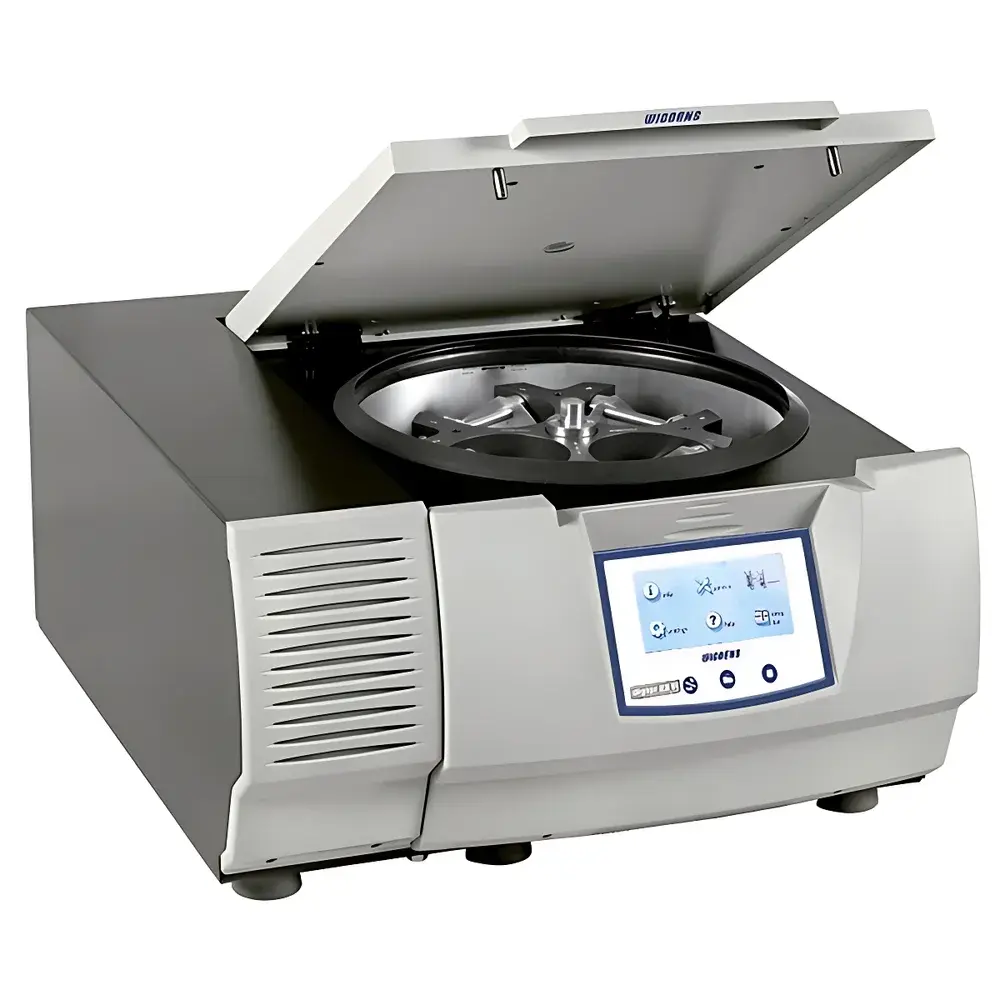
WIGGENS DIGTOR 22R Refrigerated Benchtop Centrifuge
| Brand | WIGGENS |
|---|---|
| Origin | Germany |
| Model | DIGTOR 22R |
| Centrifuge Type | Benchtop Refrigerated Centrifuge |
| Maximum Speed | 14,300 rpm |
| Maximum RCF | 21,948 × g |
| Maximum Capacity | 4 × 750 mL |
| Temperature Range | −20 °C to +40 °C |
| Temperature Control Resolution | 1 °C |
| Refrigerant | R449A (CFC-free) |
| Dimensions (W × D × H) | 720 × 805 × 390 mm |
| Net Weight | 95 kg |
| Power Supply | 220–230 V, 50–60 Hz |
| Power Consumption | 1050 W |
| Safety Certification | CE compliant |
| Unbalance Detection | ULS (Unbalance Location System) |
| Acceleration/Deceleration Profiles | 175 programmable PCBS slopes |
| Timer Range | 1 s to 99 h |
| Programmable Methods | 40 user-defined protocols with password protection |
| Display | TFT color touchscreen (visible up to 3 m) |
| Rotor Compatibility | Horizontal, fixed-angle, and swing-out rotors |
Overview
The WIGGENS DIGTOR 22R is a high-performance refrigerated benchtop centrifuge engineered for precision, reproducibility, and operational safety in regulated laboratory environments. It operates on the principle of sedimentation under controlled gravitational force (RCF), enabling efficient separation of biological, clinical, and industrial samples based on density, size, and molecular weight differences. Designed for routine and method-critical applications—including cell pelleting, nucleic acid isolation, protein purification, and quality control testing—the DIGTOR 22R delivers consistent thermal stability and mechanical reliability across its full operational range. Its robust stainless-steel chamber, brushless induction motor, and active refrigeration system ensure minimal temperature drift during extended runs—even at maximum speed—making it suitable for heat-sensitive biomolecules and time-resolved kinetic separations.
Key Features
- Refrigerated operation from −20 °C to +40 °C with real-time cavity temperature monitoring via internal Pt100 sensor
- TFT color touchscreen interface (≥3 m visibility) displaying simultaneous RPM, RCF, elapsed time, acceleration/deceleration status, and ULS alerts
- Unbalance Location System (ULS): visually identifies unbalanced rotor position by number (e.g., “Position 3”), reducing troubleshooting time and minimizing mechanical stress
- Precision speed control in 10 rpm / 10 × g increments with real-time RCF recalculation based on selected rotor and tube geometry
- Programmable timer (1 s–99 h) with forward/backward counting, endpoint RPM/RCF-triggered timing, and multi-step protocol capability
- PCBS (Progressive Control Braking System): 175 selectable acceleration/deceleration profiles to prevent resuspension or shearing of delicate pellets
- 40 user-programmable methods with individual password protection for GLP/GMP traceability and role-based access control
- R449A eco-friendly refrigerant (zero ODP, low GWP), compliant with EU F-Gas Regulation (EU No. 517/2014)
- Pre-cooling mode and rotor-aware temperature maintenance—ensures chamber remains at setpoint ±0.5 °C during high-speed operation
Sample Compatibility & Compliance
The DIGTOR 22R supports broad sample format flexibility: from 0.2 mL PCR tubes and 96-well microplates to 750 mL bottles via horizontal carriers. Over 50 certified adapters accommodate conical, round-bottom, and skirted tubes across standard diameters (10–50 mm). All rotors are validated per ISO 15195:2021 (clinical laboratory centrifuge performance) and undergo dynamic balancing per DIN EN 61000-6-3. The instrument meets IEC 61010-1:2010 for electrical safety and carries CE marking under the EU Machinery Directive 2006/42/EC and Electromagnetic Compatibility Directive 2014/30/EU. Its audit trail functionality—including timestamped parameter changes, run logs, and error events—supports compliance with FDA 21 CFR Part 11 when integrated with validated LIMS or ELN systems.
Software & Data Management
While the DIGTOR 22R operates autonomously via its embedded firmware, its full parameter logging (start/stop time, actual vs. set RCF, temperature deviation, rotor ID, unbalance events) is exportable via USB port in CSV format. Each run generates a unique identifier linked to operator login (if password-enabled), method name, and rotor serial number—facilitating retrospective analysis and deviation investigations. The system maintains internal memory for ≥1,000 recent runs. Optional Ethernet/Wi-Fi modules (sold separately) enable remote monitoring and centralized fleet management through WIGGENS’ LabLink software suite, which supports automated report generation aligned with ISO/IEC 17025 documentation requirements.
Applications
- Bioscience: Mammalian cell harvesting (e.g., HEK293, CHO), organelle fractionation, exosome isolation (via differential ultracentrifugation-compatible rotors)
- Clinical Diagnostics: Serum/plasma separation, urine sediment analysis, PBMC isolation per CLSI GP45-A4 guidelines
- Pharmaceutical QA/QC: Filter integrity testing, residual moisture analysis in lyophilized formulations, particle count validation
- Food & Beverage: Fat separation in dairy emulsions, yeast removal in fermentation broths, pesticide residue extraction support
- Environmental Testing: Sedimentation of suspended solids in wastewater, microplastic concentration from aqueous matrices
FAQ
What is the minimum temperature achievable during a 14,300 rpm run?
At maximum speed, the DIGTOR 22R maintains chamber temperature within ±0.8 °C of the setpoint down to 4 °C; sustained operation below 4 °C at top speed requires reduced runtime or lower setpoints.
Does the ULS function require calibration or special rotor markings?
No—ULS is hardware-integrated and automatically detects mass asymmetry using motor current signature analysis; compatible with all WIGGENS-certified rotors without modification.
Can the centrifuge store rotor-specific RCF limits to prevent overspeeding?
Yes—each rotor profile (including max speed, max load, and RCF curves) is preloaded into firmware; the system enforces hard limits and displays warnings before unsafe parameters are accepted.
Is the refrigeration system active during standby or only during runs?
Refrigeration remains active in standby when temperature is set ≤15 °C; the unit enters energy-saving mode above that threshold but resumes cooling within 90 seconds of run initiation.
How is data integrity ensured for regulatory submissions?
All parameter changes, run executions, and error events are immutably timestamped and logged with operator ID; export files include digital signatures verifiable via SHA-256 hash, meeting ALCOA+ principles for raw data handling.



