
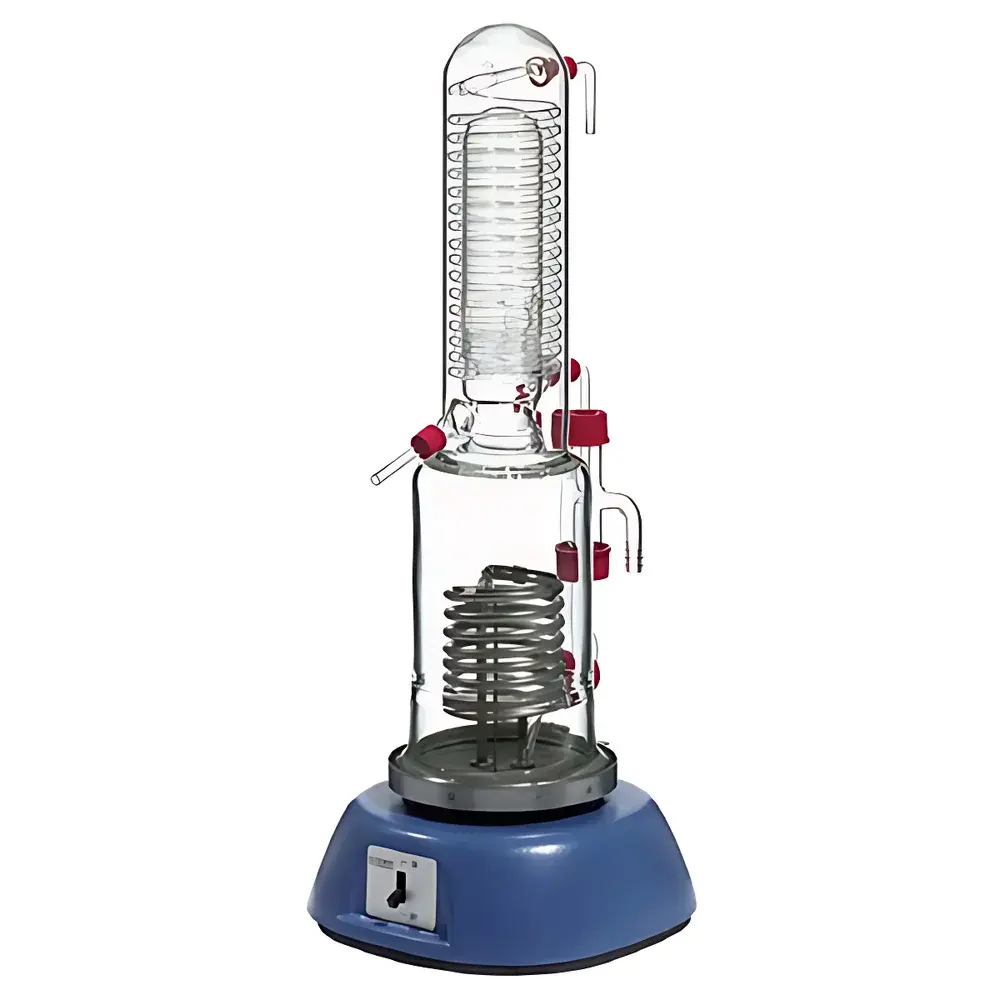
WIGGENS DURAN 3.3 Borosilicate Glass Distillation Apparatus
| Brand | WIGGENS |
|---|---|
| Origin | Germany |
| Construction Material | SCHOTT DURAN 3.3 borosilicate glass |
| Heating Element | CrNi 4876 stainless steel immersion heater |
| Output Conductivity | ~1 µS/cm at 25 °C |
| Feed Water | Tap water |
| Cooling Water Inlet Temperature | >60 °C |
| Power Supply Options | 230 V / 14 A (4 L/h) |
| Base Dimensions | 300 × 300 mm |
| Safety Features | Automatic water level control, dry-run protection |
| Operating Cost | Negligible (no consumables or regeneration required) |
Overview
The WIGGENS DURAN 3.3 Borosilicate Glass Distillation Apparatus is a laboratory-grade primary water purification system engineered for continuous production of Type III purified water (ASTM D1193-20) via atmospheric-pressure thermal distillation. Unlike membrane-based or ion-exchange systems, this apparatus relies on phase-change separation — boiling feed water and condensing the vapor in an integrated, self-cooling glass condenser — to remove non-volatile ions, organic contaminants, particulates, endotoxins, and microorganisms with high reproducibility. Constructed entirely from SCHOTT DURAN 3.3 borosilicate glass (a material compliant with DIN ISO 3585 and USP Class A), the system ensures chemical inertness, thermal shock resistance up to 150 K, and zero leachable metal content. The immersion heater, fabricated from CrNi 4876 stainless steel (equivalent to ASTM A240 UNS S48760), is fully isolated from the distilled water path, eliminating risk of heavy metal contamination. Its unique dual-function condenser — where incoming cooling water flows through the outer jacket of the condenser tube — preheats feed water while simultaneously maintaining condensate temperature below 30 °C, thereby minimizing CO₂ reabsorption and stabilizing final conductivity at approximately 1 µS/cm (25 °C).
Key Features
- Fully all-glass wetted path using SCHOTT DURAN 3.3 borosilicate glass — compliant with ISO 17025 traceability requirements for calibration-grade water generation
- Integrated counter-current cooling design: cooling water enters the condenser jacket at >60 °C, reducing thermal stress and preventing CO₂ dissolution in distillate
- Dual safety architecture: float-controlled automatic fill system + redundant dry-run cut-off circuitry prevents heater damage during low-water conditions
- No consumables required — eliminates recurring costs associated with resin replacement, membrane cleaning, or UV lamp servicing
- Modular power configurations support flexible lab integration: single-phase 230 V options (4 L/h and 7 L/h) and three-phase 400 V (7 L/h) for high-throughput core facilities
- Compact footprint (300 × 300 mm base) enables benchtop deployment without dedicated utility islands or floor-standing infrastructure
Sample Compatibility & Compliance
This distillation apparatus accepts standard municipal tap water (chlorinated or non-chlorinated) as feedstock, provided total dissolved solids (TDS) do not exceed 500 ppm and free chlorine remains below 2 mg/L — conditions typical of EU and North American public supplies. It is validated for routine generation of water meeting ASTM Type III specifications and ISO 3696:1987 Grade 3 purity criteria. While not intended for pharmaceutical-grade WFI (Water for Injection) or USP Purified Water compliance, its output serves as a robust feed source for downstream polishing systems (e.g., deionization or UV oxidation). All glass components are certified to DIN EN 15552 for laboratory glassware and conform to RoHS 2011/65/EU restrictions on hazardous substances.
Software & Data Management
As a standalone analog process instrument, this apparatus operates without embedded firmware or digital interfaces. Operational parameters — including heating status, water level, and power draw — are monitored via front-panel indicators and mechanical float switches. For laboratories requiring audit-ready documentation under GLP or GMP frameworks, optional analog-to-digital signal converters (e.g., 4–20 mA transmitters for level and temperature) can be integrated with third-party SCADA or LIMS platforms. No software validation is required per FDA 21 CFR Part 11, as no electronic records or signatures are generated natively.
Applications
- Preparation of reagent-grade water for general analytical chemistry (titrations, spectrophotometry, buffer preparation)
- Feed water supply for ultrapure water systems (e.g., Milli-Q® or ELGA PURELAB® units)
- Calibration standards preparation where ionic background must be minimized (e.g., ICP-MS blank matrices)
- Long-term stability testing of pH electrodes and conductivity cells
- Teaching laboratories requiring transparent, principle-based demonstration of phase-change purification
- Backup water source in facilities where RO membrane fouling or resin exhaustion compromises primary purification
FAQ
Can this unit produce water suitable for HPLC or cell culture applications?
No — its output meets ASTM Type III and ISO Grade 3 specifications only. For HPLC mobile phase preparation or mammalian cell culture, further polishing (e.g., 0.22 µm filtration, UV oxidation, or mixed-bed deionization) is required.
Is routine descaling necessary?
Yes — although DURAN glass resists scaling, calcium carbonate deposits may accumulate in the boiler chamber over time. Weekly vinegar (5% acetic acid) flushes are recommended; full disassembly is unnecessary.
Does the system require connection to chilled water?
No — it uses ambient tap water as coolant. Inlet temperature must exceed 60 °C to ensure effective CO₂ exclusion; recirculating chillers are incompatible.
What maintenance intervals are recommended for GLP-compliant operation?
Monthly visual inspection of glass integrity, quarterly verification of float switch function, and annual calibration of the built-in conductivity meter (if equipped) — documented per ISO/IEC 17025 clause 7.7.



