
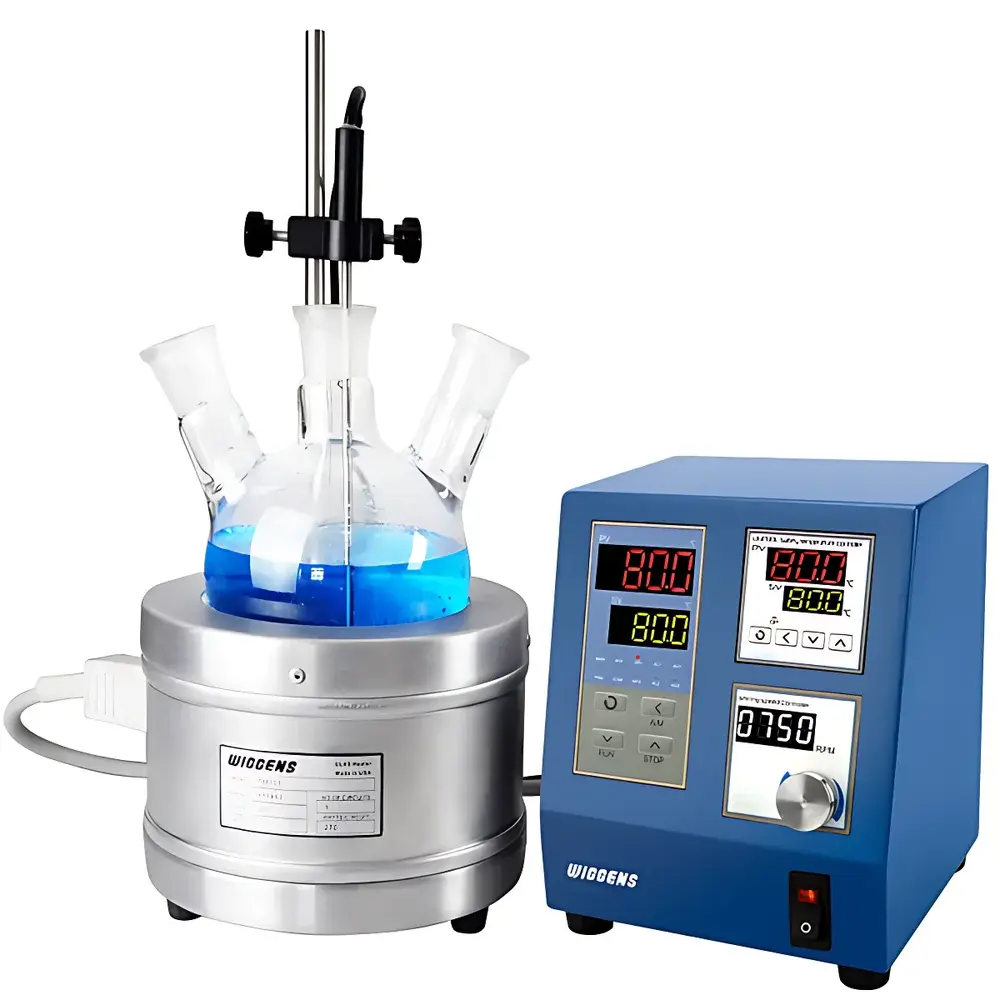
WIGGENS EMS107 Magnetic Stirring Heating Mantle
| Brand | WIGGENS |
|---|---|
| Origin | Germany |
| Model | EMS107 |
| Heating Power | 270 W |
| Max. Flask Capacity | 500 mL |
| Internal Depth | 51 mm |
| External Diameter | 159 mm |
| External Height | 133 mm |
| Weight | 2.0 kg |
| Stirring Speed Range | 5–750 rpm (with StirControl II) |
| Max. Temperature | 450 °C |
| Controller Compatibility | PL524 Pro, TCSS, StirControl II |
Overview
The WIGGENS EMS107 Magnetic Stirring Heating Mantle is an integrated laboratory heating and agitation system engineered for precise thermal control and consistent mechanical mixing in round-bottom flasks. Unlike conventional hotplates or standalone mantles, the EMS107 combines resistive heating with a precisely calibrated rotating magnetic field—enabling simultaneous, independent, or sequential operation of heating and stirring functions. Its design follows Couette-type fluid dynamics principles, where the rotating magnetic stir bar induces laminar flow within viscous or heterogeneous reaction mixtures, minimizing vortex formation and thermal stratification. The mantle’s ceramic-fiber insulated aluminum housing ensures rapid thermal response, uniform heat distribution across the flask curvature, and stable temperature maintenance up to 450 °C—making it suitable for reflux, synthesis, dissolution, and catalytic reaction applications under controlled atmospheric or inert-gas conditions.
Key Features
- Triple-mode operational flexibility: heating-only, stirring-only, or synchronized heating-stirring—configurable via front-panel selector or external controller interface.
- StirControl II dual-channel controller (optional or included in kit configurations) enables linear magnetic field synchronization, eliminating “jumping” or misalignment of stir bars during flask repositioning or thermal cycling.
- Modular architecture: separation of heating mantle and controller via shielded low-voltage control cable allows remote placement of electronics—critical for corrosion-prone environments (e.g., HCl, HF, or organic solvent vapor zones).
- Optimized geometry for 500 mL round-bottom flasks: internal depth of 51 mm and conical contour ensure full contact area coverage and minimal thermal loss at the flask shoulder.
- Robust construction: high-purity aluminum mantle body with ceramic fiber insulation; IP20-rated enclosure; CE-compliant electromagnetic compatibility per EN 61326-1.
- Integrated safety logic: overtemperature cutoff (adjustable limit), open-circuit detection, and thermal runaway prevention via PID-regulated power modulation.
Sample Compatibility & Compliance
The EMS107 is validated for use with standard borosilicate glass (e.g., DIN 12331, ASTM E438 Type I Class A) and quartz round-bottom flasks up to 500 mL. Its non-contact magnetic drive eliminates shaft seals and mechanical wear—supporting GLP/GMP workflows requiring traceable, contamination-free agitation. When paired with the PL524 Pro temperature controller, the system meets requirements for ISO/IEC 17025 calibration traceability (NIST-traceable RTD sensor input), and supports audit-ready data logging compliant with FDA 21 CFR Part 11 when used with validated software interfaces. No direct contact with process media ensures compliance with USP and for sterile and hazardous drug compounding environments where equipment surface decontamination is required.
Software & Data Management
While the EMS107 operates as a standalone analog-controlled unit, its modular interface supports digital integration. The PL524 Pro controller provides RS485 Modbus RTU output (optional USB-to-RS485 adapter), enabling real-time temperature and setpoint logging into LIMS or ELN platforms such as LabArchives or Benchling. StirControl II offers analog 0–10 V speed reference input, permitting synchronization with programmable logic controllers (PLCs) in pilot-scale reactor systems. All firmware updates and configuration backups are performed via micro-USB—no proprietary drivers required. Data integrity safeguards include timestamped event logging (power-on, overtemp trigger, stir start/stop), configurable sampling intervals (1–60 s), and cyclic redundancy check (CRC)-protected memory storage.
Applications
- Organic synthesis requiring precise temperature ramping and homogeneous mixing (e.g., Grignard reactions, esterifications, Suzuki couplings).
- Standard solution preparation per ISO 3696 Grade 2/3 water specifications, including buffer dissolution and pH adjustment under thermostatic control.
- Accelerated stability testing (ICH Q1A) of pharmaceutical intermediates using jacketed flask setups with external condensers.
- Environmental sample digestion (EPA Method 3050B, 3051A) with closed-vessel reflux under controlled heating profiles.
- Materials science workflows: polymerization initiation, nanoparticle dispersion, and sol-gel precursor homogenization.
- Teaching laboratories: demonstration of Arrhenius kinetics, heat transfer coefficients, and rheological behavior in Newtonian/non-Newtonian model systems.
FAQ
Can the EMS107 be used with flat-bottom flasks or beakers?
No. The EMS107 is geometrically optimized for spherical curvature of round-bottom flasks. Use with flat-bottom vessels results in poor thermal contact, uneven heating, and potential thermal stress fracture.
Is the StirControl II controller compatible with other WIGGENS mantles?
Yes—StirControl II supports all EMS-series mantles (EMS103 through EMS122) via standardized 8-pin DIN interface and auto-detects connected units for multi-mantle coordination.
What is the recommended stir bar size for 500 mL flasks on the EMS107?
A PTFE-coated elliptical stir bar measuring 30 × 8 mm (Cat. No. SB-308-E) is optimal for laminar flow generation and torque efficiency at speeds above 200 rpm.
Does the system support external temperature probe feedback for jacketed reactors?
Not natively—the EMS107 regulates based on internal mantle RTD. For external probe feedback, integrate via PL524 Pro’s auxiliary input channel (supports Pt100 or thermocouple inputs) in cascade control mode.
How often does the unit require recalibration?
Annual verification against NIST-traceable reference thermometer is recommended per ISO/IEC 17025; no field recalibration is user-accessible—service must be performed by WIGGENS-certified technicians.



