
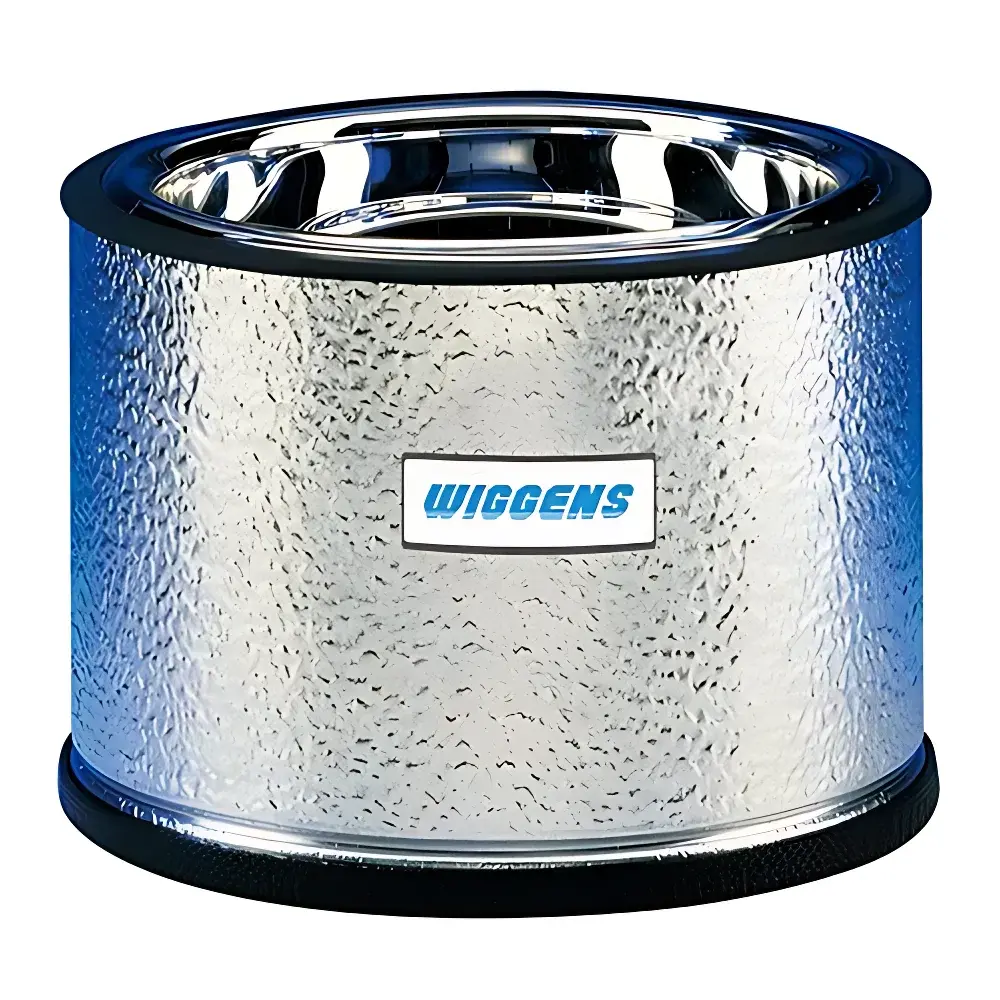
WIGGENS SCH CAL Series Shallow-Dish Cryogenic Dewar Flasks
| Brand | WIGGENS |
|---|---|
| Origin | Germany |
| Product Line | SCH CAL Series |
| Temperature Range | –200 °C to +200 °C |
| Construction | Double-Walled Vacuum-Insulated Stainless Steel |
| Lid Options | Polyethylene (PE) or Aluminum/Polyurethane (ALU/PU) Insulated Lids |
| Volume Range | 80 mL to 5800 mL |
Overview
The WIGGENS SCH CAL Series Shallow-Dish Cryogenic Dewar Flasks are precision-engineered vacuum-insulated stainless steel containers designed for stable, long-duration thermal management across extreme temperature ranges (–200 °C to +200 °C). Unlike conventional cylindrical Dewars, the shallow-dish geometry features a wide, low-profile opening and reduced depth—optimized for integration with overhead or submerged magnetic stirrers, immersion circulators, and jacketed reaction vessels. This architecture ensures uniform heat transfer distribution, minimizes thermal stratification, and enables direct mechanical agitation of reaction mixtures without lid interference. The flasks operate on passive cryogenic stabilization principles: high-vacuum interstitial space between inner and outer walls suppresses conduction and convection losses, while polished stainless steel surfaces minimize radiative heat ingress. They serve as primary thermal baths in applications requiring precise, non-pressurized, open-bath temperature control—particularly where conventional recirculating chillers lack compatibility with volatile solvents or ultra-low setpoints.
Key Features
- Vacuum-insulated double-walled 304 stainless steel construction ensures thermal stability and mechanical durability under repeated thermal cycling.
- Shallow-dish profile (depth-to-diameter ratio ≤ 0.5) maximizes surface area exposure and facilitates unobstructed placement of magnetic stir bars and temperature probes.
- Wide aperture design accommodates standard laboratory glassware—including round-bottom flasks up to 6000 mL—and supports simultaneous stirring, sampling, and gas inlet/outlet routing.
- Two lid systems available: chemically inert polyethylene (PE) lids for general low-temperature use (–80 °C to +60 °C), and ALU/PU composite insulated lids with integrated sealing gaskets for sustained operation below –150 °C.
- Graduated volume markings etched directly onto the inner wall provide traceable, solvent-resistant calibration references compliant with ISO 4787:2022 (volumetric glassware).
- Base-mounted leveling feet and anti-slip silicone pads ensure stable positioning on stirrer hotplates and vibration-sensitive optical benches.
Sample Compatibility & Compliance
The SCH CAL series is validated for use with liquid nitrogen, liquid argon, dry ice–acetone slurries, ethylene glycol–water mixtures, and silicone oil baths. All models meet EN 61000-6-3 (EMC immunity) for safe operation adjacent to sensitive analytical instrumentation. Inner vessel surfaces are electropolished to Ra < 0.4 µm, minimizing nucleation sites and supporting Good Laboratory Practice (GLP) requirements for reproducible cryo-reaction initiation. The PE lids conform to USP Class VI biocompatibility standards; ALU/PU lids comply with ASTM D1622 for thermal insulation performance at cryogenic temperatures. No pressure relief valves or safety certification (e.g., PED 2014/68/EU) are required, as all units operate exclusively at ambient pressure.
Software & Data Management
While inherently analog in operation, the SCH CAL flasks integrate seamlessly into digitally controlled lab environments via compatible external sensors and controllers. When paired with WIGGENS WT-1000 temperature monitoring modules or third-party PID controllers (e.g., Omega CNi16D), real-time bath temperature data can be logged with ±0.1 °C accuracy and exported in CSV format. Audit trails—including timestamped setpoint changes, dwell times, and ambient humidity readings—support compliance with FDA 21 CFR Part 11 when used within validated workflows. Optional RFID-tagged lid assemblies (accessory kit SK-SCH-RFID) enable automated inventory tracking and usage history logging in LIMS-integrated facilities.
Applications
- Cryogenic enzymatic assays requiring strict thermal ramping profiles (e.g., cold-adapted protease kinetics at –40 °C).
- Low-temperature Grignard and organolithium reactions conducted under inert atmosphere with continuous stirring.
- Controlled-rate freezing of primary cell suspensions and tissue explants prior to LN₂ vapor-phase storage.
- Calibration reference baths for thermocouple and RTD probe validation per ISO/IEC 17025:2017 Clause 6.5.2.
- Thermal sink platforms for superconducting quantum interference device (SQUID) shielding and cryo-EM sample preparation stages.
FAQ
Can the SCH CAL Dewars be used with circulating chillers?
Yes—models SCH15 CAL and larger feature dual 1/4″ NPT threaded ports (inlet/outlet) for integration with external recirculating systems operating down to –90 °C.
Is vacuum integrity monitored over time?
Each unit undergoes helium leak testing (<1×10⁻⁹ mbar·L/s) during manufacturing. A visual vacuum indicator (VVI) port is included on SCH30 CAL and above for periodic verification using a handheld vacuum gauge.
Are custom volume calibrations available?
WIGGENS offers NIST-traceable volumetric calibration certificates (ISO/IEC 17025 accredited) for individual units upon request, with uncertainty budgets reported per EURAMET cg-18.
Do ALU/PU lids require pre-cooling before use at –196 °C?
No—pre-conditioning is unnecessary. The ALU/PU composite maintains structural integrity and thermal resistance without embrittlement due to its graded-density polyurethane core and anodized aluminum cladding.
What is the maximum allowable fill level for safe stirring?
For optimal vortex control and minimal splashing, maintain liquid levels at ≤70% of nominal volume—verified experimentally across all models using 100 rpm magnetic agitation with PTFE-coated stir bars.






