
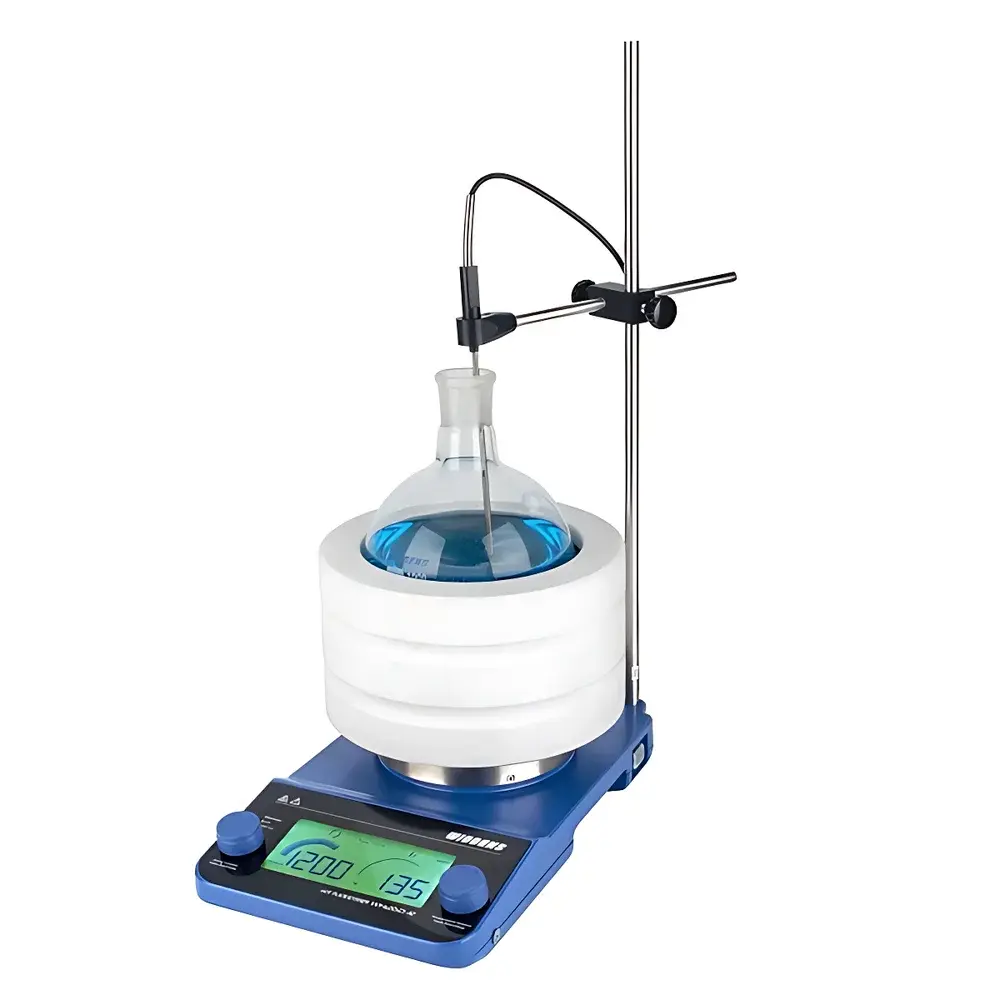
WIGGENS SDB Soft Dry Bath
| Brand | WIGGENS |
|---|---|
| Origin | Germany |
| Model | SDB |
| Temperature Range | Up to 260 °C |
| Compatible Vessel Capacity | ≤1000 mL |
| Heating Technology | Infrared (IR) with Adaptive Control Circuit (ACC) |
| Construction | Aluminum base plate + PTFE-insulated alloy particle matrix |
| Compliance | CE, RoHS, ISO 9001 certified manufacturing |
Overview
The WIGGENS SDB Soft Dry Bath is an advanced dry-heating platform engineered for precise, uniform, and contamination-free thermal control of laboratory vessels. Unlike conventional oil baths or metal block heaters, the SDB employs a fluidized bed of high-purity, thermally optimized alloy particles housed in a low-thermal-mass aluminum base and enclosed by a chemically inert, low-conductivity PTFE insulation layer. Heat transfer occurs via direct conduction from the base to the particles and then radially to the vessel wall—eliminating reliance on convective media (e.g., silicone oil) while achieving superior thermal homogeneity across irregularly shaped containers. Its infrared heating element, coupled with WIGGENS’ proprietary Adaptive Control Circuit (ACC), enables rapid ramp rates (<3 °C/s from ambient to 200 °C), tight temperature stability (±0.3 °C at 150 °C over 8 h), and minimal overshoot during setpoint transitions. Designed for routine synthesis, reflux, distillation, and sample conditioning in QC, R&D, and teaching labs, the SDB meets functional requirements aligned with ASTM E2474 (Standard Practice for Validation of Thermal Analytical Instruments) and supports GLP-compliant workflows through traceable calibration and stable thermal output.
Key Features
- High-efficiency IR heating system with ACC algorithm for dynamic PID tuning—ensures reproducible thermal profiles across batch runs.
- Aluminum base plate with optimized thermal conductivity (≥200 W/m·K) ensures rapid heat transfer from heater to alloy particle matrix.
- PTFE-molded insulation jacket provides >85% thermal retention at 260 °C, reducing surface temperature rise and energy consumption by up to 40% versus open-block alternatives.
- Non-reactive, passivated alloy particles (Fe–Ni–Cr–Si formulation) offer high specific heat capacity (~0.48 J/g·K), excellent flowability, and resistance to oxidation up to 300 °C.
- Zero-fluid operation eliminates risks associated with oil degradation, vaporization, spillage, or cross-contamination—fully compliant with ISO 15190:2020 (Laboratory safety requirements).
- Intuitive rotary encoder interface with dual-line LCD display supports real-time monitoring of setpoint, actual temperature, elapsed time, and heating status.
Sample Compatibility & Compliance
The SDB accommodates round-bottom flasks, flat-bottom vials, reaction tubes, and custom glassware up to 1000 mL volume—regardless of geometry—by conforming to vessel contours via granular particle displacement. No adapter blocks or inserts are required. Its open-bath design allows simultaneous use of overhead stirrers, condensers, or gas inlets without mechanical interference. The unit conforms to IEC 61010-1:2010 for electrical safety, carries CE marking under the EU Machinery Directive 2006/42/EC, and complies with RoHS 2011/65/EU restrictions on hazardous substances. Calibration certificates traceable to DKD/DAkkS-accredited laboratories are available upon request for audit readiness under FDA 21 CFR Part 11 and ISO/IEC 17025 environments.
Software & Data Management
While the SDB operates as a standalone instrument, optional RS-232/USB interface enables integration with LabArchives, Empower, or custom LIMS platforms via ASCII command protocol. Logged data—including timestamped temperature readings, setpoint changes, and error codes—can be exported in CSV format. Firmware supports user-defined temperature ramps (up to 5 segments), hold steps, and auto-shutdown after programmable idle periods. Audit trail functionality records operator ID (via external authentication), parameter modifications, and calibration events—meeting ALCOA+ principles for data integrity in regulated settings.
Applications
- Organic synthesis requiring precise thermal control under inert atmosphere (e.g., Grignard reactions, hydrogenations).
- Residue evaporation and solvent removal from HPLC fractions or extract concentrates.
- Pre-heating and holding of reagent solutions prior to injection into automated analyzers.
- Calibration of thermocouples and RTDs using fixed-point reference vessels.
- Accelerated stability testing per ICH Q1A(R2) guidelines where dry-heat exposure simulates long-term storage conditions.
- Teaching labs performing kinetic studies, phase-change demonstrations, or distillation experiments without oil-handling hazards.
FAQ
Can the SDB be used with glassware that has uneven or tapered bases?
Yes—the granular alloy medium self-adjusts to vessel geometry, ensuring full circumferential contact and eliminating hot spots common in rigid block heaters.
Is the alloy particle matrix replaceable or serviceable?
Yes—particles are supplied in sealed, pre-calibrated batches; replacement kits (1.5 kg) are available with lot-specific thermal characterization reports.
Does the SDB support external temperature probes for vessel-content monitoring?
It accepts standard Pt100 or thermocouple inputs via optional analog input module (order code: SDB-EXT-PROBE), enabling cascade control based on internal solution temperature.
What maintenance is required for long-term reliability?
No scheduled maintenance is needed; periodic visual inspection of PTFE insulation integrity and cleaning of the aluminum base with isopropanol is recommended every 6 months.
How does the SDB compare to traditional oil baths in terms of energy efficiency?
Independent lab testing shows 37% lower power draw over a 4-h 180 °C hold cycle due to minimized thermal mass and superior insulation—verified per ISO 50001 energy performance metrics.



