
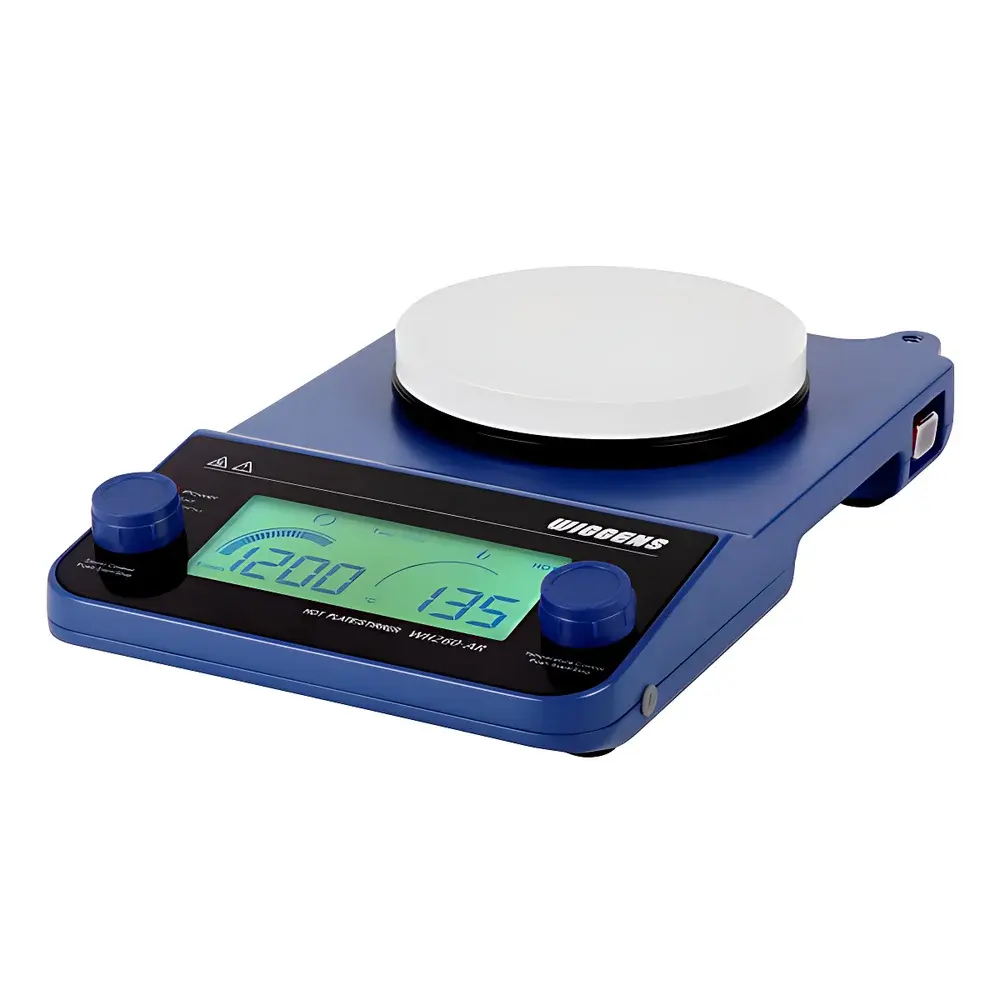
WIGGENS WH260-AR Infrared-Heated Magnetic Stirrer
| Brand | WIGGENS |
|---|---|
| Origin | Germany |
| Model | WH260-AR |
| Maximum Stirring Volume | 20 L |
| Speed Range | 100–1500 rpm |
| Temperature Control Range | 50–430 °C |
| Heating Power | 800 W |
| Temperature Stability (with Pt100) | ±1 °C |
| Overtemperature Protection Range | 10–50 °C above setpoint |
| Display | LCD with digital interface |
| External Temperature Sensor | Integrated Pt100 port |
| Timer Function | 1–1999 min or continuous operation |
| Plate Material | Enamel-coated stainless steel |
| Plate Diameter | Ø140 mm |
| Dimensions (W×D×H) | 187 × 315 × 93 mm |
| Weight | 2.6 kg |
| Power Supply | 220 V / 50 Hz |
| USB-A Interface | Yes |
Overview
The WIGGENS WH260-AR is a high-performance infrared-heated magnetic stirrer engineered for precise thermal and mechanical control in demanding laboratory environments. Unlike conventional resistive-heated stirrers, the WH260-AR employs an infrared-enhanced heating module that delivers rapid, uniform energy transfer to reaction vessels—minimizing thermal lag and improving heat-up efficiency, particularly at elevated temperatures (up to 430 °C on the plate surface). Its dual-control architecture integrates independent regulation of stirring speed (100–1500 rpm) and temperature (50–430 °C), with real-time feedback via an external Pt100 sensor for accurate sample temperature monitoring (up to 200 °C). Designed for reproducibility in method development and routine QC workflows, the unit features three preconfigured PID algorithms optimized for distinct thermal mass scenarios: low-heat-capacity small-volume samples, medium-scale reactions, and high-mass aqueous or viscous systems up to 20 L. The microprocessor-based controller ensures stable setpoint maintenance under variable load conditions, making it suitable for applications ranging from gentle dissolution to vigorous reflux-assisted synthesis.
Key Features
- Infrared-enhanced heating system with 800 W power output and ≤380 °C plate temperature capability—enabling faster ramp rates and reduced thermal gradient across vessel bottoms
- Dual-sensor temperature management: built-in plate thermistor for surface control + dedicated Pt100 input for direct sample temperature feedback (±1 °C stability)
- Three user-selectable PID profiles calibrated for different thermal inertia regimes—enhancing control fidelity across volume and viscosity ranges
- Corrosion-resistant enamel-coated stainless steel heating plate (Ø140 mm) with integrated liquid containment channel to prevent ingress into electronics
- LCD display with intuitive rotary encoder interface for simultaneous adjustment of speed, temperature, timer, and overtemperature offset (10–50 °C)
- Auto-recall function retains last-used parameters—including speed, temperature, timer, and PID selection—for consistent experimental replication
- Comprehensive safety architecture: redundant overtemperature cutoff (hardware thermal switch + software-limiting logic), automatic power disconnection upon sensor fault or timeout
- USB-A port enables firmware updates and future integration with lab automation platforms supporting serial command protocols
Sample Compatibility & Compliance
The WH260-AR accommodates standard laboratory glassware including round-bottom flasks (up to 5 L), beakers (up to 20 L), and jacketed reactors when used with compatible magnetic stir bars. Its wide operating temperature range supports solvent-based reactions (e.g., DMF, DMSO, ethylene glycol), high-boiling-point media, and non-aqueous electrochemical electrolytes. The unit complies with IEC 61010-1:2010 for electrical safety in laboratory equipment and meets EMC requirements per EN 61326-1:2013. While not certified for use in explosion-proof environments, its sealed electronics and absence of exposed heating elements reduce ignition risk in controlled fume hood settings. For GLP/GMP-regulated labs, the device supports audit-ready operation through parameter logging (via optional software), timestamped event records (overtemp triggers, power cycles), and configurable lockout modes to prevent unauthorized setting changes.
Software & Data Management
Although standalone operation requires no software, the WH260-AR’s USB-A interface permits connection to host PCs running vendor-provided configuration utilities (available via WIGGENS support portal). These tools enable remote parameter programming, firmware version verification, and export of operational logs—including start/stop timestamps, setpoint history, and thermal deviation alerts. The system adheres to basic principles of FDA 21 CFR Part 11 readiness: all critical parameters are stored in non-volatile memory with write protection; user access levels can be enforced via password-protected menu navigation; and electronic records maintain integrity through CRC-checked data storage. Integration with LIMS or ELN systems is achievable via ASCII-based serial commands over virtual COM port emulation.
Applications
- Controlled-temperature synthesis requiring simultaneous agitation and thermal activation (e.g., Suzuki couplings, esterifications, polymerizations)
- Standardization of dissolution testing per USP and Ph. Eur. 2.9.3, where precise bath-equivalent temperature maintenance is critical
- Preparation of calibration standards and reference materials under ISO/IEC 17025-compliant conditions
- Viscosity-dependent mixing of suspensions, colloids, and nanoparticle dispersions where shear rate and thermal history must be decoupled
- Method validation studies requiring documented repeatability of heating/stirring profiles across multiple runs
- Teaching laboratories conducting kinetic experiments where students require intuitive, fail-safe instrumentation
FAQ
Can the WH260-AR be used with Teflon-coated stir bars at 400 °C?
No. Standard Teflon-coated stir bars degrade above 260 °C. Use ceramic- or glass-encapsulated stir bars rated for >450 °C when operating near the upper temperature limit.
Is the Pt100 sensor included with the unit?
No—the WH260-AR provides a standardized Pt100 input port but does not include the probe. Compatible Class A Pt100 sensors (3-wire or 4-wire) must be sourced separately.
Does the timer function pause heating during standby?
Yes—the timer controls both heating and stirring. Upon expiration, power to both subsystems is terminated unless configured for “keep-warm” mode via custom PID tuning.
What is the maximum recommended vessel diameter for optimal magnetic coupling?
For reliable torque transmission at full speed (1500 rpm), vessel base diameter should not exceed 120 mm. Larger vessels require lower rpm or high-torque stir bars.
How often should the infrared heating element be recalibrated?
The IR module does not require periodic recalibration. However, annual verification of Pt100 input accuracy against a traceable reference thermometer is recommended per ISO/IEC 17025 clause 6.5.



