
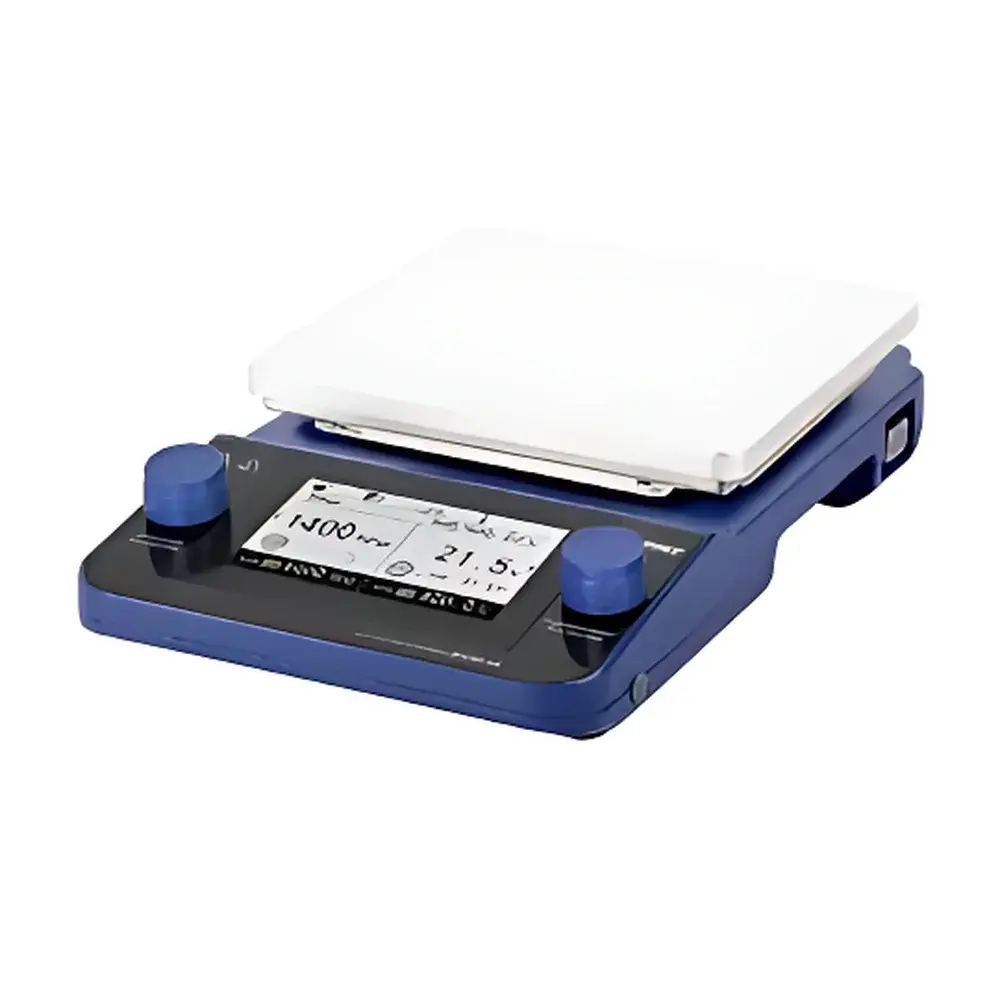
WIGGENS WH280-AH Infrared Heating Magnetic Stirrer
| Brand | WIGGENS |
|---|---|
| Origin | Germany |
| Model | WH280-AH |
| Stirrer Type | Magnetic Stirrer |
| Speed Range | 100–1500 rpm |
| Temperature Control Range | ≤380 °C |
| Heating Power | 800 W |
| Plate Material | Enamel-Coated Stainless Steel |
| Plate Dimensions | 180 × 180 mm |
| External Temperature Sensors | PT-100 (sample) + Independent Safety Thermocouple |
| Temperature Stability (with PT-100) | ±1 °C |
| Over-Temperature Protection Range | 50–430 °C (adjustable) |
| Excess Temp Offset (T) | 10–50 °C (adjustable) |
| Timer Range | 00:01:00 to 99:59:00 or Continuous |
| Interface | RS-232 & RS-485 |
| Weight | 3.4 kg |
| Dimensions (W×H×D) | 187 × 315 × 75 mm |
| Power Supply | 220 V / 50 Hz |
Overview
The WIGGENS WH280-AH is a high-performance infrared heating magnetic stirrer engineered for precision thermal and mechanical control in demanding laboratory environments. Unlike conventional resistive-heating stirrers, the WH280-AH employs an advanced infrared-enhanced heating module that delivers rapid, uniform thermal transfer to reaction vessels—minimizing thermal lag and enabling faster ramp rates up to 380 °C on the ceramic-coated stainless steel plate. Its dual-sensor architecture integrates a calibrated PT-100 probe for accurate sample temperature feedback and an independent safety thermocouple for hardware-level overtemperature cutoff—ensuring compliance with IEC 61010-1 safety requirements for laboratory equipment. The unit operates on the principle of magnetic coupling: a rotating permanent magnet beneath the heated plate induces rotation in a PTFE- or glass-coated stir bar immersed in the sample, enabling contactless mixing without mechanical shaft penetration. This design eliminates contamination risk and supports sealed-vessel applications under inert or reactive atmospheres.
Key Features
- Infrared-enhanced heating system delivering fast thermal response and high energy efficiency—ideal for viscous media and high-boiling-point solvents
- Intelligent ICC (Intelligent Control Circuit) temperature regulation algorithm ensuring ±1 °C stability when paired with external PT-100 sensing
- Full-color capacitive touchscreen with rotary encoder for intuitive, glove-compatible operation—even with lab gloves
- Integrated anti-spill liquid channel above control panel, preventing ingress of corrosive reagents into electronics
- Dual independent temperature monitoring: primary PT-100 loop for process control + redundant thermocouple for fail-safe shutdown (configurable offset: 10–50 °C above setpoint)
- RS-232 and RS-485 digital interfaces supporting remote parameter setting, real-time data logging, and integration into centralized lab automation systems (e.g., LIMS or SCADA)
- Hermetically sealed housing with isolated internal layout—rated IP20 for use in standard chemical laboratories per EN 60529
- Programmable timer (00:01:00 to 99:59:00) with auto-shutdown and memory retention of last-used parameters across power cycles
Sample Compatibility & Compliance
The WH280-AH accommodates standard round-bottom flasks (up to 2 L), beakers, and custom reactor vessels with diameters ≤160 mm. Its enamel-coated stainless steel plate resists acid, alkali, and organic solvent exposure—validated per DIN 51302 for chemical resistance. Stir bar compatibility spans 10–80 mm lengths with maximum torque output sufficient for viscosities up to 10,000 mPa·s (water-glycerol mixture, 25 °C). The device conforms to key international standards including IEC 61010-1 (Safety Requirements for Electrical Equipment for Measurement, Control, and Laboratory Use), EN 61326-1 (EMC for laboratory instrumentation), and RoHS 2011/65/EU. Optional validation documentation supports GLP and GMP workflows, including IQ/OQ protocols and traceable calibration certificates for PT-100 input channels.
Software & Data Management
While the WH280-AH operates autonomously via its embedded firmware, its RS-232/RS-485 ports enable bidirectional communication using ASCII-based command protocol (WIGGENS Standard Command Set v2.1). Third-party software—including LabVIEW™ drivers, Python pySerial libraries, and custom C# applications—can configure setpoints, read real-time temperature/speed values, log timestamps, and trigger alarms. All parameter changes are recorded in a non-volatile audit trail with timestamp and user ID (when integrated with networked authentication systems). Data export supports CSV format for post-processing in MATLAB®, OriginLab®, or statistical analysis platforms compliant with FDA 21 CFR Part 11 requirements (when deployed with electronic signature and access control layers).
Applications
- Synthesis of metal-organic frameworks (MOFs) requiring precise temperature ramping and homogeneous nucleation under reflux
- Enzymatic assays where thermal denaturation must be avoided—enabled by tight ±1 °C control at 37 °C with low-speed stirring (150–300 rpm)
- Preparation of nanoparticle dispersions in high-viscosity polymer matrices (e.g., PVDF/NMP solutions) leveraging high-torque, low-shear agitation
- Accelerated stability testing per ICH Q1A(R2), maintaining constant 40 °C/75% RH chamber-equivalent conditions inside sealed vessels
- Standardization of titration procedures (e.g., ASTM D975) where consistent mixing intensity and thermal homogeneity directly impact endpoint reproducibility
FAQ
Does the WH280-AH support external temperature control via PT-100 in closed-loop mode?
Yes—the unit accepts analog input from industry-standard PT-100 sensors (DIN EN 60751 Class B) and executes PID-based closed-loop regulation with configurable P/I/D gains.
Can the safety thermocouple be calibrated independently of the PT-100 channel?
No—its function is purely protective; it triggers immediate power cutoff without user-adjustable calibration. It is factory-trimmed to ±2 °C accuracy.
Is the RS-485 interface compatible with Modbus RTU protocol?
Yes—Modbus RTU slave implementation is supported out-of-the-box with configurable slave ID and baud rate (9600–115200 bps).
What is the maximum recommended vessel weight for stable operation at 1500 rpm?
For optimal mechanical stability and bearing longevity, the total load (vessel + contents) should not exceed 3 kg at full speed.
Does the unit meet electromagnetic compatibility requirements for use near NMR spectrometers?
Yes—tested to EN 61326-1:2013 Annex A (Laboratory Environment), with radiated emissions <20 dBµV/m at 3 m (30–230 MHz) and immunity ≥3 V/m (80 MHz–2.7 GHz).



