
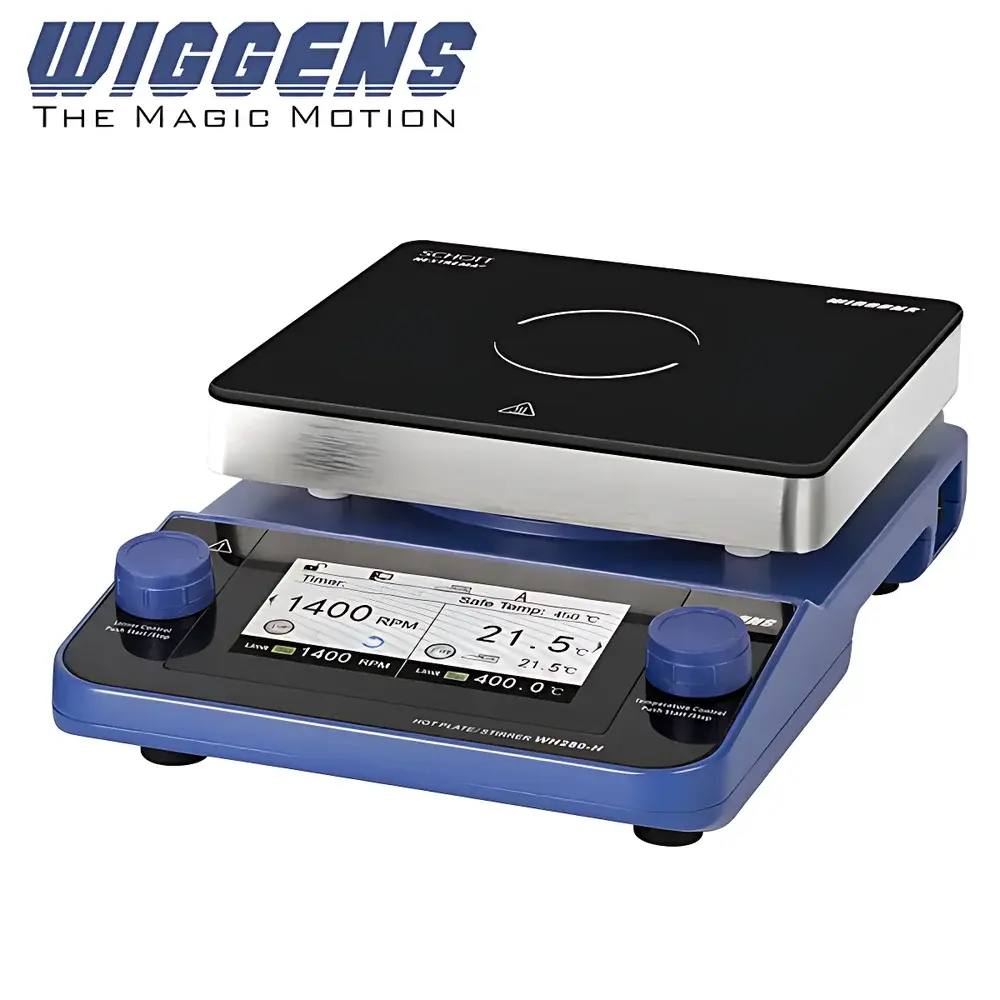
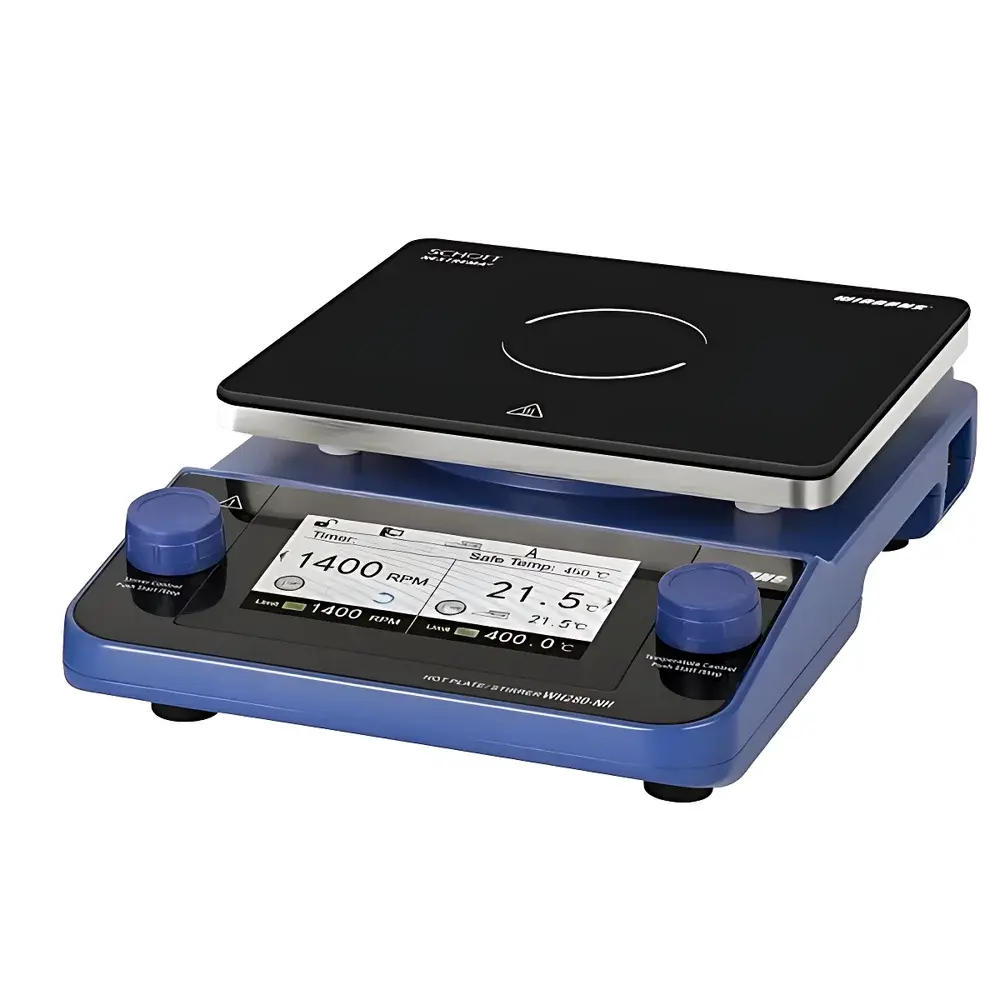
WIGGENS WH280-NH Infrared-Enhanced Heating Magnetic Stirrer
| Brand | WIGGENS |
|---|---|
| Origin | Germany |
| Model | WH280-NH |
| Instrument Type | Magnetic Stirrer |
| Maximum Stirring Volume | 20 L |
| Speed Range | 100–1500 rpm |
| Temperature Control Range | 0–300 °C |
| Heating Power | 1000 W |
| Plate Temperature Max | ≤450 °C |
| Sample Temp Accuracy (with Pt100) | ±1 °C |
| Over-Temperature Protection ΔT | 10–50 °C adjustable |
| Safety Cut-off Temp Range | 50–500 °C adjustable |
| Interface | RS-232 & RS-485 |
| Plate Material | Nano-metal-coated enamel glass |
| Plate Dimensions | 180 × 180 mm |
| Dimensions (W × D × H) | 187 × 315 × 74 mm |
| Weight | 2.7 kg |
| Power Supply | 220 V / 50 Hz |
Overview
The WIGGENS WH280-NH Infrared-Enhanced Heating Magnetic Stirrer is an engineered solution for laboratories requiring simultaneous high-precision temperature control and robust mechanical mixing under demanding thermal conditions. Unlike conventional resistive-heating stirrers, the WH280-NH integrates a focused infrared heating module that delivers rapid, uniform thermal energy transfer directly to the vessel base—minimizing thermal lag and improving heat-up efficiency by up to 35% compared to standard ceramic or aluminum plates. This architecture supports stable operation across the full 0–300 °C sample temperature range (when used with external Pt100 feedback), with plate surface temperatures reaching up to 450 °C for accelerated solvent evaporation or high-boiling-point reaction setups. Designed for reproducible process execution in QC, synthesis, and materials development workflows, the unit employs closed-loop ICC (Intelligent Current Control) regulation for both stirring torque and thermal output—ensuring consistent rotational dynamics even as viscosity or load changes during extended runs.
Key Features
- Infrared-enhanced heating system optimized for fast thermal response and reduced ambient heat dissipation
- High-resolution color touchscreen interface with intuitive rotary encoder for simultaneous adjustment of speed, temperature, timer, and safety thresholds
- Dual-sensor support: Integrated Pt100 input for precise sample temperature feedback + dedicated thermocouple port for independent safety monitoring
- Automatic parameter recall: Last-used settings are retained after power cycling to maintain experimental continuity
- Corrosion-resistant liquid guidance channel above control panel prevents ingress damage from accidental spills
- Hermetically sealed housing with isolated internal electronics, rated for continuous operation in ISO Class 5–7 laboratory environments
- Configurable overtemperature protection: Independent ΔT offset (10–50 °C) and absolute safety cutoff (50–500 °C) ensure multi-layer thermal safeguarding
- RS-232 and RS-485 serial interfaces enable integration into centralized lab automation systems and LIMS-compatible data logging protocols
Sample Compatibility & Compliance
The WH280-NH accommodates standard round-bottom flasks, beakers, and jacketed vessels up to 20 L volume (water-equivalent), supporting both low-viscosity aqueous solutions and moderately viscous organic media (e.g., polymer melts, glycerol-based suspensions). Its nano-metal-coated enamel glass plate provides exceptional chemical resistance to acids, bases, and halogenated solvents—validated per DIN EN 61000-6-3 (EMC immunity) and IEC 61010-1:2010 (safety for electrical equipment in laboratory use). The dual-sensor architecture satisfies critical requirements for GLP-compliant thermal validation studies, while the configurable audit trail (via external software) supports FDA 21 CFR Part 11 readiness when paired with compliant data acquisition systems. Device firmware complies with RoHS 2 and REACH directives; CE marking confirms conformity with EU Machinery Directive 2006/42/EC and Low Voltage Directive 2014/35/EU.
Software & Data Management
Although the WH280-NH operates autonomously via its embedded controller, its RS-232/RS-485 ports allow bidirectional communication using ASCII-based command protocols. Third-party software—including LabVIEW drivers, Python PySerial libraries, and WIGGENS’ optional WinStir Suite—can initiate remote parameter setting, real-time telemetry streaming (speed, plate temp, sample temp, elapsed time), and event-triggered logging (e.g., alarm activation, timer completion). All temperature and speed values are timestamped with millisecond resolution, and the device maintains a non-volatile internal log of the last 100 operational events (start/stop cycles, safety interventions, setpoint changes). When integrated into networked lab infrastructure, the unit supports Modbus RTU protocol for interoperability with SCADA platforms and enterprise-level instrument management systems.
Applications
- Controlled-temperature synthesis of metal-organic frameworks (MOFs) and coordination polymers requiring prolonged reflux at 180–280 °C
- Accelerated stability testing of pharmaceutical formulations under ICH Q1A-recommended stress conditions (40 °C/75% RH simulated via heated humidity chambers)
- Preparation of homogeneous nanoparticle dispersions in high-boiling solvents (e.g., o-dichlorobenzene, DMF) where rapid heat transfer minimizes agglomeration
- Calibration of reference thermometers and thermal sensors using NIST-traceable Pt100 probes in standardized oil baths
- Reaction monitoring in DOE (Design of Experiments) workflows where identical thermal–mechanical profiles must be replicated across multiple parallel reactors
- Teaching labs performing Arrhenius kinetic studies requiring precise, repeatable temperature ramps and steady-state holds
FAQ
What is the difference between the WH280-NH and WH260-NH models?
The WH280-NH features an upgraded infrared heating module with higher power density (1000 W vs. 800 W), improved thermal uniformity across the 180 × 180 mm plate, and ICC-based speed–temperature coupling logic—not available in the WH260 series.
Can the WH280-NH be used with non-magnetic vessels?
No. Like all magnetic stirrers, it requires ferromagnetic or magnetically responsive stir bars and conductive vessel bottoms. Glass, quartz, or PTFE-coated vessels must contain compatible stir elements.
Is the Pt100 sensor included with the unit?
No. The WH280-NH provides a calibrated Pt100 input port but does not include the probe; users must specify compatible Class A or AA grade Pt100 sensors (DIN EN 60751) separately.
Does the device support programmable ramp-and-soak temperature profiles?
Not natively—the front panel allows only single-setpoint control. Complex profiles require external software control via RS-232/RS-485 with custom scripting or third-party scheduling tools.
What maintenance is required for long-term reliability?
Annual verification of Pt100 input accuracy using a certified dry-block calibrator is recommended; no routine lubrication or calibration of internal components is needed due to solid-state design and sealed motor assembly.
Related Products



