
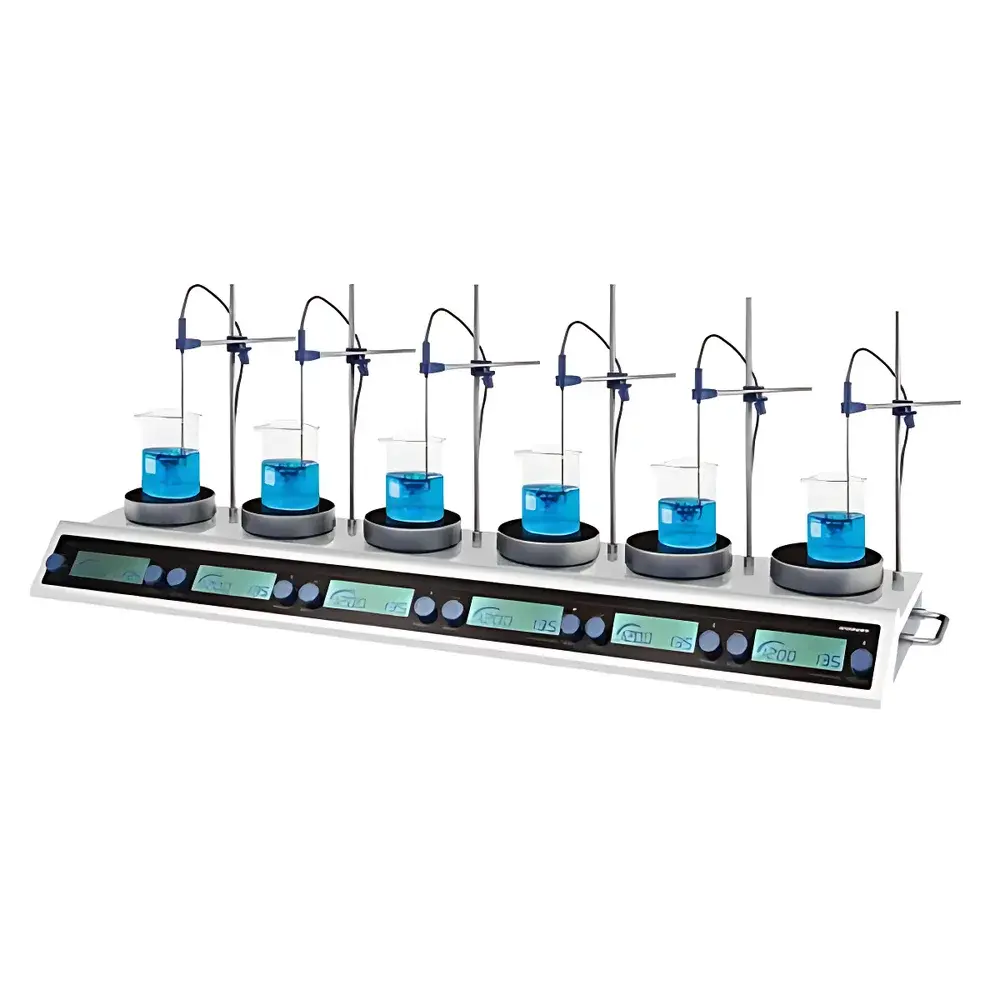
WIGGENS WH620R-L Multi-Position Heated Magnetic Stirrer
| Brand | WIGGENS |
|---|---|
| Origin | Germany |
| Model | WH620R-L |
| Heating Plate Set Temperature | ≤450 °C |
| Sample Temperature Control Range (with Pt100) | ≤300 °C |
| Safety Overtemperature Limit | Adjustable 50–500 °C |
| ΔT Overtemperature Protection Offset | Adjustable 10–50 °C |
| Temperature Stability (with Pt100) | ±1 °C |
| Heating Power per Position | 500 W |
| Total Heating Power | 3000 W |
| Stirring Speed Range | 100–1500 rpm |
| Max. Stirring Volume (H₂O) | ≤20 L |
| Timer Range | 1–999 min or Continuous |
| Display & Control | Individual LCD per position + Rotary Knob |
| External Temperature Sensor | Pt100 compatible |
| Panel Material | Enamel-coated glass |
| Plate Diameter | Ø135 mm |
| Center-to-Center Spacing Between Positions | 187 mm |
| Dimensions (W×D×H, w/o sensor holder) | 1180×309×113 mm |
| Weight | 23.5 kg |
| Power Supply | 220 V / 50 Hz |
| Communication Interface | USB-A |
Overview
The WIGGENS WH620R-L is a precision-engineered multi-position heated magnetic stirrer designed for high-throughput laboratory environments where independent thermal and mechanical control across multiple samples is essential. Unlike conventional single-station units, the WH620R-L integrates six individually addressable heating/stirring positions on a single compact platform—each operating with full autonomy in temperature setpoint, stirring speed, timing, and safety monitoring. Its core functionality relies on contactless magnetic coupling for agitation and infrared-assisted resistive heating for rapid, uniform thermal response. The system employs a robust enamel-glass ceramic top plate engineered to withstand thermal shock up to 700 °C and resist aggressive chemical exposure—including organic solvents, strong acids, and alkalis—ensuring long-term integrity in demanding QC, synthesis, and method development workflows.
Key Features
- Six independent heating/stirring stations, each with dedicated LCD display, rotary encoder control, and real-time parameter feedback
- Enamel-glass ceramic heating surface with exceptional chemical resistance and thermal shock tolerance (>700 °C)
- Infrared-enhanced heating architecture enabling fast ramp rates and stable plateau control (±1 °C with Pt100 feedback)
- Three user-selectable PID tuning profiles optimized for distinct thermal mass scenarios: PID1 (low-thermal-mass/small-volume), PID2 (standard), PID3 (high-thermal-mass/rapid ramp)
- Configurable overtemperature protection: safety cutoff threshold adjustable from 50–500 °C; differential overtemp offset (ΔT) independently tunable from 10–50 °C per station
- Integrated Pt100 sensor compatibility for closed-loop sample temperature monitoring and regulation
- IP54-rated control panel housing with corrosion- and splash-resistant materials for reliable operation in wet or reagent-intensive settings
- USB-A interface supporting firmware updates and optional data logging via external host software
Sample Compatibility & Compliance
The WH620R-L accommodates standard laboratory glassware including beakers (up to 2 L per position), round-bottom flasks, and reaction vessels—enabling simultaneous processing of up to six 20 L aqueous equivalents under controlled conditions. Its design complies with IEC 61010-1:2010 for electrical safety in laboratory equipment and meets CE marking requirements for EMC and low-voltage directives. While not intrinsically rated for hazardous area use, its sealed electronics and non-sparking magnetic drive make it suitable for general-purpose organic synthesis, buffer preparation, dissolution testing, and stability studies under ISO/IEC 17025-accredited quality systems. The adjustable safety limits and audit-ready parameter logging support alignment with GLP and GMP documentation practices, particularly when used in conjunction with validated Pt100 probes and timestamped USB data export.
Software & Data Management
Though primarily operated via intuitive front-panel controls, the WH620R-L supports basic digital integration through its USB-A port. Firmware updates are performed using vendor-provided utilities compliant with Windows and macOS platforms. When connected to a host PC, the device can transmit operational logs—including start/stop timestamps, setpoints, actual temperatures, RPM values, and alarm events—for traceability in regulated environments. These logs are structured in CSV format and may be imported into LIMS or ELN platforms. No proprietary cloud service or subscription is required; all data remains under user control. The system does not implement FDA 21 CFR Part 11 electronic signature functionality natively but provides sufficient metadata (user ID placeholder, time stamps, parameter change history) to serve as foundational input for internally developed audit-trail modules.
Applications
- Parallel optimization of reaction conditions in synthetic chemistry (e.g., catalyst screening, solvent effect studies)
- High-volume buffer and media preparation in bioprocessing and cell culture labs
- Dissolution testing per USP and Ph. Eur. 2.9.3 protocols, especially when paired with calibrated Pt100 sensors
- Accelerated stability studies requiring precise, reproducible thermal profiles across replicate samples
- Method validation experiments requiring identical treatment of multiple reference standards or controls
- QC release testing for pharmaceutical excipients, polymers, and colloidal suspensions where viscosity-temperature relationships must be assessed
FAQ
Can the WH620R-L be used with non-magnetic vessels such as aluminum or stainless steel containers?
No. Magnetic stirring requires ferromagnetic or paramagnetic coupling between the stir bar and drive magnet. Non-magnetic metals and most plastics do not permit effective torque transfer. Glass, ceramic, and PTFE-coated vessels are recommended.
Is the 500 °C maximum temperature rating applicable to both the heating plate and the sample?
The 500 °C limit applies only to the adjustable safety cutoff for the plate surface. The maximum recommended sample temperature—when using a Pt100 probe—is 300 °C. Exceeding this may compromise sensor accuracy and vessel integrity.
Does the unit support external temperature feedback for all six positions simultaneously?
Yes. Each position has an independent Pt100 input channel, allowing true closed-loop temperature regulation at the sample level—not just at the plate surface.
What is the purpose of the three PID profiles, and how are they selected?
PID1 prioritizes stability for low-thermal-mass systems (e.g., small vials); PID3 emphasizes rapid heating for large-volume reactors; PID2 offers balanced performance. Selection is made via the menu-driven interface on each station’s LCD.
Is calibration certificate included with shipment?
A factory calibration report is provided with each unit. NIST-traceable calibration of Pt100 inputs and temperature sensors requires third-party service and is not included by default.



