
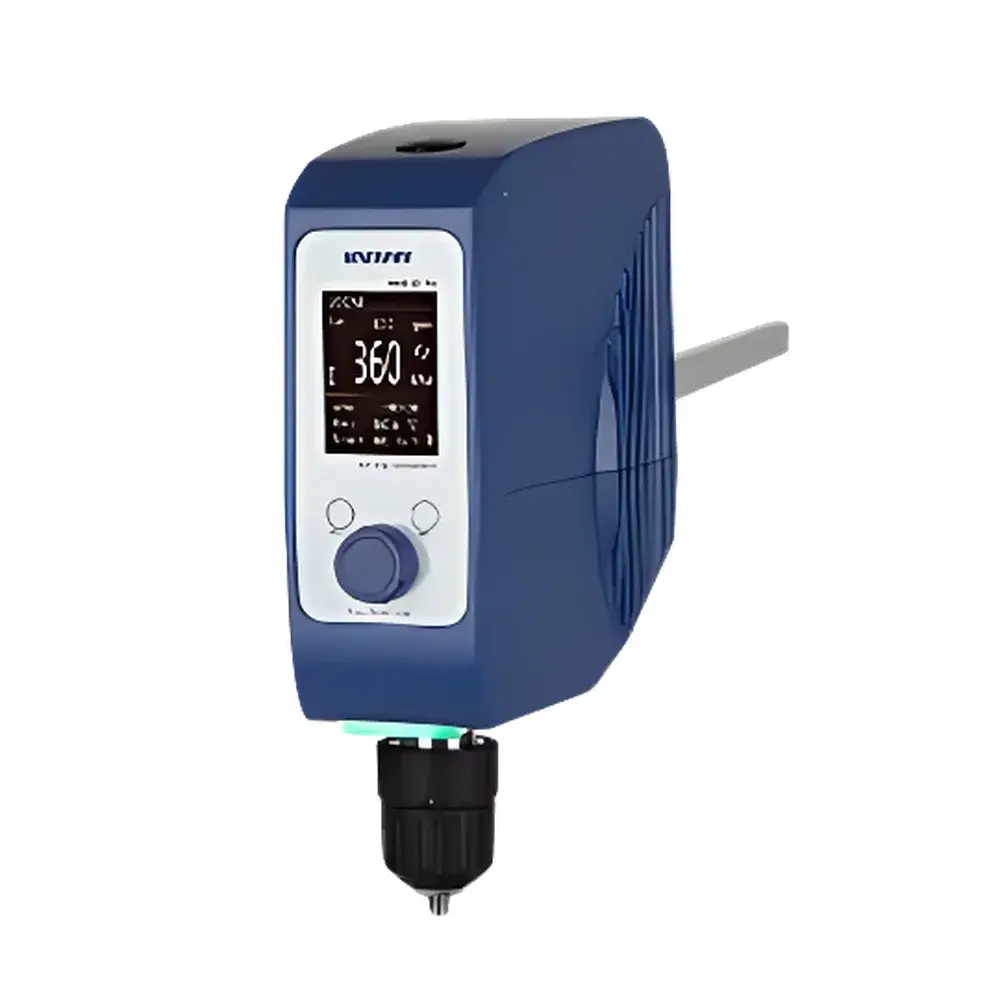
WIGGENS WOHS-20H Pro High-Torque High-Speed Laboratory Stirrer
| Brand | WIGGENS |
|---|---|
| Origin | Germany |
| Model | WOHS-20H Pro |
| Stirrer Type | Electronic Overhead Stirrer |
| Max. Mixing Volume | 100 L |
| Speed Range | 60–6000 rpm (Dual-Range: I: 60–1200 rpm, II: 1201–6000 rpm) |
| Torque Output | 170 N·cm (Low-Speed Range), 34 N·cm (High-Speed Range) |
| Torque Display | Current-to-Torque Conversion |
| Viscosity Handling | ≥70,000 cP |
| Speed Accuracy | ±3% (n > 300 rpm) |
| Step Resolution | 1 rpm |
| Temperature Measurement Range | −10 to 350 °C |
| Temp. Resolution | 0.1 °C |
| Power Input | 100–240 VAC, 50/60 Hz |
| Motor Type | Brushless DC Motor |
| Chuck Type | Self-Locking Quick-Release |
| Shaft Clamp Diameter | 0.5–10 mm |
| Hollow Shaft Inner Diameter | 10.2 mm |
| Time Setting Range | 0–99 h 59 min |
| Status Indicators | Standby (Blue), Running (Green), Alarm (Red) |
| Rated Power | 150 W |
Overview
The WIGGENS WOHS-20H Pro High-Torque High-Speed Laboratory Stirrer is an engineered solution for demanding mixing and dispersion tasks in research and quality control laboratories. Designed around a robust brushless DC motor architecture, it delivers exceptional torque density and thermal stability during prolonged operation—critical for handling high-viscosity media (≥70,000 cP) and large-volume batches up to 100 L. Its dual-range speed control system enables precise adaptation to process requirements: low-speed mode (60–1200 rpm) prioritizes torque delivery (up to 170 N·cm), while high-speed mode (1201–6000 rpm) supports rapid homogenization of low-to-medium viscosity systems. The instrument operates on the principle of mechanical shear transfer via rotating impellers, with torque output dynamically monitored through real-time current-to-torque conversion—a feature that provides insight into load variation and process consistency without external sensors.
Key Features
- Dual-range speed control with independent torque optimization: 170 N·cm at ≤1200 rpm; 34 N·cm at 1201–6000 rpm
- Brushless DC motor ensures maintenance-free operation, extended service life, and stable rotational performance under continuous high-load conditions
- TFT display with intuitive touch-key + rotary encoder interface for precise parameter entry (speed, time, temperature)
- Self-locking quick-release chuck accepts stirring shafts from 0.5 to 10 mm diameter; hollow shaft design (10.2 mm inner diameter) accommodates temperature probes or auxiliary sensors
- Real-time torque visualization derived from motor current draw—enabling trend-based assessment of viscosity changes or agglomeration onset
- Comprehensive status feedback via tri-color LED indicators (blue = standby, green = active, red = fault/alarm)
- Programmable timer with resolution up to 1 minute across a 0–99 h 59 min range, supporting unattended batch processing
Sample Compatibility & Compliance
The WOHS-20H Pro is validated for use with Newtonian and non-Newtonian fluids across pharmaceutical formulation development, polymer synthesis, emulsion stabilization, and bioprocess scale-down studies. Its mechanical design complies with IEC 61010-1:2010 safety standards for laboratory electrical equipment. While not intrinsically rated for hazardous environments, its sealed motor housing and reinforced gear train meet IP20 ingress protection requirements. The device supports GLP-compliant workflows when integrated with validated SOPs—its digital logging capability (via optional RS-232/USB interface) permits traceable record retention aligned with FDA 21 CFR Part 11 principles where electronic signatures and audit trails are implemented externally.
Software & Data Management
Although the WOHS-20H Pro operates as a standalone unit, its embedded firmware supports ASCII-based serial communication protocols (RS-232 or USB virtual COM port). This allows integration with third-party laboratory information management systems (LIMS) or custom Python/Matlab scripts for automated data capture—including real-time speed, torque trend, elapsed time, and temperature readings (when paired with compatible PT100 or thermocouple probes). All parameter settings are retained after power cycling. No proprietary software is required; configuration and monitoring can be performed using standard terminal emulators or SCADA-compatible drivers.
Applications
- Chemical synthesis: Catalyst suspension, exothermic reaction mixing, viscous intermediate blending
- Pharmaceutical manufacturing: API suspension in oral suspensions, granulation fluid distribution, ointment base homogenization
- Food & cosmetics: Emulsifier incorporation into high-fat matrices, thickener hydration in sauces and creams
- Materials science: Nanoparticle dispersion in polymer melts, graphite slurry deagglomeration, battery electrode slurry preparation
- Biotechnology: Cell culture media component dissolution, agarose gel precursor mixing prior to casting
FAQ
What is the maximum recommended viscosity for continuous operation?
The WOHS-20H Pro is rated for viscosities ≥70,000 cP under controlled ambient conditions (20–25 °C); sustained operation above 100,000 cP requires intermittent duty cycles and active cooling of the motor housing.
Can the stirrer be used with temperature-controlled reactors?
Yes—the hollow shaft (10.2 mm ID) allows insertion of calibrated Pt100 probes or K-type thermocouples; temperature measurement range (−10 to 350 °C) supports compatibility with jacketed vessels and heating mantles.
Is the torque reading calibrated or relative?
Torque values are derived from motor current draw and scaled to N·cm using factory-characterized motor constants; absolute calibration requires periodic verification against a traceable torque standard per ISO 6789-2.
Does the device support analog or digital I/O for PLC integration?
No native analog I/O is provided; however, digital control and readback are achievable via RS-232/USB using Modbus RTU or custom ASCII command sets documented in the technical manual.
What maintenance is required for long-term reliability?
None beyond periodic visual inspection of chuck integrity and cleaning of ventilation grilles; the brushless motor contains no consumable parts and exhibits <0.5% speed drift over 10,000 hours of cumulative runtime.



