
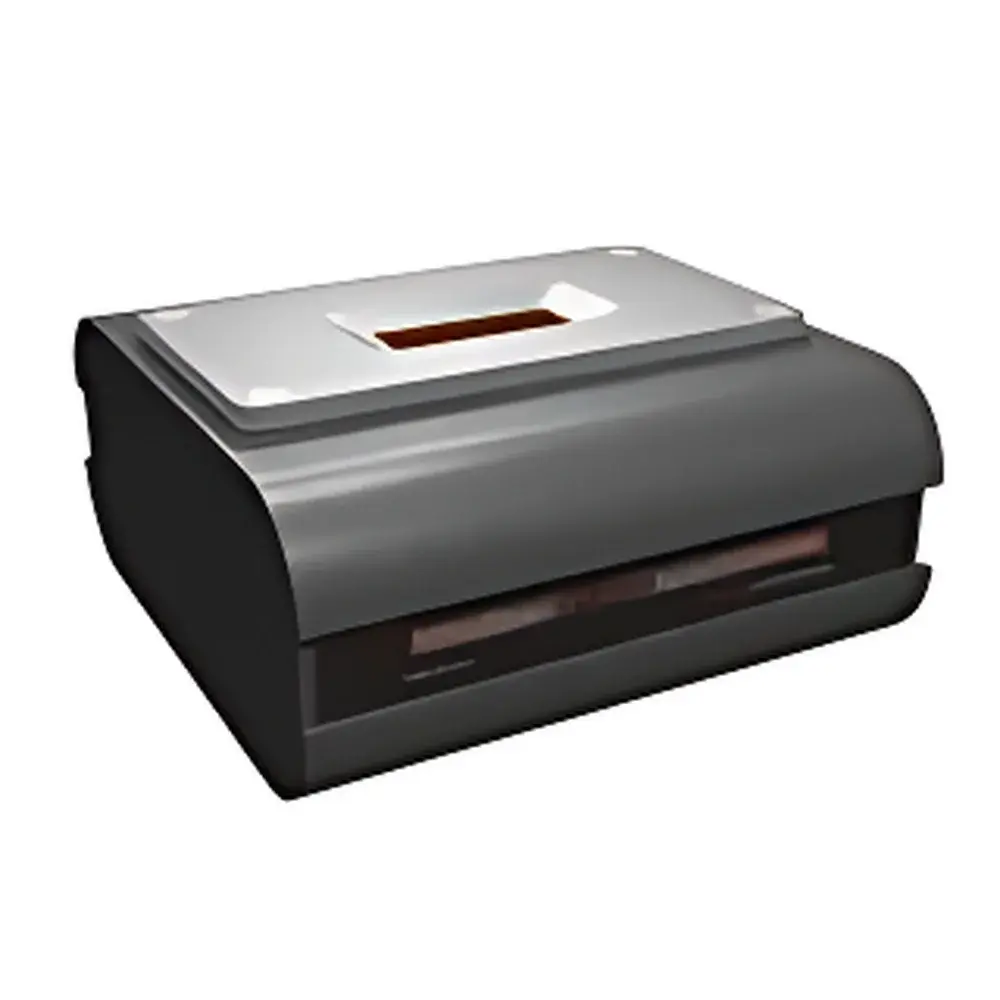
Wilks InfraSpec VFA-IR Variable Filter Array Infrared Spectrometer
| Brand | Wilks |
|---|---|
| Origin | USA |
| Manufacturer Type | Authorized Distributor |
| Import Status | Imported |
| Model | InfraSpec VFA-IR |
| Price | Upon Request |
| Power Supply | 12 V DC, 2.0 A |
| Weight | 1.5 kg |
| Dimensions | 152 × 165 × 70 mm³ |
| Operating Temperature Range | 5–40 °C |
| Relative Humidity Range | 0–98 % RH |
| Detector Array | 128-pixel linear pyroelectric array |
| Array Responsivity | 5.4–105 V/W |
| Spectral Range | 5.4–10.8 µm |
| Spectral Resolution | 25 cm⁻¹ |
| Ethanol Measurement Range (in gasoline) | 0–98 % v/v |
| Biodiesel Measurement Range (in diesel) | 0–100 % v/v |
| Analysis Time | < 60 s |
| Repeatability | ±0.2 % (0–20 % concentration), ±1 % of concentration (20–100 %) |
| Communication Interfaces | RS-232 and USB |
| ATR Crystal Material | Zinc Selenide (ZnSe) |
| ATR Surface Area | 50 mm × 16 mm |
| Part Numbers | 405-2017-1013 (Model E), 405-2026-1013 (Model ES), 405-2017-1020 (Model EB) |
Overview
The Wilks InfraSpec VFA-IR Variable Filter Array Infrared Spectrometer is a purpose-built mid-infrared (MIR) analytical instrument engineered for rapid, field-deployable, and laboratory-grade quantitative analysis of organic liquids and semi-solid matrices. Unlike dispersive or Fourier-transform infrared (FTIR) systems, the InfraSpec leverages patented variable filter array (VFA) technology — a solid-state optical architecture that replaces moving interferometers or grating mechanisms with a fixed, multi-bandpass filter array coupled to a linear pyroelectric detector. This design eliminates mechanical wear, ensures long-term optical stability, and enables robust operation in non-laboratory environments including production floors, fuel depots, and mobile testing units. The instrument operates across a calibrated spectral window of 5.4–10.8 µm (1850–925 cm⁻¹), a region rich in fundamental C–H, C=O, C–O, and O–H vibrational absorptions essential for hydrocarbon, ester, alcohol, and water quantification. Its compact footprint (152 × 165 × 70 mm³), low power requirement (12 V DC), and sealed optical path make it suitable for continuous-duty applications under ambient conditions ranging from 5 to 40 °C and up to 98 % relative humidity.
Key Features
- Solid-state VFA optical engine with no moving parts — delivers high instrument uptime and minimal maintenance requirements
- Integrated ZnSe attenuated total reflectance (ATR) sampling interface with 50 mm × 16 mm crystal surface — optimized for direct liquid and viscous sample contact without solvent dilution or KBr pellet preparation
- 128-pixel linear pyroelectric detector array providing spatially resolved spectral acquisition and enhanced signal-to-noise ratio
- Sub-60-second analysis cycle time — enabling high-throughput screening of biofuel blends, edible oils, and industrial solvents
- Factory-calibrated chemometric models pre-loaded for ethanol-in-gasoline (0–98 % v/v) and biodiesel-in-diesel (0–100 % v/v) quantification, traceable to NIST-traceable reference standards
- RS-232 and USB communication interfaces supporting both real-time data streaming and batch file export for integration into LIMS or SCADA environments
- Ruggedized aluminum housing rated for industrial handling and transport; optional stainless steel sample plate cover (Model ES) for enhanced chemical resistance in fuel-handling environments
Sample Compatibility & Compliance
The InfraSpec VFA-IR accommodates a broad range of physical sample forms including clear and turbid liquids, emulsions, slurries, thin films, and semi-solid pastes. Its ZnSe ATR interface supports direct measurement of neat samples with minimal volume (≤1 mL), eliminating the need for hazardous solvents or complex sample preparation. For low-concentration biodiesel detection (<1 % v/v in diesel), the Model EB variant employs a 2 mm pathlength flow-through transmission cell, enabling precise quantification per ASTM D7371 and EN 14078 methodologies. All factory-installed calibration models comply with ISO/IEC 17025:2017 requirements for analytical method validation, including linearity, accuracy, precision, limit of detection (LOD), and robustness assessments. Instrument firmware and software support audit trail functionality aligned with FDA 21 CFR Part 11 for electronic records and signatures where required under GLP or GMP frameworks.
Software & Data Management
The InfraSpec operates with Igor Pro-based acquisition and analysis software (included), offering both guided workflow modes for routine operators and advanced scripting capabilities for method development. Raw spectral data are stored in HDF5 format, preserving metadata such as date/time stamp, operator ID, instrument serial number, and environmental sensor readings (temperature, humidity). Calibration models are encrypted and digitally signed to prevent unauthorized modification. Users may generate PDF reports compliant with internal QA protocols or external regulatory submissions, including full spectral overlays, residual error plots, and statistical summaries of replicate measurements. Software updates are delivered via secure HTTPS download with version-controlled release notes and change logs archived for compliance review.
Applications
- Real-time quality control of biodiesel (FAME) blends in petroleum distribution networks per ASTM D6751 and EN 14214
- Quantitative determination of ethanol content in gasoline (E10–E85) per ASTM D7889 and EPA Method 311
- Authentication and adulteration screening of edible oils (e.g., olive, sunflower, palm) based on fatty acid methyl ester (FAME) profiles
- Process monitoring of transesterification reactions during biofuel synthesis
- Measurement of D₂O/H₂O isotopic ratios in pharmaceutical excipients and nuclear-grade coolants
- In-line verification of polymer film composition and thickness uniformity in packaging manufacturing
FAQ
What is the difference between Model E, ES, and EB?
Model E is the base configuration with an open ATR trough plate; Model ES adds a stainless steel hinged cover for spill containment and corrosion resistance in fuel labs; Model EB replaces the ATR interface with a 2 mm pathlength flow-through transmission cell optimized for sub-1 % biodiesel detection.
Is the instrument compatible with third-party chemometric software?
Yes — spectral data exports in standard formats (CSV, HDF5) enable import into Unscrambler, Pirouette, or MATLAB for custom model development and cross-platform validation.
Does the InfraSpec require annual recalibration?
No routine recalibration is required; however, users should perform daily performance qualification using certified reference standards per internal SOPs. Factory recalibration is recommended every 24 months or after major component replacement.
Can the ZnSe ATR crystal be cleaned with common solvents?
Yes — ZnSe is chemically resistant to alcohols, hydrocarbons, and mild acids; avoid prolonged exposure to strong alkalis or halogenated solvents such as chloroform or carbon tetrachloride.
What sample volume is needed for ATR analysis?
Typically 0.5–1.0 mL is sufficient to fully wet the 50 mm × 16 mm crystal surface; for highly volatile or low-surface-tension samples, use the optional Luer-Lok syringe (10 mL glass) to ensure controlled delivery and minimize evaporation artifacts.





