
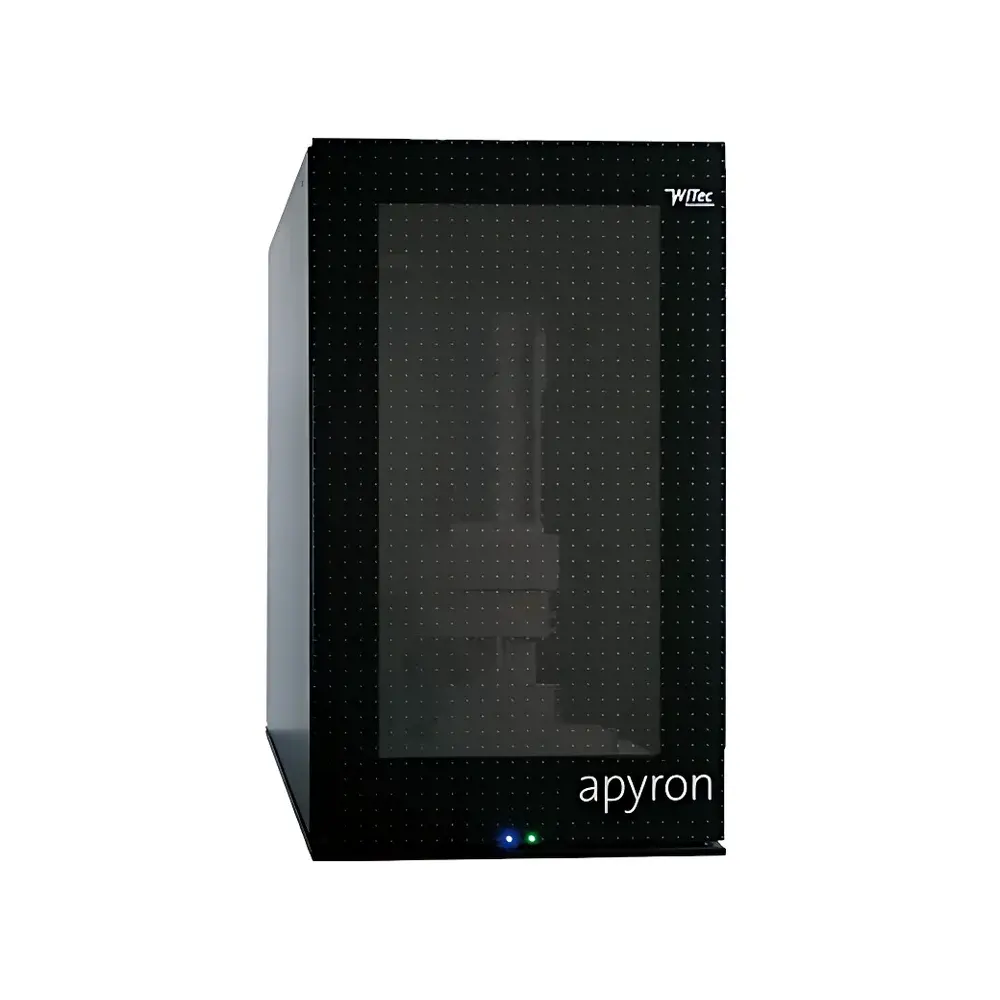
WITec Apyron Automated Confocal Raman Microscope
| Brand | WITec |
|---|---|
| Country of Origin | Germany |
| Model | Apyron |
| Instrument Type | Confocal Raman Microscope |
| Spectral Range | 90–9000 cm⁻¹ |
| Spectral Resolution | ≤0.2 cm⁻¹ |
| Spatial Resolution | Lateral 350 nm, Axial 800 nm |
| Low-Wavenumber Cutoff | 10 cm⁻¹ |
| Spectral Reproducibility | ≤±0.02 cm⁻¹ |
Overview
The WITec Apyron Automated Confocal Raman Microscope is a high-precision, fully integrated confocal Raman imaging platform engineered for quantitative chemical mapping at diffraction-limited spatial resolution and sub-wavenumber spectral fidelity. Based on confocal laser scanning microscopy coupled with ultra-high-throughput spectroscopy (UHTS), the Apyron system implements a true confocal optical architecture with motorized z-stacking, piezo-driven sample positioning, and real-time spectral acquisition across millions of pixels. Its core measurement principle relies on inelastic scattering of monochromatic laser light—where photon energy shifts correspond to vibrational modes of molecular bonds—enabling label-free, non-destructive identification and spatial distribution analysis of chemical species within heterogeneous solid, liquid, or biological samples. Designed for compliance with ISO/IEC 17025 requirements for analytical laboratory competence, the Apyron supports traceable calibration protocols, instrument qualification (IQ/OQ/PQ) documentation, and audit-ready data integrity workflows.
Key Features
- TruePower Laser Power Control: Real-time absolute laser power measurement (mW) directly in the delivery fiber, adjustable with <0.1 mW precision; integrated shutter ensures laser exposure only during spectral acquisition to prevent photodegradation.
- Automated Wavelength Switching: One-click selection of excitation lasers (e.g., 488, 532, 633, 785 nm); software-triggered reconfiguration of edge filters, gratings, and UHTS spectrometer alignment for optimal throughput and stray-light rejection.
- UHTS Spectrometer Family Integration: Modular UHTS-300 (speed-optimized), UHTS-400 (red/NIR-optimized), and UHTS-600 (resolution-optimized, up to 0.1 cm⁻¹ @ 633 nm) configurations—each calibrated per laser line and focal length.
- TrueSignal Fiber Coupling Optimization: Active feedback control of input/output fiber alignment to maximize coupling efficiency and signal-to-noise ratio under variable illumination conditions.
- TrueCal On-Demand Calibration: Predefined, user-initiated recalibration routines for microscope optics, stage coordinates, laser focus, and spectrometer wavelength axis—fully traceable and timestamped.
- Laser Safety Class 1 Operation: Fully enclosed beam path with interlocked access points; no operator training in laser safety required per IEC 60825-1.
Sample Compatibility & Compliance
The Apyron accommodates standard microscope slides, wafer substrates (up to 200 mm), thin-film stacks, polymer composites, pharmaceutical tablets, and hydrated biological tissues—including live-cell imaging under environmental control (optional temperature/humidity chamber). Sample mounting requires no conductive coating or vacuum. The system complies with ISO 17830 (Raman spectroscopy—general requirements), ASTM E1840 (standard guide for Raman microspectroscopy), and supports GLP/GMP-aligned workflows through optional 21 CFR Part 11-compliant software modules (electronic signatures, audit trails, role-based access control). All calibration standards—including NIST-traceable polystyrene and silicon reference wafers—are integrated into the instrument’s validation suite.
Software & Data Management
Controlled by WITec’s proprietary Project Mode software, the Apyron enables scriptable experiment design, real-time spectral preview, and automated batch processing. Each acquired dataset comprises a full hyperspectral cube (x, y, λ) stored in vendor-neutral HDF5 format with embedded metadata (laser power, integration time, objective magnification, grating ID, calibration timestamps). Advanced post-processing includes multivariate curve resolution (MCR), principal component analysis (PCA), cluster analysis, and false-color chemical mapping with pixel-wise spectral fitting against user-defined libraries. Raw data export supports ASCII, CSV, and JCAMP-DX formats for third-party chemometric tools (e.g., MATLAB, Python scikit-learn, Unscrambler). Data provenance is maintained via immutable audit logs covering all parameter changes, calibration events, and user actions.
Applications
- Pharmaceutical Solid-State Analysis: Polymorph identification, API-excipient distribution mapping, coating thickness quantification, and counterfeit drug detection.
- Materials Science: Stress/strain mapping in 2D materials (graphene, TMDCs), carbon nanotube chirality assignment, battery electrode degradation profiling.
- Geosciences: Inclusion fluid characterization, mineral phase discrimination in thin sections, microfossil organic content analysis.
- Life Sciences: Label-free cell typing, lipid droplet dynamics, collagen/elastin ratio quantification in tissue sections, bacterial biofilm spatial metabolism.
- Microelectronics: Contamination identification on semiconductor wafers, stress mapping in SiN/SiO₂ stacks, dopant distribution verification.
FAQ
What excitation wavelengths are supported natively?
The Apyron platform supports 488 nm, 532 nm, 633 nm, and 785 nm lasers as standard configurations; additional wavelengths (e.g., 405 nm, 830 nm) are available upon request with corresponding UHTS spectrometer optimization.
Can the system perform correlative imaging with other modalities?
Yes—via WITec’s TrueMatch interface, the Apyron synchronizes with SEM-EDS, AFM, and fluorescence microscopes using shared coordinate referencing and time-synchronized trigger signals.
Is remote operation and monitoring supported?
Full remote desktop control is enabled over secure LAN/WAN connections; real-time spectral preview and queue management are accessible via browser-based dashboard (optional WITec Cloud Connect module).
How is spectral calibration maintained over time?
TrueCal routines execute wavelength and intensity calibration using internal neon/argon lamps or user-loaded reference standards; calibration validity is automatically verified before each measurement series.
What is the maximum achievable pixel count per Raman map?
Hardware-accelerated acquisition supports up to 4096 × 4096 pixel maps; typical high-resolution datasets range from 1000 × 1000 to 2000 × 2000 pixels, with full spectral coverage (1024–2048 channels) per pixel.
Related Products






