
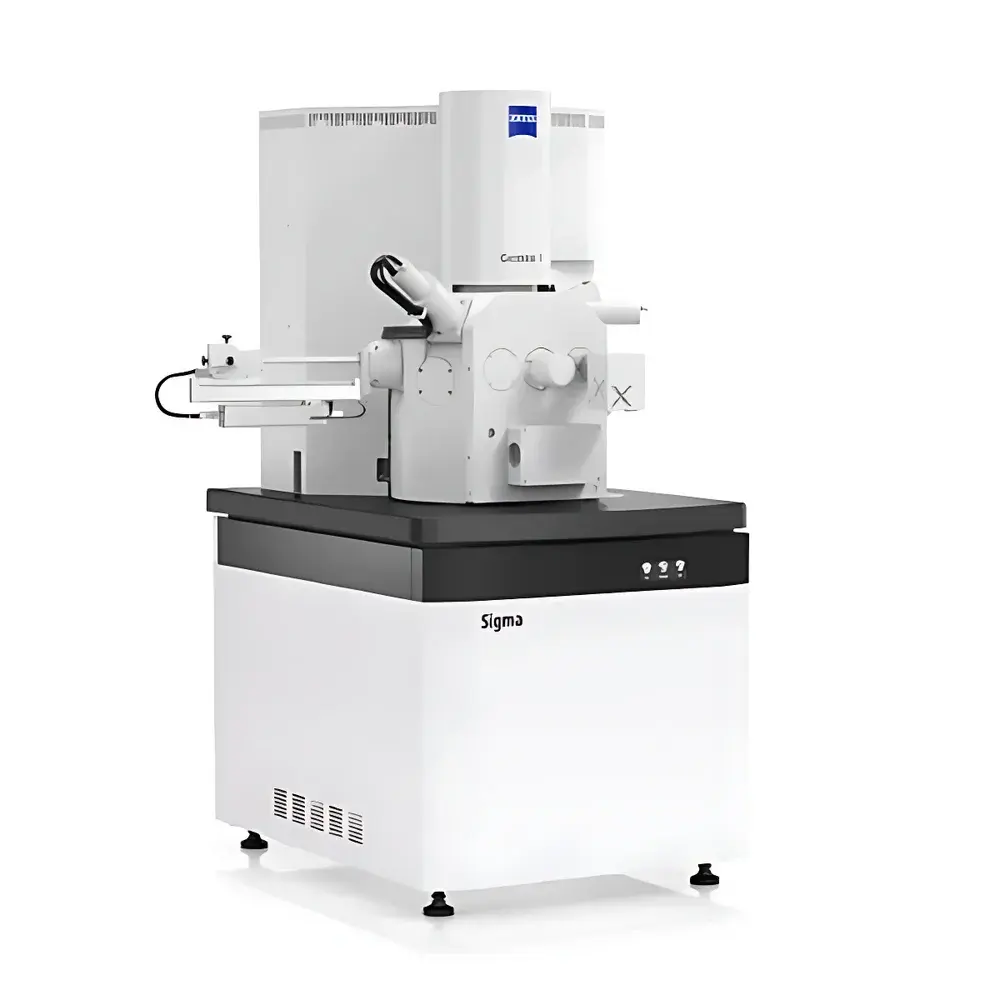
ZEISS Sigma Scanning Electron Microscope
| Brand | ZEISS |
|---|---|
| Origin | Shanghai, China |
| Manufacturer Type | Original Equipment Manufacturer (OEM) |
| Regional Classification | Domestic (China-made) |
| Model | Sigma |
| Pricing | Available Upon Request |
| Instrument Form Factor | Floor-standing / Conventional Large-Format SEM |
Overview
The ZEISS Sigma Scanning Electron Microscope (SEM) is a high-performance, floor-standing electron optical platform engineered for industrial and advanced materials research laboratories requiring nanoscale surface and compositional characterization with operational flexibility and analytical rigor. Built upon ZEISS’s proprietary Gemini electron optical column architecture, the Sigma delivers exceptional resolution, signal fidelity, and beam stability across multiple detection modalities. Its core principle relies on scanning a focused electron beam across a conductive or coated sample surface and detecting emitted electrons—including secondary electrons (SE), backscattered electrons (BSE), transmitted electrons (STEM), and characteristic X-rays—to generate topographic, compositional, crystallographic, and electronic contrast images. The Gemini in-lens detection concept integrates signal collection directly within the objective lens, minimizing path length and maximizing signal-to-noise ratio—enabling sub-nanometer resolution imaging at low kV (≤1 kV) without compromising beam current or depth of field. Designed for 24/7 industrial deployment, the Sigma features a robust mechanical architecture, vibration-damped optical bench, and climate-controlled chamber environment to ensure long-term measurement reproducibility and inter-laboratory comparability.
Key Features
- Gemini II electron optical column with chromatic and spherical aberration-optimized design for stable high-resolution imaging from 0.1 kV to 30 kV
- Multi-detector configuration: In-lens SE detector (high-resolution topography), ETSE (Everhart-Thornley SE), VPSE (Variable Pressure SE), C2D (Cathodoluminescence-compatible BSE), HDBSD (High Dynamic Range BSE), YAG scintillator (for compositional contrast), and STEM-in-SEM detector (for thin-section transmission imaging)
- Integrated variable pressure (VP) mode supporting imaging of non-conductive, hydrated, or beam-sensitive samples without metal coating (up to 130 Pa water vapor or nitrogen)
- Automated stage with 150 mm × 150 mm travel range, ±90° tilt, and 360° rotation—compatible with in situ heating, cooling, and mechanical testing holders
- Dedicated hardware-accelerated image acquisition engine enabling real-time drift correction, auto-focus, and auto-stigmation
- Modular EDS (Energy Dispersive X-ray Spectroscopy) and EBSD (Electron Backscatter Diffraction) integration pathways compliant with ISO 16700 and ASTM E1508 standards
Sample Compatibility & Compliance
The ZEISS Sigma accommodates a broad spectrum of specimen types—from bulk metallic alloys and ceramic composites to delicate biological tissues, polymer blends, battery electrodes, and 2D materials such as graphene and transition metal dichalcogenides. Its VP mode enables direct analysis of insulating materials (e.g., oxides, polymers, geological specimens) without sputter coating, reducing preparation artifacts and preserving native surface chemistry. All vacuum systems comply with ISO 2740 and IEC 61000-6-3 electromagnetic compatibility requirements. The instrument supports GLP/GMP-aligned workflows via optional audit trail logging, user access control, and electronic signature modules compliant with FDA 21 CFR Part 11. Routine calibration protocols follow ISO/IEC 17025–accredited reference standards, including certified microgrid and line-pair resolution test samples traceable to NIST SRM 2059.
Software & Data Management
ZEISS SMART (Scanning Microscopy Advanced Reconstruction Toolkit) provides an integrated, scriptable software environment supporting acquisition, processing, quantification, and reporting. It includes embedded machine learning–based particle segmentation (trained on >10⁶ annotated industrial particles), automated multi-modal correlation between optical microscopy (via ZEISS Axio Imager integration), SEM, and EDS maps, and batch-processing pipelines for cleanliness analysis per VDA 19.2 and ISO 16232. All raw data are stored in vendor-neutral TIFF/OME-TIFF formats with embedded metadata (acquisition parameters, detector settings, stage coordinates). Export modules support ASTM E1351–compliant XML reports and direct import into LIMS platforms via RESTful API. Software updates are delivered through ZEISS Connect—a secure, encrypted over-the-air update framework validated under ISO/IEC 27001 information security management.
Applications
- Failure analysis of structural components in aerospace and automotive sectors—mapping crack initiation sites, inclusion distributions, and intergranular corrosion
- Process control in semiconductor fabrication—critical dimension metrology, defect review, and gate oxide integrity assessment
- Medical device inspection—surface roughness quantification of orthopedic implants, coating adhesion evaluation, and particulate contamination screening per USP
- Nanomaterials R&D—morphological and crystallinity mapping of MOFs, quantum dots, and MXenes using STEM + EBSD correlation
- Battery research—spatially resolved Li distribution via low-kV SE/EDS correlation, cathode cracking kinetics, and SEI layer thickness profiling
- Automated cleanliness analysis—particle counting, classification by morphology/composition, and source attribution across powertrain, hydraulic, and additive manufacturing supply chains
FAQ
What vacuum modes does the ZEISS Sigma support?
It operates in high vacuum (≤1×10⁻⁷ mbar), medium vacuum (10⁻³–10⁻¹ mbar), and variable pressure mode (up to 130 Pa), each optimized for specific detector configurations and sample types.
Is the system compatible with third-party EDS or EBSD detectors?
Yes—standardized flange interfaces (CF100, CF63) and digital trigger synchronization enable seamless integration with major vendors’ spectroscopy and diffraction systems.
Can the Sigma perform automated particle analysis without manual thresholding?
Yes—SMART software includes supervised and unsupervised ML models trained on industry-specific particle libraries, supporting ISO 16232 Class A–F classification without user-defined thresholds.
Does the instrument meet regulatory requirements for pharmaceutical QC labs?
With optional 21 CFR Part 11 compliance package (audit trail, role-based access, electronic signatures), it satisfies FDA and EMA expectations for regulated environments.
What is the typical service life and maintenance interval for the Gemini column?
Under standard industrial use (8 h/day, 5 days/week), the column requires preventive maintenance every 12 months; filament replacement intervals exceed 6,000 hours for CeB₆ sources.




