
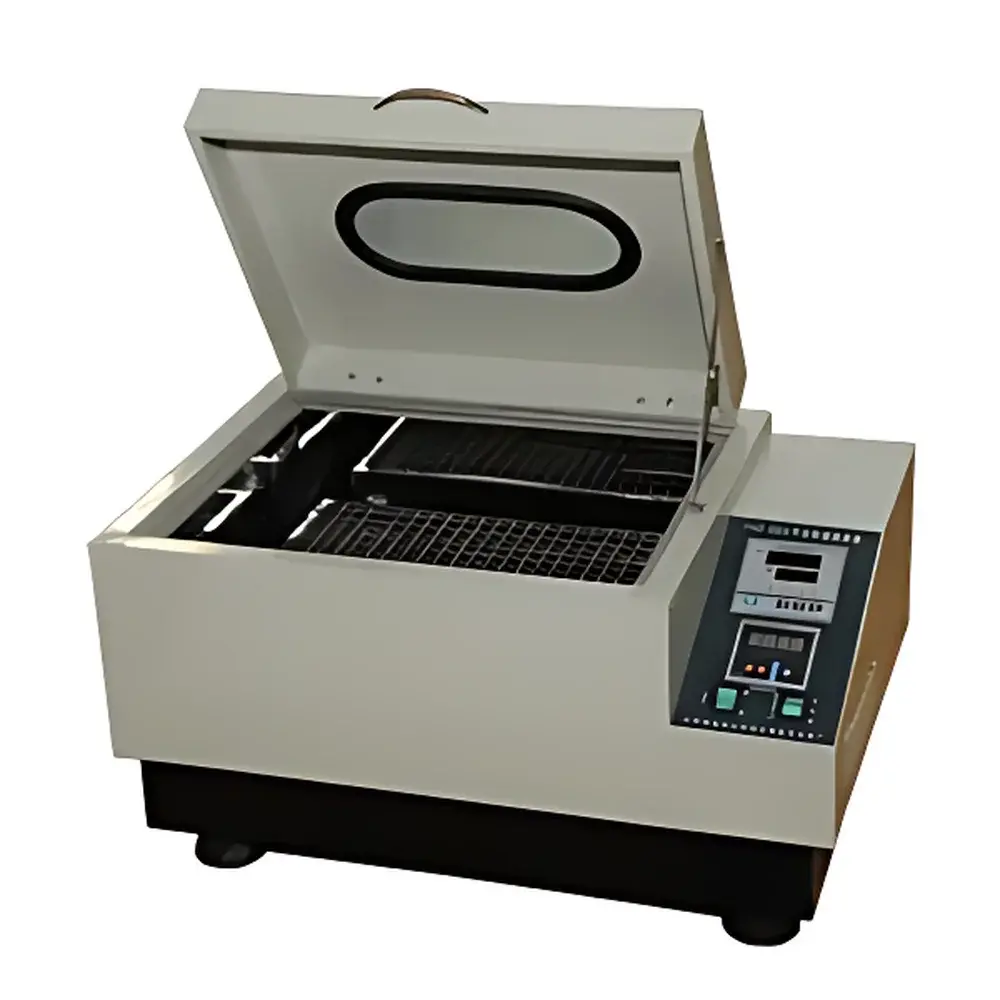
BOXUN THZ-92A/B/C Air-Bath Constant-Temperature Orbital/Reciprocal Shaker
| Brand | BOXUN |
|---|---|
| Origin | Shanghai, China |
| Manufacturer Type | Direct Manufacturer |
| Instrument Type | Air-Bath Constant-Temperature Shaker |
| Model | THZ-92A / THZ-92B / THZ-92C |
| Timer Range | 0–999 h |
| Oscillation Frequency | 0–220 rpm (orbital), 0–300 rpm (reciprocal) |
| Amplitude | 20 mm (orbital), 30 mm (reciprocal) |
| Temperature Range | RT + 5°C to 65°C |
| Platform Quantity | 1 |
| Platform Dimensions | 430 × 340 mm |
| Power Consumption | 400 W |
| Load Capacity | 6 × 500 mL flasks or 2 × 1000 mL flasks |
| Housing Material | Stainless Steel (304) |
| Control System | Microprocessor-Based PID Temperature & Speed Controller with Digital Display (Model C includes programmable timer and speed ramping) |
Overview
The BOXUN THZ-92A/B/C series represents a line of precision-engineered air-bath constant-temperature shakers designed for rigorous life science and bioengineering applications requiring simultaneous control of temperature and mechanical agitation. Unlike water-bath shakers, this air-bath configuration eliminates liquid contamination risks, simplifies maintenance, and enables rapid thermal equilibration across the entire platform. The system operates on orbital or reciprocal motion—configurable by model—to accommodate distinct mixing dynamics: orbital motion (THZ-92A/B) provides gentle, uniform suspension ideal for aerobic microbial culture and cell expansion, while reciprocal motion (THZ-92B/C) delivers higher shear and enhanced oxygen transfer suited for viscous media or dense inocula. Temperature regulation employs a PID-controlled heating element with forced-air circulation, achieving ±0.3°C stability across the full operating range (RT + 5°C to 65°C). The unit’s structural integrity derives from a 304 stainless steel chamber and reinforced aluminum-alloy platform—engineered for long-term dimensional stability under continuous oscillation.
Key Features
- Microprocessor-based dual-loop PID controller for independent, high-resolution regulation of temperature (0.1°C setpoint resolution) and oscillation speed (1 rpm increment)
- Three operational configurations: THZ-92A (orbital only), THZ-92B (dual-mode: selectable orbital or reciprocal), THZ-92C (dual-mode with programmable ramping, multi-step timing, and auto-restart after power interruption)
- Robust spring-loaded universal clamping system compliant with ISO 8573-1 for secure retention of Erlenmeyer flasks (50–1000 mL), test tubes, and custom vessels without slippage or resonance-induced detachment
- Sealed, brushless DC motor delivering consistent torque across the full speed range (0–220 rpm orbital; 0–300 rpm reciprocal) with noise ≤55 dB(A) at 1 m distance
- Integrated over-temperature and motor overload protection circuits meeting IEC 61010-1 safety requirements for laboratory equipment
- Front-accessible calibration ports for traceable temperature and speed verification using external NIST-traceable probes
Sample Compatibility & Compliance
The THZ-92 series accommodates standard microbiological and biochemical vessels including glass and polycarbonate Erlenmeyer flasks (50–1000 mL), serum bottles, and multi-well plates mounted on adapter platforms. Its open-chamber design supports real-time sampling and in-process monitoring without interrupting operation. All models comply with ISO/IEC 17025 requirements for equipment used in accredited testing laboratories. The THZ-92C variant includes audit-trail-enabled firmware supporting 21 CFR Part 11-compliant electronic records when paired with BOXUN’s optional LabLink™ software—enabling user authentication, parameter change logging, and electronic signature workflows required under GLP and GMP environments.
Software & Data Management
While standalone operation requires no software, the THZ-92C integrates seamlessly with BOXUN LabLink™ (v3.2+), a Windows-based application enabling remote parameter configuration, real-time data streaming (temperature, speed, elapsed time), and CSV export of time-stamped logs. The software supports method templates, batch sequencing, and alarm notification via email/SNMP. All stored data include embedded timestamps synchronized to UTC via NTP, ensuring temporal integrity for regulatory submissions. Firmware updates are delivered via encrypted USB key to maintain system security and version traceability.
Applications
This shaker is routinely deployed in controlled-environment protocols aligned with ASTM D5210 (aerobic biodegradation), USP (microbial limits testing), and ISO 8664 (fermentation process validation). Typical use cases include: aerobic bacterial cultivation (E. coli, Bacillus spp.) under defined O2 transfer rates; enzyme kinetic assays requiring precise thermal stabilization during agitation; hybridization optimization in molecular diagnostics; mycelial growth studies in fungal bioprocessing; and dissolution profile development for solid-dose pharmaceutical formulations. Its stable amplitude control (20 mm orbital / 30 mm reciprocal) ensures reproducible mass transfer coefficients critical for scale-up correlation between shake-flask and bioreactor systems.
FAQ
What is the difference between orbital and reciprocal motion in this shaker?
Orbital motion generates circular trajectories ideal for homogeneous suspension of cells or particles with minimal shear; reciprocal motion produces linear back-and-forth displacement, increasing turbulence and gas exchange—preferred for high-density cultures or viscous reaction mixtures.
Can the THZ-92 series be validated for GMP production environments?
Yes—the THZ-92C model supports IQ/OQ documentation packages and includes hardware-level password protection, event logging, and electronic signatures compatible with FDA 21 CFR Part 11 and EU Annex 11 requirements.
Is calibration certificate included with shipment?
A factory-issued calibration report (temperature and speed) is provided with each unit; UKAS-accredited certificates are available upon request at time of order.
What maintenance intervals are recommended?
Lubrication-free motor design requires no routine lubrication; annual verification of thermal sensor accuracy and mechanical alignment is advised per ISO/IEC 17025 Clause 6.4.6.
Does the unit support external temperature probe input for sample-core monitoring?
No—this model regulates chamber air temperature only; for direct sample temperature feedback, integration with an external PT100 probe and third-party PID controller is required.




