
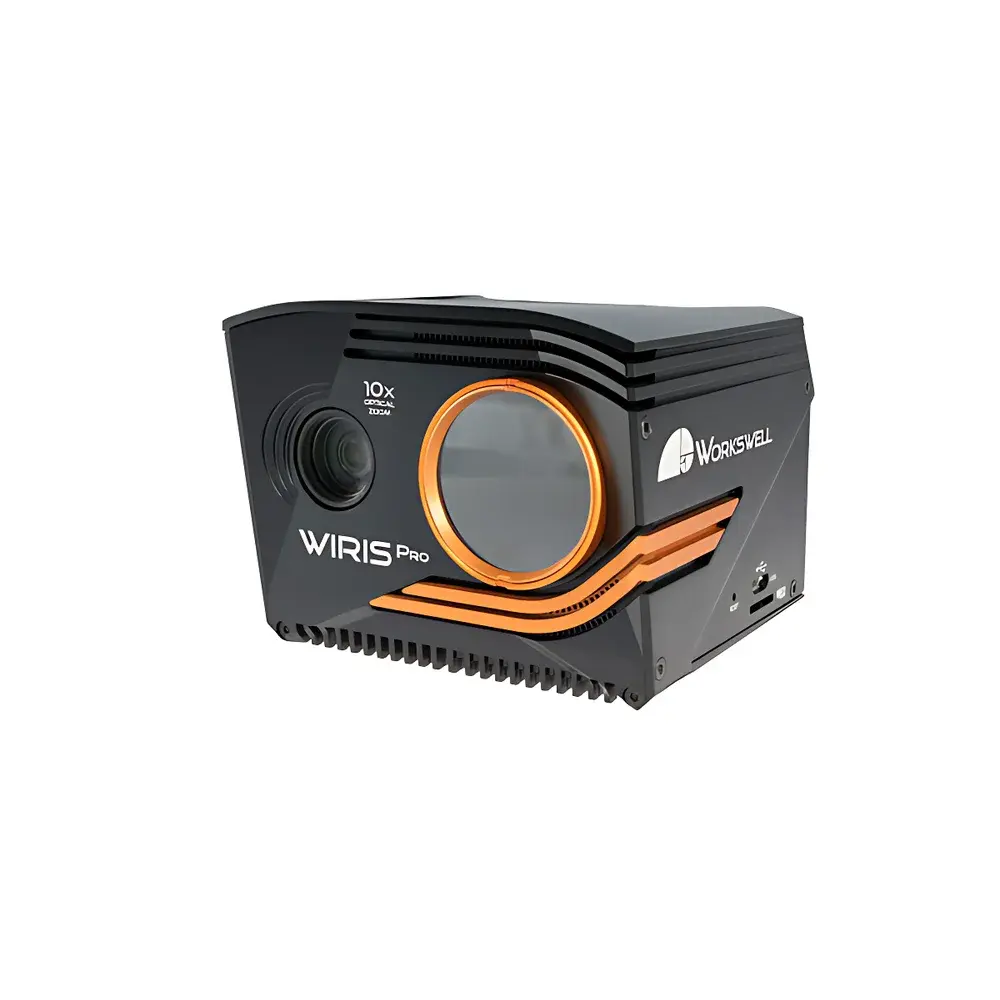
Workswell WIRIS Pro Sc Research-Grade Dual-Sensor Aerial Thermal Imaging System
| Brand | Workswell |
|---|---|
| Origin | Czech Republic |
| Model | WIRIS Pro Sc |
| Detector Type | Uncooled VOx Microbolometer |
| Spectral Range | 7.5–13.5 µm |
| Thermal Resolution | 1266 × 1010 px (Super-Resolution Mode) |
| Standard IR Resolution | 640 × 512 px |
| NETD | ≤30 mK |
| Temperature Range Options | −25 °C to +150 °C |
| Accuracy | ±2 % of reading or ±2 °C (typical measurement uncertainty: ±1 °C) |
| Frame Rate | 9 Hz or 30 Hz selectable |
| RGB Camera Resolution | 1920 × 1080 px (FHD) |
| Optical Zoom | 10× (FOV: 6.9°–58.2°, focal length: 33.0–3.3 mm) |
| Digital Zoom | 1–14× continuous |
| Image Stabilization | Built-in optical anti-shake |
| Lens Options | Interchangeable LWIR lenses (18°, 32°, 45°, 69° FOV) with removable Ge protective window |
| Calibration | Per-lens and system-level radiometric calibration with NIST-traceable certificate provided |
| Storage | Internal 128 GB or 256 GB SSD + microSD/UVC/USB 2.0 expansion |
| Interfaces | HDMI (Micro), RJ45 Ethernet (Wi-Fi/RTSP), CAN bus, S.BUS, PWM/TTL trigger, GPS input |
| Power | 9–36 V DC, 12 W typical |
| Dimensions | 83 × 85 × 68 mm |
| Weight | < 450 g |
| Operating Temperature | −20 °C to +55 °C |
| Storage Temperature | −30 °C to +60 °C |
| Compliance | CE, RoHS, EN 61000-6-3/-4 |
Overview
The Workswell WIRIS Pro Sc is a research-grade dual-sensor aerial thermal imaging system engineered for high-fidelity radiometric measurement and synchronized multispectral observation in demanding field and laboratory environments. Unlike conventional uncooled thermal cameras, the WIRIS Pro Sc integrates a high-sensitivity long-wave infrared (LWIR) microbolometric detector (VOx) with a full-HD visible-light camera—both mechanically and temporally aligned to ensure pixel-registered data acquisition. Its core measurement principle relies on calibrated radiometric response within the atmospheric transmission window of 7.5–13.5 µm, enabling quantitative surface temperature mapping under variable emissivity and ambient conditions. Designed explicitly for integration into UAV platforms—including DJI Matrice 600 and A3 flight controllers—the system supports real-time telemetry synchronization, hardware-triggered acquisition, and georeferenced thermal video logging. Its compact, aluminum-alloy housing (<450 g) meets MIL-STD-810G-derived mechanical robustness requirements for airborne deployment, while its sealed optical path and removable germanium lens cap ensure operational reliability across diverse climatic zones.
Key Features
- Simultaneous dual-sensor capture: Radiometric LWIR imaging (640 × 512 native / 1266 × 1010 super-resolved) paired with optically stabilized 10× zoom RGB imaging (1920 × 1080)
- High thermal sensitivity: Noise-equivalent temperature difference (NETD) ≤30 mK at 30 Hz, enabling detection of sub-degree thermal gradients in dynamic scenes
- Multi-range radiometric calibration: Four factory-configurable temperature spans (−40 °C to +550 °C; +50 °C to +1000 °C; +400 °C to +1500 °C; etc.), each individually validated and certified per lens
- Hardware-level synchronization: Sub-millisecond temporal alignment between IR and RGB frames, critical for thermomechanical correlation analysis and photogrammetric thermal modeling
- Industrial-grade interface suite: CAN bus (DJI-compatible), S.BUS (18-channel), PWM/TTL triggering, RJ45 Ethernet with Wi-Fi-enabled RTSP streaming, and dedicated GPS input for geotagged metadata embedding
- Onboard processing & storage: Dual-boot-capable WIRIS OS firmware, 128/256 GB internal SSD, plus microSD/USB 2.0 expansion for redundant data capture
Sample Compatibility & Compliance
The WIRIS Pro Sc is designed for non-contact surface temperature measurement across heterogeneous material classes—including metals, composites, ceramics, polymers, and vegetative surfaces—under ambient or controlled environmental conditions. Its spectral band (7.5–13.5 µm) avoids atmospheric absorption peaks, ensuring stable radiance transmission over distances up to 500 m in standard humidity conditions. Each delivered unit includes a manufacturer-issued calibration certificate traceable to NIST standards, documenting per-lens spatial uniformity, non-uniformity correction (NUC) coefficients, and absolute temperature accuracy across the full operational range. The system complies with CE Directive 2014/30/EU (EMC), RoHS 2011/65/EU, and EN 61000-6-3 (emission) / EN 61000-6-4 (immunity). For regulated applications, raw TIFF and JPEG thermal outputs are compatible with ASTM E1933-19 (Standard Test Methods for Measuring and Compensating for Emissivity Using Infrared Imaging Systems) workflows, and metadata-rich recording supports GLP-aligned audit trails when used with CorePlayer’s timestamped annotation and export logs.
Software & Data Management
WIRIS OS—a purpose-built embedded operating system—orchestrates sensor fusion, real-time NUC, and low-latency data routing without reliance on external host computers. CorePlayer desktop software (5-seat volume license included) provides comprehensive post-processing: emissivity correction, reflected-apparent temperature compensation, isotherm overlay, min/max/centroid temperature extraction, and ROI-based statistical reporting. Batch processing via ThermoFormat enables automated conversion of large thermal video datasets into Pix4D- and Agisoft Metashape-compatible TIFF stacks for thermographic 3D reconstruction. The MATLAB SDK grants programmatic access to raw frame buffers, metadata headers, and hardware control registers—supporting custom algorithm development for transient thermal event detection, thermal anomaly classification, or model-predictive thermal feedback loops. All stored data embed EXIF-compliant thermal metadata (including shutter time, lens ID, calibration epoch, and GPS coordinates when available), satisfying ISO 18434-1 (Condition monitoring — Thermography) documentation requirements.
Applications
The WIRIS Pro Sc serves advanced thermal metrology use cases where spatial registration, temporal fidelity, and traceable accuracy are non-negotiable. Key application domains include: UAV-based solar farm inspection (hot-spot detection per IEC 62446-3), composite material delamination assessment during in-situ curing, volcanic fumarole temperature profiling, industrial furnace refractory monitoring, wildfire front propagation analysis, and aerospace component thermal stress validation under flight-representative loads. Its 10× optical zoom and 14× digital zoom enable targeted observation of small features (e.g., solder joints, microcracks, or electrical contacts) from standoff distances, while synchronized RGB-IR output facilitates supervised machine learning training for automated defect segmentation. Researchers also deploy it for boundary-layer heat transfer studies in wind tunnels and convective cooling characterization of next-generation battery packs.
FAQ
Is the WIRIS Pro Sc compliant with FDA 21 CFR Part 11 for regulated thermal process validation?
No—while the system supports audit-ready metadata logging and secure file export, it is not validated as a medical or pharmaceutical production device. It may be deployed in GMP-adjacent R&D contexts with supplementary procedural controls.
Can the thermal image resolution be interpolated beyond 1266 × 1010 pixels?
No—super-resolution mode is achieved via proprietary sub-pixel dithering and multi-frame registration, not software interpolation. Output dimensions are fixed and radiometrically validated.
Does the system support real-time radiometric video streaming over Wi-Fi?
Yes—RTSP streaming delivers full-frame 30 Hz thermal video at native resolution with embedded temperature metadata, subject to local RF environment and bandwidth constraints.
How often is recalibration required for field-deployed units?
Annual recalibration is recommended for metrological continuity; however, built-in shutter-based NUC ensures stability between calibrations, and field NUC can be executed autonomously via command interface.
Are lens exchange procedures user-serviceable without voiding calibration?
Yes—each lens ships with its own calibration matrix. Swapping requires only selecting the corresponding lens profile in WIRIS OS; no manual recalibration is needed.




