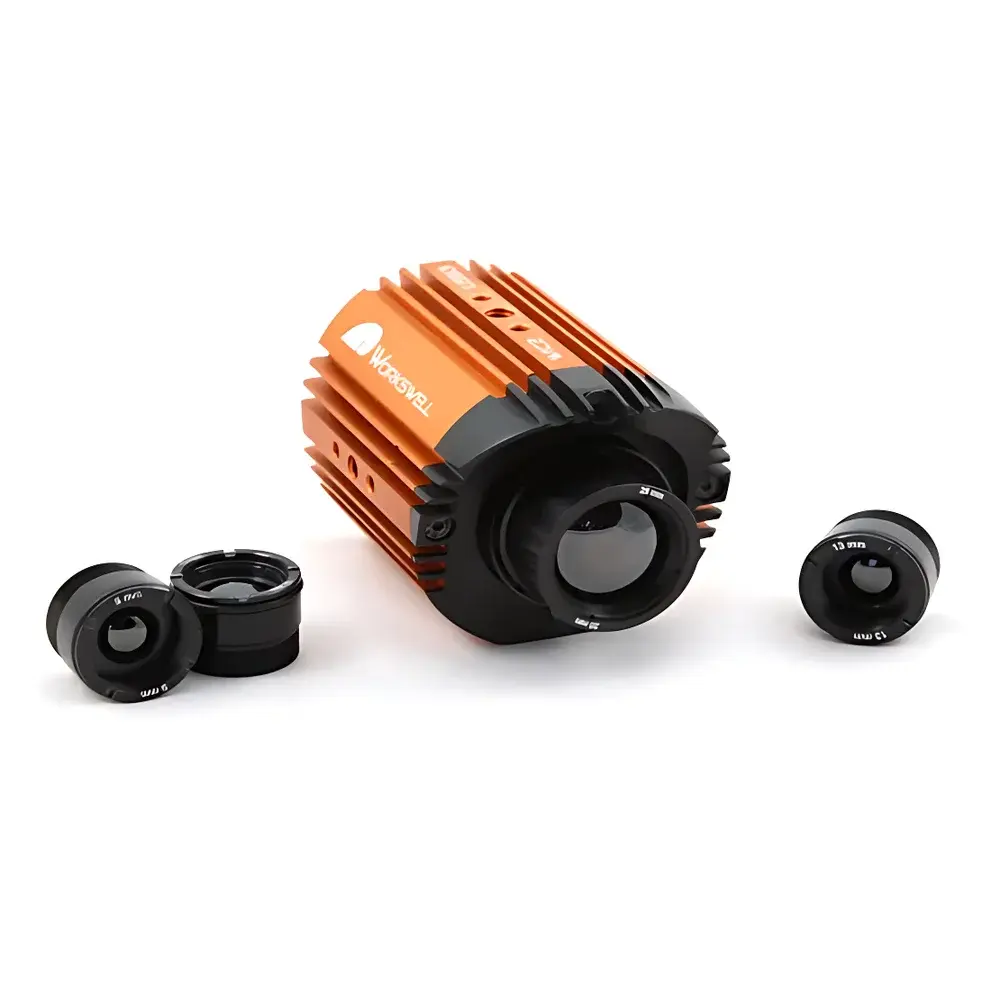
WIC Workswell WIC 2nd Industrial-Grade Thermal Imaging Camera
| Origin | Czech Republic |
|---|---|
| Manufacturer Type | Authorized Distributor |
| Origin Category | Imported |
| Model | WIC 2nd |
| Pricing | Available Upon Request |
| Resolution Options | 160×128, 336×256, or 640×512 pixels |
| Thermal Sensitivity | ≤0.03 °C (30 mK) @ 30 °C |
| Frame Rate | 9 Hz or 30 Hz |
| Temperature Range | −25 °C to +150 °C standard |
| Accuracy | ±2 °C or ±2% of reading |
| Spectral Band | 7.5–13.5 µm |
| Detector Type | Uncooled VOx microbolometer FPA |
| Dynamic Range | 14-bit radiometric data & raw output |
| Calibration | Dual-point factory calibration with user-definable 3-point field calibration |
| Lens Options | Interchangeable manual-focus lenses (6.8 mm, 9 mm, 13 mm, 19 mm, 25 mm, 35 mm, 60 mm, 100 mm) |
| Interface | GigE Vision (RJ-45) or USB3 Vision (Micro-B) |
| Power | 5 V DC via USB3 |
| Environmental Rating | IP65 (industrial housing) |
| Operating Temp | −15 °C to +50 °C |
| Dimensions (GigE/IP65) | 179 mm × 65 mm × 63 mm |
| Weight (GigE/IP65) | 360 g |
| Mounting | 4×¼"-20 UNC + 10×M4 threaded holes |
| Software Support | CorePlayer SDK, FLIR Tools compatibility, GPS metadata embedding |
Overview
The Workswell WIC 2nd is a high-performance, industrial-grade thermal imaging camera engineered for precise non-contact temperature measurement in demanding laboratory, R&D, and field-deployed applications. Based on uncooled vanadium oxide (VOx) microbolometer focal plane array (FPA) technology, the WIC 2nd operates within the long-wave infrared (LWIR) spectral band (7.5–13.5 µm), ensuring robust performance across ambient and elevated temperature regimes while minimizing atmospheric absorption effects. Its radiometric design delivers true quantitative thermal data — not just thermal visualization — enabling traceable, repeatable surface temperature analysis compliant with ISO 18434-1 (condition monitoring) and ASTM E1933 (standard test methods for radiation thermometers). The dual-interface architecture — Gigabit Ethernet (GigE Vision) and USB3 Vision — supports seamless integration into automated test benches, process monitoring systems, and mobile inspection platforms without requiring external power supplies or complex cabling infrastructure.
Key Features
- Radiometric accuracy of ±2 °C or ±2% of reading across calibrated ranges, validated per ISO/IEC 17025-accredited procedures
- Thermal sensitivity ≤0.03 °C (30 mK) at 30 °C ambient, enabling detection of subtle thermal gradients in electronics, composites, or low-emissivity surfaces
- Three resolution configurations (160×128, 336×256, 640×512) to balance spatial detail, frame rate (9/30 Hz), and system bandwidth requirements
- Interchangeable manual-focus LWIR lenses (6.8 mm to 100 mm) supporting wide-angle, telephoto, and macro inspection modes with consistent MTF performance
- IP65-rated ruggedized housing for dust-tight and water-jet resistant operation in outdoor, factory-floor, or harsh environmental deployments
- 14-bit radiometric data streaming with full dynamic range preservation — essential for post-acquisition analysis, emissivity correction, and thermal signature modeling
- On-camera non-uniformity correction (NUC) with fully controllable timing, eliminating image interruption during continuous monitoring or closed-loop control workflows
Sample Compatibility & Compliance
The WIC 2nd accommodates diverse sample geometries and surface characteristics through configurable emissivity settings (0.01–1.00), reflected apparent temperature compensation, and real-time background radiation correction. It is routinely deployed for thermal validation of PCB assemblies, battery cell thermal runaway studies, composite material curing verification, and HVAC duct leakage assessment. Regulatory alignment includes compliance with CE marking (EMC Directive 2014/30/EU, RoHS 2011/65/EU), conformity to EN 62471 (photobiological safety), and support for audit-ready documentation under GLP and GMP environments when integrated with timestamped, GPS-geotagged radiometric datasets. While not FDA-cleared as a medical device, its radiometric traceability supports ISO 13485-aligned quality system documentation for thermal process validation.
Software & Data Management
CorePlayer SDK provides native C/C++, Python, and MATLAB APIs for custom application development, including real-time thermal analytics, alarm triggering, and multi-camera synchronization. Radiometric TIFF and SEQ file formats preserve full 14-bit pixel-level temperature values with embedded metadata (lens ID, calibration coefficients, exposure time, GPS coordinates). Integration with third-party platforms such as LabVIEW, HALCON, and MATLAB Image Processing Toolbox enables automated thermal defect classification, statistical process control (SPC) charting, and time-series anomaly detection. All calibration files are stored onboard and digitally signed to ensure data integrity — critical for 21 CFR Part 11-compliant environments when paired with validated electronic record systems.
Applications
- Electronics reliability testing: Junction temperature mapping of power semiconductors, thermal cycling validation of solder joints
- Materials science: Real-time monitoring of laser welding, additive manufacturing melt pools, and polymer crystallization kinetics
- Energy infrastructure: Substation component thermography, photovoltaic panel hotspot detection, transformer winding hot-spot localization
- Mechanical systems: Bearing temperature trending, gearbox lubrication failure prediction, brake disc thermal fatigue analysis
- Research & education: Heat transfer coefficient estimation, natural convection visualization, emissivity database generation for novel coatings
FAQ
Does the WIC 2nd require external power when connected via USB3?
No. The USB3 Vision interface supplies regulated 5 V DC power, and total system consumption remains below 1.3 W — eliminating the need for auxiliary power adapters or batteries.
Can I perform in-field recalibration without returning the unit to the manufacturer?
Yes. The camera supports user-defined 3-point NUC calibration using reference blackbodies or certified thermal sources, with calibration parameters saved locally and applied automatically upon startup.
Is GigE Vision implementation compatible with existing industrial vision software?
Yes. The WIC 2nd complies fully with the GigE Vision 2.0 standard and is certified for interoperability with common GenICam-compliant frameworks including Common Vision Blox, Stemmer Imaging’s Common Vision Blox, and Matrix Vision mvIMPACT.
What lens options provide the narrowest instantaneous field of view (IFOV)?
The 100 mm f/1.0 lens achieves an IFOV of 0.37 mrad (at 640×512 resolution), enabling high-magnification thermal inspection of small targets at distances up to 10 meters.
How is GPS data synchronized with thermal frames?
GPS timestamps are embedded into each radiometric frame header via PPS (pulse-per-second) signal alignment, ensuring sub-100 ms temporal correlation between geographic position and thermal measurement — critical for UAV-mounted survey applications.