
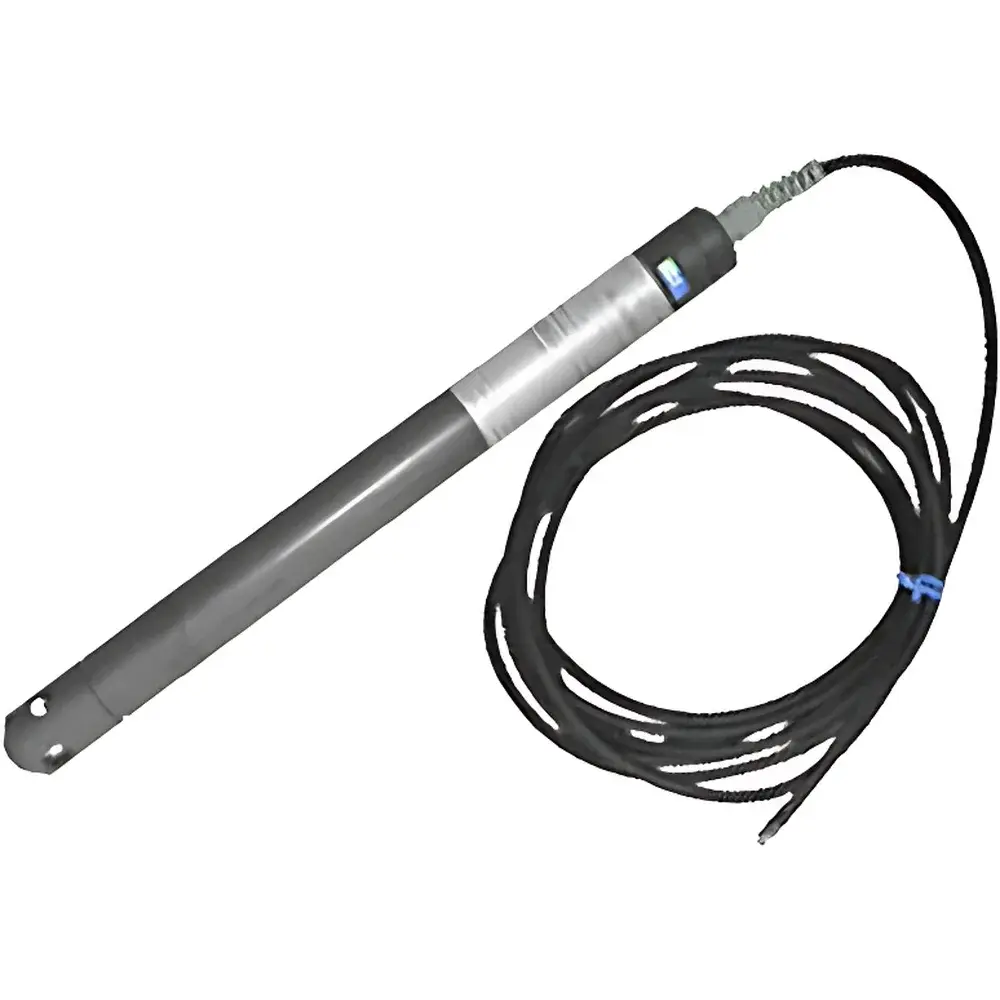
WSI3 Tri-Ion Sensor for Continuous Water Quality Monitoring
| Origin | Italy |
|---|---|
| Manufacturer Type | Authorized Distributor |
| Origin Category | Imported |
| Model | WSI3 |
| Price Range | USD 6,800–13,600 (FOB) |
| Instrument Type | Multi-Ion Online Sensor |
| Measurement Range | 0–5,000 ppm |
| Detection Limit | 0.2 ppm |
| Response Time | ≤1 s |
| Accuracy | ±15% |
| Operating Temperature | −5 to +60 °C |
| Communication Interface | RS485 or USB (configurable) |
| Output Signal | Analog mV (scalable to ppm) |
| Housing Material | PVC |
| Submersion Rating | IP68, up to 20 m depth |
| Power Supply | 10.8–16 V DC |
| Dimensions | 500 mm × 42 mm (L × Ø) |
| Cable Length | 30 m (standard), IP68 waterproof connector |
| Weight | <1.6 kg |
| Certifications | CE compliant |
| Compatible Ions | NH₄⁺, NO₃⁻, Cl⁻ (standard) |
Overview
The WSI3 Tri-Ion Sensor is an industrial-grade, submersible online sensor engineered for continuous, real-time monitoring of three ionic species in natural and engineered water systems. Based on solid-state ion-selective electrode (ISE) technology, the WSI3 employs potentiometric measurement principles—detecting the Nernstian potential shift across selectively permeable membranes in response to target ion activity. This enables direct, non-destructive quantification of key water quality indicators without reagent consumption or sample pretreatment. Designed for deployment in open-water bodies (lakes, rivers, coastal zones) and pressurized distribution networks (potable water mains, aquaculture recirculation loops), the WSI3 delivers rapid, field-deployable ion analytics with minimal operational overhead. Its compact cylindrical form factor (500 mm × 42 mm) and 20 m submersion rating support both surface-floating buoys and inline pipe insertion configurations. The sensor operates within a broad environmental envelope (−5 to +60 °C), making it suitable for temperate, tropical, and seasonal cold-water applications—including seawater monitoring where salinity-induced interference is mitigated via built-in temperature compensation and multi-point calibration routines.
Key Features
- Simultaneous detection of three ions from a configurable set: NH₄⁺, NO₃⁻, Cl⁻ (factory-standard), with optional expansion to K⁺, Na⁺, Ca²⁺, or F⁻ via interchangeable ISE modules;
- Sub-second electrochemical response time (≤1 s) enabling dynamic process tracking in fast-flowing or tidal environments;
- Dual communication interface: RS485 (Modbus RTU protocol) for integration into SCADA/PLC infrastructure, and USB (virtual COM port) for direct PC connection and configuration;
- Plug-and-play compatibility with TMF-series data loggers—supporting cellular (GSM/GPRS/UMTS), satellite, Ethernet, and LoRaWAN telemetry paths for remote data transmission;
- IP68-rated PVC housing with integrated 30 m armored cable and hermetic connector; rated for continuous immersion up to 20 m depth;
- Low-power DC operation (10.8–16 V) optimized for solar-battery-powered remote stations;
- Field-replaceable ISE cartridges—no need for full sensor replacement during routine maintenance or electrode aging;
- CE-marked for conformity with EU electromagnetic compatibility (EMC Directive 2014/30/EU) and low-voltage safety (LVD Directive 2014/35/EU);
- Calibration performed in situ or benchtop via intuitive Windows-based configuration software—supports 2-point or 3-point standardization using certified reference solutions.
Sample Compatibility & Compliance
The WSI3 is validated for use in clear to semi-turbid aqueous matrices, including freshwater, brackish water, and full-strength seawater (up to 35 ppt salinity). It exhibits robust performance in high-ionic-strength environments due to integrated liquid-junction stabilization and drift-compensated signal processing. While not intended for highly suspended solids (>50 NTU) or viscous wastewater streams without pre-filtration, its design complies with common regulatory sampling frameworks: measurements align with ASTM D1293 (pH and conductivity context), ISO 5667-3 (water sampling preservation), and support GLP-aligned data integrity when paired with TMF loggers featuring audit-trail-enabled firmware (21 CFR Part 11 ready upon configuration). No hazardous materials are used in electrode construction; all components meet RoHS 2011/65/EU restrictions.
Software & Data Management
Configuration, calibration, and diagnostics are managed through the vendor’s cross-platform WSI Control Suite (Windows/macOS/Linux), which provides real-time waveform visualization, automatic temperature compensation profiles, and batch export of timestamped mV-to-ppm converted datasets (CSV/Excel). When interfaced with TMF-series loggers, raw sensor outputs are stored locally with microSD redundancy and transmitted via encrypted payloads to cloud platforms (e.g., ThingSpeak, AWS IoT Core) or on-premise databases. Firmware updates preserve historical calibration coefficients and user-defined alarm thresholds (e.g., NH₄⁺ > 1.5 mg/L triggers SMS alert). All data logs include embedded metadata: sensor ID, UTC timestamps, battery voltage, temperature, and diagnostic flags (e.g., “electrode saturation”, “cable resistance anomaly”).
Applications
- Real-time nutrient monitoring in eutrophication-sensitive reservoirs and estuaries (NH₄⁺/NO₃⁻ as nitrogen cycle proxies);
- Chloride intrusion detection in coastal aquifers and desalination plant intakes;
- Process control in municipal drinking water treatment—tracking residual disinfectant byproducts (Cl⁻) and coagulant dosing efficacy;
- Smart aquaculture—automated feeding feedback based on ammonium accumulation in recirculating tanks;
- Regulatory compliance reporting for wastewater discharge permits (e.g., EPA NPDES parameters);
- Long-term ecological observatories requiring unattended, low-maintenance ion profiling over seasonal cycles.
FAQ
What ion combinations can be configured on a single WSI3 unit?
The WSI3 supports any three-ion subset from the seven available: NH₄⁺, NO₃⁻, Cl⁻ (default), plus optional K⁺, Na⁺, Ca²⁺, and F⁻. Electrode modules are physically swapped—not software-selected—so configuration is fixed per unit at time of order.
Is temperature compensation automatic?
Yes. An integrated Pt1000 RTD measures ambient water temperature continuously, and the firmware applies Nernst equation corrections in real time using ion-specific thermal coefficients stored in EEPROM.
Can the WSI3 operate in ice-covered lakes?
It is rated for −5 °C minimum operating temperature; however, mechanical ice shear forces may damage the cable or housing. Deployment beneath ice requires protective conduit or buoy-mounted suspension above the ice-water interface.
How often does calibration require verification in field use?
Under stable conditions, quarterly verification against traceable standards is recommended. In high-dynamic or high-fouling environments (e.g., tidal estuaries), monthly checks are advised. Drift exceeding ±5% of span triggers recalibration.
Does the sensor output comply with Modbus register mapping standards?
Yes. RS485 output follows Modbus RTU protocol with predefined holding registers for each ion channel (40001–40003), temperature (40004), status flags (40005), and diagnostic codes (40006–40009).
Related Products







