
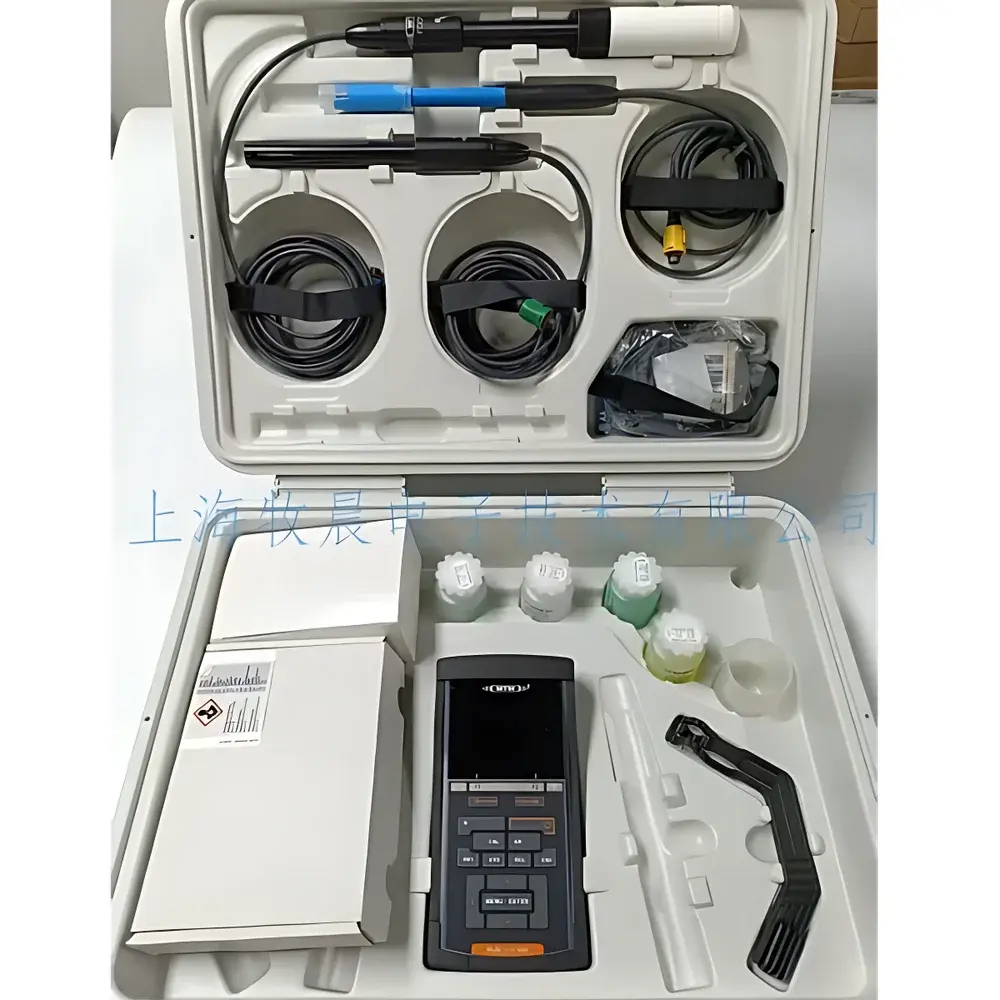
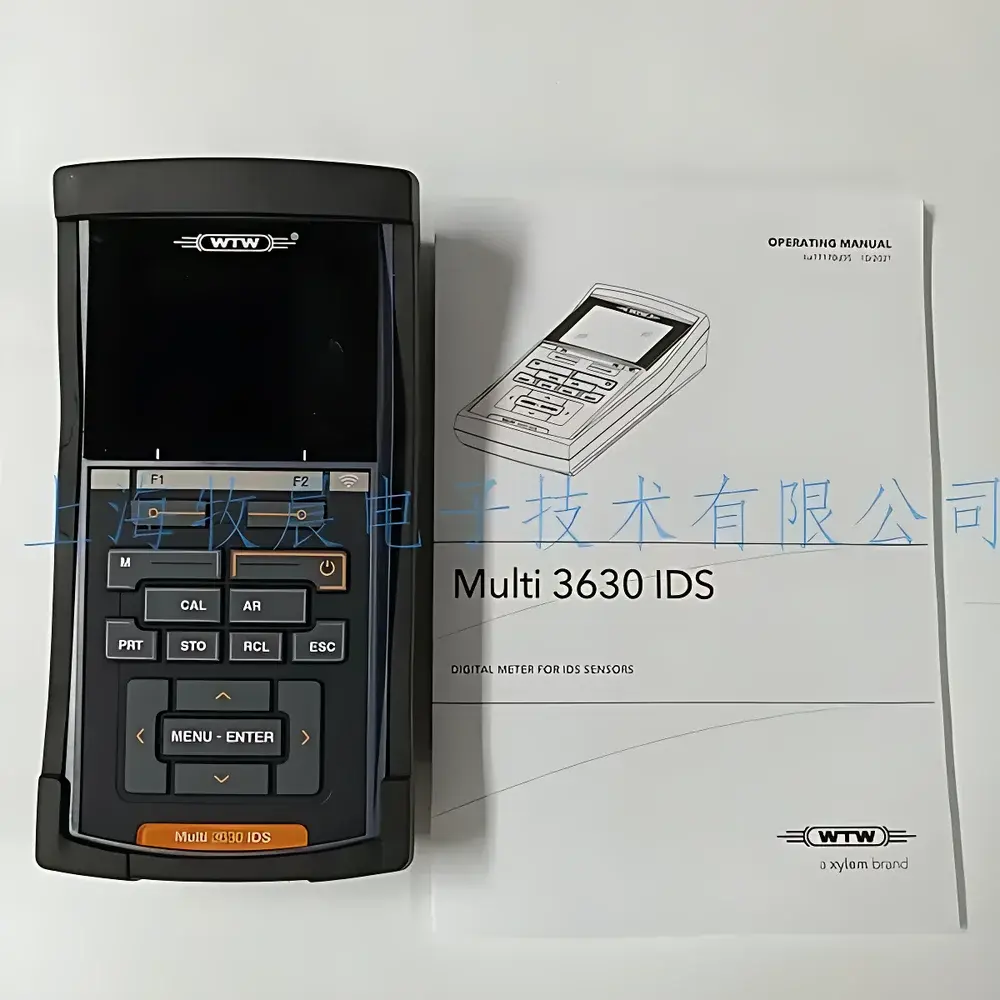
WTW Multi 3630 IDS Portable Multiparameter Water Quality Analyzer
| Brand | WTW |
|---|---|
| Origin | Germany |
| Model | Multi 3630 IDS |
| Instrument Type | Portable/Handheld Water Quality Analyzer |
| Detection Principle | Electrochemical Sensing (pH, ORP, Conductivity, DO) & Optical Turbidity Measurement (Nephelometry) |
| Measured Parameters | pH, ORP, Dissolved Oxygen (DO), Conductivity, Turbidity |
| Display | Color LCD with Graphical Interface |
| Data Storage | Up to 10,000 datasets (manual & time-controlled logging) |
| Communication | USB-B port, optional wireless module (Bluetooth-compatible IDS interface) |
| Protection Rating | IP67 |
| Power Supply | 4 × AA alkaline / 4 × NiMH rechargeable / USB bus power |
| Measurement Channels | 3 independent digital IDS channels |
| Compliance | CE-marked, designed for GLP-compliant field and laboratory use |
Overview
The WTW Multi 3630 IDS is a high-precision, portable multiparameter water quality analyzer engineered for reliable, field-deployable measurement of five core environmental parameters: pH, oxidation-reduction potential (ORP), dissolved oxygen (DO), electrical conductivity, and turbidity. Built upon WTW’s Intelligent Digital Sensor (IDS) platform, the instrument employs digital signal transmission directly from sensor to analyzer—eliminating analog noise, drift, and calibration ambiguity associated with legacy analog probes. Each IDS probe contains embedded microelectronics that store individual calibration data, temperature compensation coefficients, and sensor-specific identification. This architecture ensures traceable, reproducible measurements across operators and locations—critical for regulatory monitoring, wastewater compliance reporting, and ecological research. The device operates on electrochemical principles for pH/ORP (glass electrode + reference system), amperometric Clark-type sensing for DO, four-electrode AC conductivity measurement for wide-range accuracy, and 860 nm nephelometric detection (90° scattering angle) for turbidity in accordance with ISO 7027 and EPA Method 180.1.
Key Features
- Three independent digital IDS channels supporting simultaneous real-time measurement of up to three parameters—including mixed configurations (e.g., pH + DO + turbidity)
- Automatic recognition and plug-and-play integration of all WTW IDS probes: SenTix (pH/ORP), FDO 925 (optical DO), TetraCon/LR 925 (conductivity), VisoTurb 900-P (turbidity), and MPP 910/930 (multi-parameter deep-water sensors)
- Integrated depth measurement capability when paired with MPP 930 IDS probes—compensated for hydrostatic pressure, water density (freshwater/seawater), and temperature (±0.25 m accuracy, 0.05–100 m range)
- Color graphical LCD display with intuitive menu navigation, real-time trend graphs, and on-screen calibration prompts
- Robust IP67-rated housing rated for immersion up to 1 m for 30 minutes—suitable for harsh outdoor, marine, and industrial site conditions
- Comprehensive data management: 10,000 internal storage capacity with timestamp, GPS-ready metadata fields (via optional external module), and user-defined sampling intervals
- pH electrode health monitoring—including slope evaluation, offset diagnostics, and lifetime estimation based on accumulated usage metrics
Sample Compatibility & Compliance
The Multi 3630 IDS is validated for use across diverse aqueous matrices including municipal wastewater effluents, surface waters (lakes, rivers), seawater, groundwater, landfill leachate, and industrial process streams. Its IDS probe architecture enables stable operation under variable salinity (0–70 PSU), temperature (−5 °C to +50 °C for turbidity; up to +100 °C for pH), and suspended solids concentrations (0–4000 FNU). All measurement protocols align with internationally recognized standards: ISO 10523 (pH), ISO 5814 (DO), ISO 7888 (conductivity), ISO 7027 (turbidity), and ASTM D3370 (field sampling practice). The instrument supports audit-trail-enabled calibration logging required under GLP and ISO/IEC 17025 frameworks. While not FDA 21 CFR Part 11 certified out-of-the-box, its structured data export (CSV, TXT) and immutable timestamping facilitate integration into validated LIMS environments.
Software & Data Management
Data transfer occurs via micro-USB-B interface to PC or mobile devices using WTW’s proprietary LabX® Light software (Windows/macOS compatible) or generic mass-storage mode. LabX Light provides automated report generation, statistical analysis (mean, SD, min/max), calibration history tracking, and export to PDF or Excel formats compliant with ISO 17025 documentation requirements. Raw datasets include full metadata: sensor ID, calibration date, operator ID, location tag (manual entry), ambient temperature, and battery status. Optional Bluetooth-enabled IDS wireless modules allow cable-free operation at distances up to 10 m—ideal for confined-space entry, bridge-based profiling, or multi-point transect surveys. Firmware updates are delivered through WTW’s secure customer portal and preserve all stored calibration profiles and user settings.
Applications
- Regulatory compliance monitoring per EU Urban Wastewater Treatment Directive (91/271/EEC) and US Clean Water Act discharge permits
- Environmental impact assessments (EIA) for coastal development, aquaculture sites, and hydropower operations
- Process control in wastewater treatment plants—especially aeration basin DO optimization and clarifier effluent turbidity verification
- Ecological field studies requiring high-temporal-resolution profiling of stratified lakes or estuarine gradients
- Emergency response deployment during chemical spills or algal bloom events—leveraging rapid DO/pH/turbidity triage capability
- Academic and government research programs requiring metrologically traceable, inter-laboratory comparable field data
FAQ
Can the Multi 3630 IDS be used for seawater measurements?
Yes—the instrument supports automatic salinity and density compensation when configured with LR 925 or MPP 930 IDS probes, enabling accurate conductivity, DO saturation, and depth readings in marine environments.
Does it support automatic temperature compensation for all parameters?
Yes—each IDS probe performs real-time, sensor-specific temperature compensation using integrated Pt1000 thermistors; no manual input or correction factors are required.
How is calibration traceability maintained across multiple field teams?
Each IDS probe stores its full calibration history—including date, buffer values, slope, offset, and operator ID—within its onboard memory; this data is automatically uploaded during connection to the analyzer.
Is the device suitable for continuous unattended monitoring?
No—the Multi 3630 IDS is designed for handheld, operator-guided spot measurements and short-term profiling; for long-term deployment, WTW recommends the IQ SensorNet or VARiON platforms.
What happens if a probe is disconnected mid-measurement?
The analyzer retains the last valid reading and timestamp; upon reconnection, it resumes data logging without gap or error—provided the probe remains within operational temperature and immersion limits.







