
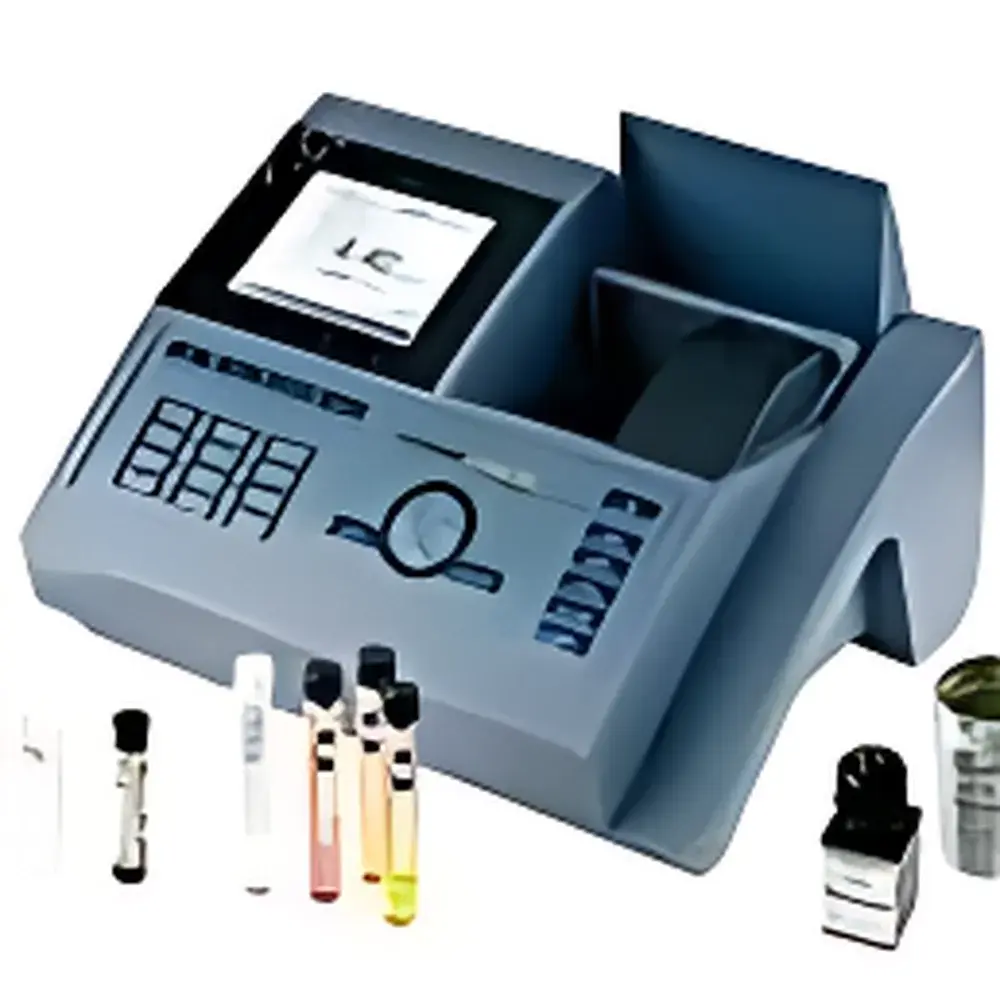
WTW PhotoLab 6100 and PhotoLab 6600 UV-VIS Spectrophotometers
| Brand | WTW |
|---|---|
| Origin | Germany |
| Model | PhotoLab 6100 (VIS), PhotoLab 6600 (UV-VIS) |
| Optical Design | Pseudo-Double-Beam |
| Wavelength Range | 320–1100 nm (PhotoLab 6100), 190–1100 nm (PhotoLab 6600) |
| Light Source | Tungsten Halogen Lamp (6100), Xenon Flash Lamp (6600) |
| Wavelength Accuracy | ±1 nm |
| Spectral Bandwidth | 4 nm |
| Absorbance Range | –3.3 to +3.3 A |
| Absorbance Resolution | 0.005 A (at A = 2.0) or 0.5% of reading |
| Photometric Repeatability | ±0.002 A (at A = 1.0) |
| Photometric Accuracy | ±0.003 A (A < 0.600 A), ±0.5% of reading (0.600–2.000 A) |
| Linearity | <1% deviation (0–2.000 A, 340–900 nm) |
| Stray Light | <0.1% (at 340 nm and 408 nm) |
| Cuvette Recognition | Automatic (16 mm round, 10/20/50 mm square) |
| Data Storage | 1000 measurement records, 100 spectra (300–900 nm), 400 dynamic test series (150 values each) |
| Built-in Methods | 200 preprogrammed, 100 user-defined, 20 photometric analysis methods |
| Interface | USB-A (for USB drive, printer, barcode scanner), USB-B (PC connection), RS232 (PC/printer) |
| Compliance | CE, UL, IP30 |
| Operating Temperature | 10–35 °C |
| Dimensions | 404 × 197 × 314 mm (W × H × D) |
| Weight | ~4.5 kg (without power supply) |
Overview
The WTW PhotoLab 6100 and PhotoLab 6600 are high-precision, benchtop UV-VIS spectrophotometers engineered for routine and advanced water quality analysis in environmental, municipal, industrial, and research laboratories. Designed and manufactured in Germany, these instruments implement a pseudo-double-beam optical architecture—featuring stabilized light sources, precision monochromators, and temperature-compensated photodetectors—to ensure long-term baseline stability and minimal drift during extended operation. The PhotoLab 6100 operates across the visible spectrum (320–1100 nm) using a tungsten halogen lamp, while the PhotoLab 6600 extends into the deep ultraviolet range (190–1100 nm) via a pulsed xenon flash lamp, enabling quantification of low-concentration analytes such as nitrate, phosphate, and organic carbon at characteristic absorption bands below 220 nm. Both models support absorbance, transmittance, concentration, spectral scanning, multi-wavelength quantitation, and kinetic/dynamic measurements—all under full software control with integrated AutoCheck diagnostics.
Key Features
- Pseudo-double-beam optical design with real-time reference beam compensation for enhanced photometric stability and reduced sensitivity to lamp aging or ambient temperature fluctuations.
- Automatic cuvette recognition system supporting 16 mm round cells and standard square cuvettes (10 mm, 20 mm, 50 mm pathlengths); eliminates manual pathlength entry errors and accelerates method setup.
- Barcode-assisted method selection: scan reagent vial barcodes to auto-load corresponding calibration curves, wavelength settings, and calculation algorithms—reducing operator dependency and transcription errors.
- Integrated AutoCheck self-diagnostic suite verifies optical alignment, lamp output, detector response, and electronic integrity prior to each measurement cycle; generates traceable diagnostic logs compliant with GLP audit requirements.
- High-resolution graphical backlit display with intuitive icon-based navigation; supports multilingual UI (English, German, French, Spanish, Chinese) without firmware reload.
- Onboard storage capacity for up to 1000 individual results, 100 full-spectrum scans (300–900 nm), and 400 dynamic test sequences (150 data points per sequence)—all timestamped and user-ID tagged.
- Flexible method development environment: 100 user-definable methods with support for linear, polynomial, and multi-point non-linear calibration; configurable kinetics parameters including delay time, interval, and total duration.
Sample Compatibility & Compliance
Both PhotoLab models accommodate standard optical cuvettes used in regulatory water testing—including DIN-compliant 16 mm round cells for turbidity measurements per DIN 27027 / ISO 7027. Turbidity quantification is performed simultaneously with absorbance measurements using dual-detector geometry, eliminating sequential instrument reconfiguration. The systems comply with key international standards governing analytical instrumentation: CE marking per EU Directive 2014/30/EU (EMC) and 2014/35/EU (LVD); UL 61010-1 certification for electrical safety; and IP30 ingress protection for laboratory environments. Data integrity meets FDA 21 CFR Part 11 expectations through secure user authentication, electronic signature capability, and immutable audit trails for all method modifications, calibrations, and result exports.
Software & Data Management
Data exchange is supported via three independent interfaces: USB-A (for direct connection to USB flash drives, thermal printers, or barcode scanners), USB-B (for PC tethering and remote control via WTW LabX® Light software), and RS232 (legacy integration with LIMS or SCADA systems). USB drive operations enable one-touch export of measurement reports, spectral datasets, dynamic test series, and firmware/method updates—eliminating reliance on proprietary cables or network infrastructure. All exported files follow standardized CSV or XML schemas compatible with third-party statistical packages (e.g., JMP, Minitab) and laboratory information management systems. Internal memory maintains full traceability: each stored result includes operator ID, timestamp, method name, cuvette type, pathlength, and raw absorbance values at all selected wavelengths.
Applications
- Regulatory compliance testing for drinking water, wastewater, and surface water per EPA Methods 365.4, 365.3, and ISO 15705 (phosphate), ISO 6060 (COD), and ISO 7150-1 (ammonia).
- Organic matter characterization using Specific UV Absorbance (SUVA) and color index (APHA/Pt-Co) calculations—fully automated without reagent addition.
- Method validation and verification studies requiring spectral scanning between 190–1100 nm to identify interference peaks or confirm peak purity.
- Process monitoring of coagulation/flocculation efficiency via time-resolved absorbance kinetics at multiple wavelengths.
- Calibration-free quantification of chromophoric dissolved organic matter (CDOM) using spectral slope analysis (S275–295, S350–400) derived from full-scan data.
- Verification of reagent lot performance using built-in AQA (Analytical Quality Assurance) routines that compare control sample responses against historical baselines.
FAQ
What distinguishes the PhotoLab 6600 from the 6100 in terms of UV performance?
The PhotoLab 6600 utilizes a xenon flash lamp enabling reliable measurements down to 190 nm, whereas the 6100’s tungsten source limits its lower detection limit to 320 nm—making the 6600 suitable for nitrate, cyanide, and aromatic compound analysis.
Can the instrument perform turbidity and absorbance measurements simultaneously?
Yes—dual-detector configuration allows concurrent turbidity (per ISO 7027) and spectral absorbance acquisition without mechanical repositioning or recalibration.
Is method validation documentation available for regulatory submissions?
WTW provides IQ/OQ documentation templates, factory calibration certificates traceable to NIST standards, and detailed uncertainty budgets for all photometric functions—supporting ISO/IEC 17025 accreditation.
How is data security enforced during USB export?
All USB transfers require administrator-level authentication; exported files include digital signatures and embedded metadata (operator ID, timestamp, method version) to prevent tampering or misattribution.
Does the system support external autosamplers or flow cells?
No—PhotoLab instruments are optimized for discrete cuvette-based analysis; continuous-flow applications require integration with WTW’s IQ Sensor Net platform or third-party peristaltic sampling modules.
Related Products





