
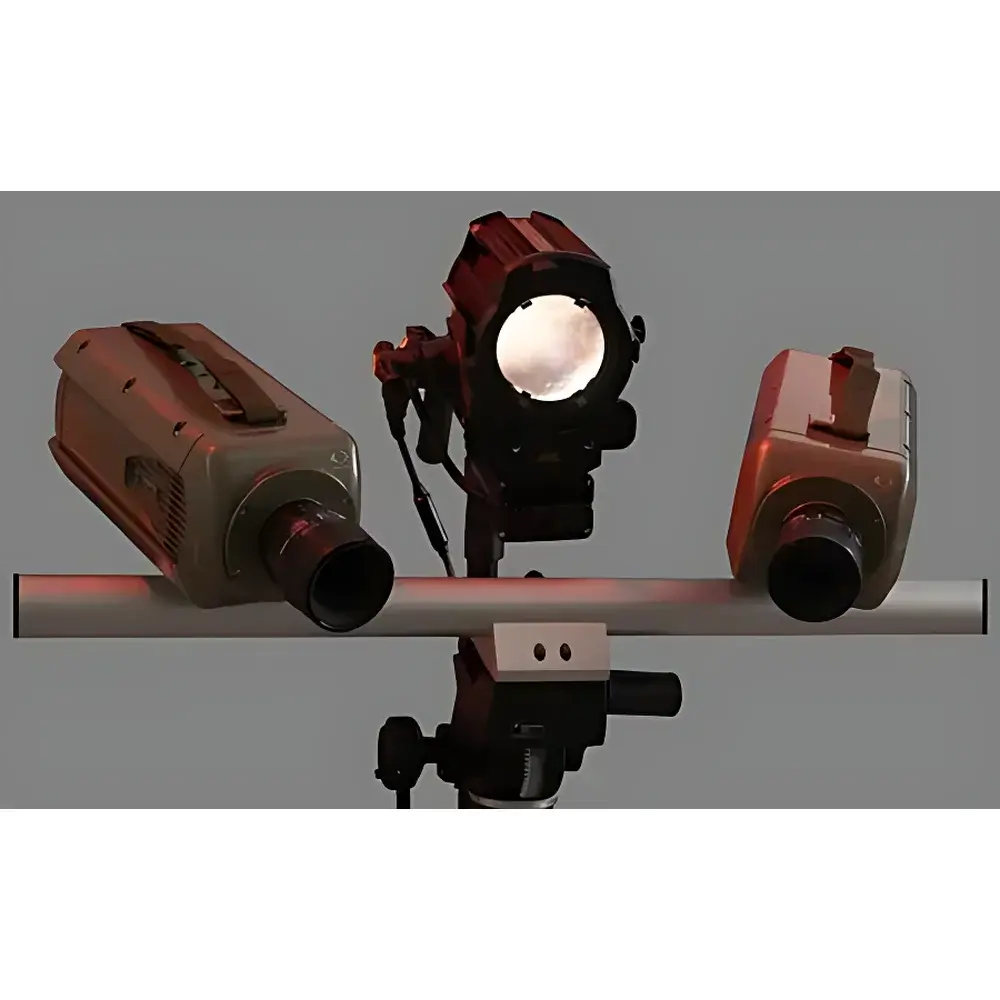
Dantec Dynamics Q-450 High-Speed Digital Image Correlation System
| Brand | Dantec Dynamics |
|---|---|
| Origin | Germany |
| Model | Q-450 |
| Measurement Dimensions | 2D & 3D |
| Frame Rate | Up to 20 kHz |
| Measurable Area | 70 mm × 50 mm to 1000 mm × 1000 mm (scalable from mm² to m²) |
| Displacement Accuracy | ±1 µm |
| Strain Accuracy | ±0.005% |
| Contactless Operation | Yes |
| Application Focus | High-frequency vibration, transient deformation, dynamic strain mapping |
Overview
The Dantec Dynamics Q-450 High-Speed Digital Image Correlation (DIC) System is an engineered optical metrology platform designed for full-field, non-contact measurement of surface displacement and strain under dynamic loading conditions. Based on stereo or single-camera digital image correlation principles, the system tracks sub-pixel intensity patterns across successive high-speed image frames to compute quantitative deformation fields in real time. Unlike point-based sensors such as strain gauges or accelerometers, DIC captures spatially resolved kinematic data over arbitrarily defined regions of interest—enabling comprehensive analysis of complex deformation modes including bending, buckling, crack propagation, and wave propagation. The Q-450 is specifically optimized for applications requiring temporal resolution up to 20 kHz, making it suitable for characterizing impact events, ultrasonic vibrations, blast-induced deformations, and rapid thermal expansion phenomena.
Key Features
- High-speed acquisition architecture: Synchronized dual-camera configuration with ultra-low latency triggering, supporting frame rates from 1 kHz to 20 kHz depending on region-of-interest size and bit depth.
- Multi-scale measurement capability: Configurable optics and calibration protocols enable seamless transition between micro-scale (sub-mm ROI with micron-level resolution) and macro-scale (square-meter fields with millimeter-level spatial coverage) analyses.
- Sub-pixel displacement tracking: Advanced correlation algorithms (e.g., inverse compositional Gauss–Newton) deliver displacement resolution down to ±1 µm and strain resolution of ±0.005%, validated against NIST-traceable reference targets.
- Robust environmental adaptability: Designed for laboratory, industrial test cell, and field-deployable environments; includes optional vibration isolation mounts, temperature-stabilized enclosures, and LED strobe synchronization for motion blur suppression.
- Modular hardware interface: Native integration with industry-standard data acquisition systems (e.g., National Instruments PXI, Dewesoft, HBM Catman) via TTL trigger, analog sync, and Ethernet-based command protocols.
Sample Compatibility & Compliance
The Q-450 imposes no intrinsic material restrictions—its optical methodology applies equally to metals, composites, polymers, biological tissues, concrete, and additively manufactured structures. Surface preparation follows ISO/IEC 17025-aligned guidelines: stochastic speckle patterns (achieved via airbrushed paint or projector-based virtual speckles) ensure optimal contrast and decorrelation stability. The system supports compliance workflows aligned with ASTM E837 (strain gage verification), ISO 15788 (optical strain measurement), and EN 15306 (non-destructive testing standards). All raw image sequences, correlation parameters, and post-processed results are stored with embedded metadata—including camera settings, calibration certificates, and environmental logs—to support GLP/GMP audit trails and FDA 21 CFR Part 11-compliant electronic records when deployed with validated software configurations.
Software & Data Management
Operation is managed through Dantec’s Istra4D software suite, a Windows-based application offering real-time visualization, batch processing, and scriptable analysis pipelines. The software provides native export to HDF5, ASCII, and MATLAB .mat formats, with direct API access (C++, Python SDK) for custom algorithm integration. Time-synchronized multi-sensor fusion is supported: DIC displacement fields can be overlaid with thermographic data (FLIR/InfraTec), accelerometer waveforms, or load-cell traces within a unified timeline. All processing steps—including subset selection, filtering, smoothing, and rigid-body motion compensation—are fully documented and reproducible. Audit logs record user actions, parameter modifications, and version-controlled analysis scripts—ensuring traceability across development, validation, and regulatory submission phases.
Applications
- Dynamic characterization of aerospace composite panels under acoustic fatigue and modal excitation
- Ballistic impact analysis of armor materials and ceramic tile systems
- Real-time strain monitoring during laser shock peening and ultrasonic welding
- Validation of explicit finite element models (e.g., LS-DYNA, Abaqus/Explicit) using high-fidelity experimental boundary conditions
- Mechanical testing of soft biomaterials and hydrogels under cyclic compression or shear
- In-process deformation control in robotic additive manufacturing and hot-forming processes
FAQ
What is the minimum measurable strain resolution of the Q-450 system?
The system achieves a strain measurement uncertainty of ±0.005% under optimal speckle contrast, illumination stability, and sub-region sizing conditions—verified per ISO 15788 Annex B procedures.
Can the Q-450 perform both 2D and 3D measurements simultaneously?
Yes—using a calibrated stereo camera pair, the system computes full 3D displacement vectors and surface normal strains; 2D mode operates with a single camera for in-plane measurements only.
Is third-party software integration supported?
Yes—the Q-450 provides open communication interfaces (TCP/IP, shared memory, DLL calls) compatible with MATLAB, Python (OpenCV, NumPy), LabVIEW, and commercial FEA pre/post-processors.
How is system calibration validated and maintained?
Calibration employs certified 3D calibration plates traceable to PTB (Physikalisch-Technische Bundesanstalt); routine verification uses grid targets with known pitch and distortion maps, logged automatically within Istra4D.
Does the system comply with regulatory requirements for quality-critical industries?
When deployed with validated Istra4D configurations and documented SOPs, the Q-450 meets data integrity requirements for ISO 9001, AS9100, and FDA-regulated R&D environments, including electronic signature and audit trail capabilities.



