
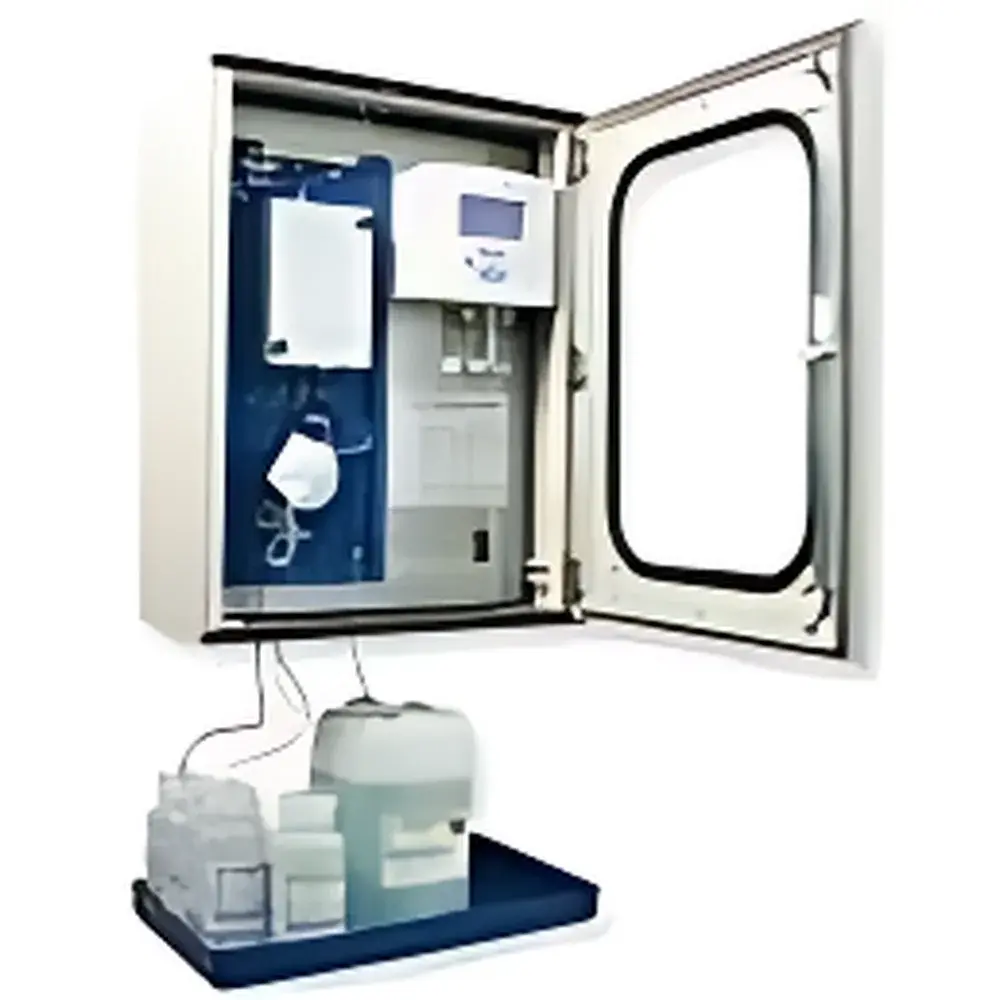
WTW TresCon UNO Online Ammonia Nitrogen Analyzer (TCU/A111)
| Brand | WTW |
|---|---|
| Origin | Germany |
| Model | TresCon UNO |
| Ammonia Nitrogen Range | 0.05–1000 mg/L NH₄–N |
| Nitrite Range | 0.05–1.200 mg/L NO₂–N |
| Orthophosphate Ranges | 0.05–3.00 mg/L PO₄–P (Range 1), 0.10–10.0 mg/L PO₄–P (Range 2), 0.10–25.0 mg/L PO₄–P (Range 3) |
| Calibration | Automatic 2-point calibration |
| Measurement Interval | Continuous, or programmable intervals from 5 min to 24 h |
| Sample Handling Options | PF105, PurCon, or PurCon IS pre-treatment modules |
| Power Supply | 230 VAC ±10%, 50 Hz / 115 VAC ±10%, 50/60 Hz |
| Operating Temperature | 0–40 °C |
| Dimensions (Analyzer) | 612 × 775 × 329 mm |
| Weight (Analyzer) | 35 kg |
| Reagent Tray Dimensions | 590 × 50 × 360 mm |
| Weight | 17 kg |
Overview
The WTW TresCon UNO Online Ammonia Nitrogen Analyzer (TCU/A111) is a compact, single-channel photometric analyzer engineered for continuous, unattended monitoring of ammonia nitrogen (NH₄–N), nitrite (NO₂–N), and orthophosphate (PO₄–P) in wastewater treatment plants, drinking water distribution systems, and environmental surface water stations. Based on the proven WTW TresCon platform architecture, the UNO variant delivers laboratory-grade analytical performance in an industrial-grade enclosure optimized for long-term field deployment. It employs segmented flow analysis (SFA) with spectrophotometric detection—typically at wavelengths between 400–800 nm—following colorimetric reactions standardized per DIN EN ISO 11732 (ammonia), DIN EN ISO 6777 (nitrite), and DIN EN ISO 6878 (orthophosphate). The system operates without manual intervention for extended periods, integrating precise reagent metering, temperature-controlled reaction zones, and optical path stabilization to ensure high reproducibility across varying matrix conditions.
Key Features
- Single-channel modular design enables focused parameter monitoring while retaining full compatibility with WTW’s broader TresCon ecosystem—including shared reagent management logic, firmware architecture, and service protocols.
- Self-diagnostic capability continuously monitors critical subsystems: peristaltic pump status, LED light source intensity, photodiode response, valve actuation cycles, and reagent level thresholds—logging diagnostic codes accessible via local display or remote SCADA integration.
- Three selectable orthophosphate measurement ranges allow method-specific optimization for low-level effluent compliance (e.g., <0.5 mg/L PO₄–P) or high-concentration influent characterization (up to 25.0 mg/L PO₄–P), minimizing dilution artifacts and improving measurement uncertainty.
- Flexible sampling scheduling supports both fixed-interval operation (5–30 min) and event-triggered acquisition (2–24 h), enabling adaptive monitoring aligned with diurnal flow patterns or process control logic.
- Ruggedized mechanical construction meets IP65 enclosure rating; internal thermal management maintains optical and fluidic stability across ambient temperatures from 0 to 40 °C—validated under IEC 61000-6-2 electromagnetic compatibility standards.
Sample Compatibility & Compliance
The TresCon UNO interfaces seamlessly with WTW’s PF105 particulate filter unit, PurCon ultrafiltration module, or PurCon IS inline sensor-compatible pre-treatment systems—ensuring representative sample conditioning for suspended solids, turbidity, and organic interference mitigation. All configured methods adhere to internationally recognized reference standards: ammonia determination conforms to DIN EN ISO 11732 (indophenol blue method), nitrite to DIN EN ISO 6777 (diazotization-coupling), and orthophosphate to DIN EN ISO 6878 (molybdenum blue reduction). Data integrity is maintained through audit-trail-enabled operation logs, supporting GLP-compliant recordkeeping and facilitating regulatory submissions under EU Water Framework Directive (2000/60/EC), US EPA Method 350.1, and ISO/IEC 17025-accredited laboratory workflows.
Software & Data Management
The embedded analyzer firmware provides native Modbus TCP/RTU and Profibus DP-V1 protocol support for direct integration into DCS, SCADA, or PLC-based infrastructure. Local HMI includes a 5.7″ TFT display with intuitive menu navigation, real-time trend plotting, and alarm configuration for limit violation, calibration overdue, or reagent depletion. All measurement data—including raw absorbance values, calibration coefficients, diagnostic timestamps, and maintenance events—are timestamped and stored internally for ≥30 days. Optional WTW LabX™ Connect software enables centralized fleet management, remote firmware updates, automated report generation (PDF/CSV), and secure cloud synchronization compliant with GDPR and FDA 21 CFR Part 11 requirements for electronic records and signatures.
Applications
- Real-time nitrification/denitrification process control in activated sludge and MBR wastewater treatment plants.
- Effluent compliance monitoring against discharge limits (e.g., EU Urban Wastewater Treatment Directive Annex I, US NPDES permits).
- Source water early-warning systems for agricultural runoff or industrial infiltration events.
- Performance verification of tertiary nutrient removal units (e.g., sand filters, ion exchange, or biological phosphorus uptake).
- Research-grade longitudinal studies requiring stable, trace-level NH₄–N quantification in mesocosm or pilot-scale reactors.
FAQ
What sample pre-treatment modules are compatible with the TresCon UNO?
The analyzer supports PF105 (mechanical filtration), PurCon (ultrafiltration, 10 kDa MWCO), and PurCon IS (direct inline coupling with pH/conductivity sensors) modules—selected based on suspended solids content and required chemical speciation fidelity.
Does the system support automatic calibration verification?
Yes—built-in 2-point automatic calibration uses certified standard solutions; optional periodic check standards can be scheduled to validate drift correction algorithms per ISO/IEC 17025 clause 7.7.
Can multiple parameters be measured simultaneously on one TresCon UNO unit?
No—the UNO is strictly single-channel; sequential multi-parameter analysis requires method switching and dedicated reagent sets, with cycle time governed by the longest reaction kinetics among selected analytes.
Is remote firmware update functionality available?
Yes—via WTW LabX™ Connect over Ethernet or cellular gateway; updates undergo cryptographic signature validation and rollback protection to ensure system integrity.
What maintenance intervals are recommended for routine operation?
Per WTW Service Bulletin TCU-UNO-2023-04: pump tubing replacement every 6 months, optical cuvette cleaning every 3 months, and full system performance verification annually—or after 10,000 measurement cycles—using WTW-certified reference materials.







