
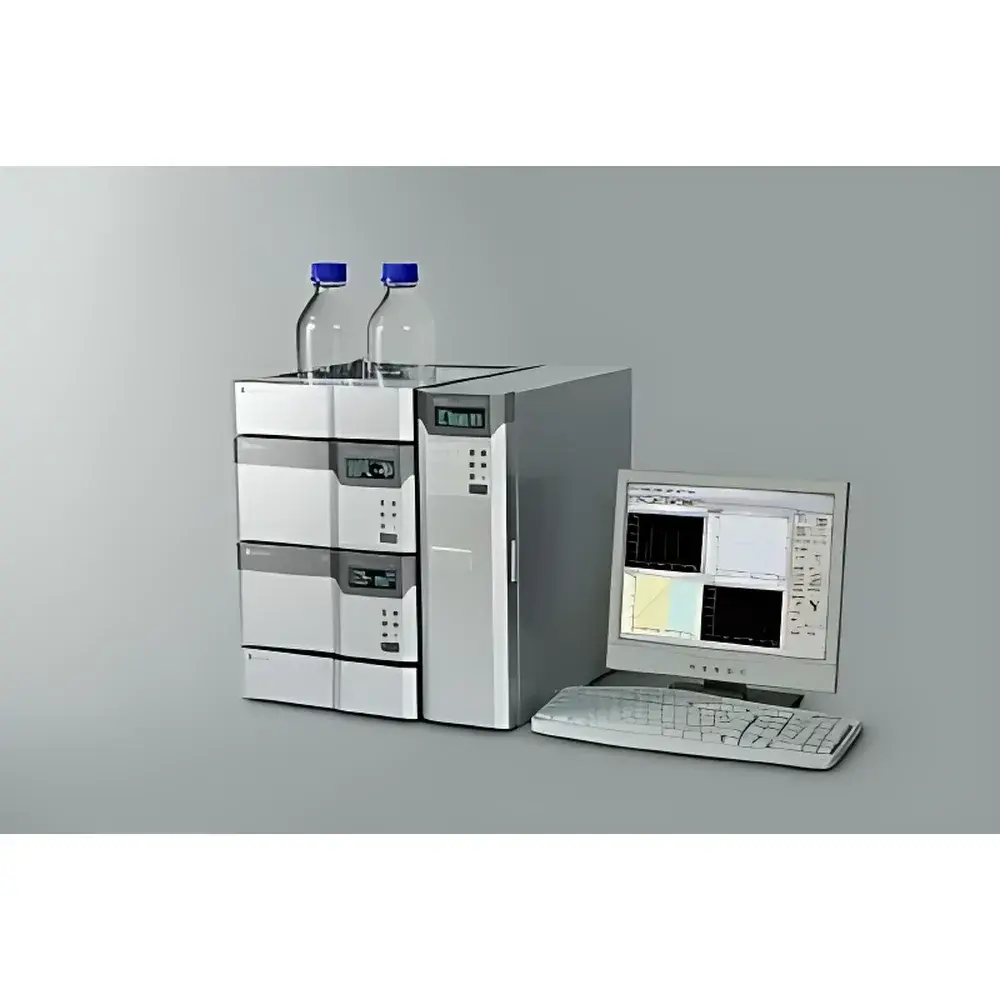
Wufeng EX1600 High-Performance Liquid Chromatograph
| Brand | Wufeng |
|---|---|
| Model | EX1600 |
| Instrument Type | Conventional HPLC System |
| Flow Rate Range | 0.1–3.0 mL/min |
| Max Operating Pressure | 42 MPa |
| Autosampler Capacity | 2 × 54 positions |
| Injection Volume Range | 0.1–120 µL |
| Column Oven Temperature Range | Ambient +10°C to 85°C |
| UV Detector Wavelength Range | 190–900 nm (D₂ + W lamp) |
| Data Acquisition Rate | Up to 100 Hz |
| Baseline Noise (UV) | ≤ ±0.2 × 10⁻⁵ AU |
| Baseline Drift (UV) | ≤ 0.3 × 10⁻⁴ AU/hr |
| Retention Time Precision | RSD < 0.06% |
| Injection Precision | RSD < 0.3% (full-loop mode) |
Overview
The Wufeng EX1600 High-Performance Liquid Chromatograph is an integrated, network-capable HPLC system engineered for precision, long-term stability, and operational autonomy in regulated and research laboratory environments. Built upon a modular architecture, the EX1600 implements classical reversed-phase, normal-phase, and ion-exchange chromatographic separations using high-pressure gradient elution. Its core measurement principle relies on differential UV-Vis absorbance detection (190–900 nm) combined with precise solvent delivery under programmable pressure control (up to 42 MPa), enabling reproducible retention time alignment and high-sensitivity quantitation of small-molecule analytes—including those exhibiting low molar absorptivity or co-eluting peaks. The system operates without a centralized controller; instead, each module (pump, autosampler, detector, column oven) features embedded microprocessor control and native Ethernet (LAN) connectivity, supporting decentralized operation, remote diagnostics, and synchronized method execution—critical for multi-user labs and 24/7 unattended runs.
Key Features
- Modular Network Architecture: Each unit (EX1600P pump, EX1600AS autosampler, EX1600UV detector, EX1600CO column oven) integrates a dedicated ARM-based controller and RJ45 interface, enabling direct IP-addressable access, firmware updates over LAN, and real-time status telemetry without middleware.
- Ultra-Low Carryover Autosampling: Dual 54-position trays support 2 mL vials; injection precision achieves RSD < 0.3% (full-loop mode) with < 0.05% carryover via integrated needle wash (solvent-switching tray design) and pressure-assisted purge cycles.
- Dual-Lamp UV Detection: Deuterium (D₂) + Tungsten (W) lamp configuration ensures continuous spectral coverage from 190 nm to 900 nm; wavelength accuracy ±1 nm, repeatability < 0.1 nm, baseline noise ≤ ±0.2 × 10⁻⁵ AU (empty cell, 1 sec time constant).
- Intelligent Predictive Maintenance: Embedded algorithms monitor pump seal wear, lamp intensity decay, detector cell contamination, and column backpressure trends; generate service alerts, estimate component remaining useful life (RUL), and recommend calibration intervals based on cumulative operational hours and thermal cycles.
- Column Oven with Extended Thermal Stability: Temperature range: 4 °C to 85 °C (ambient +10 °C minimum); stability ±0.1 °C over 24 h; dual-zone air circulation and insulated chamber minimize radial temperature gradients across 30 cm columns.
- Self-Verification Protocol: Automated performance qualification (PQ) routines execute pre-run checks—including flow accuracy verification, wavelength calibration using holmium oxide reference, and baseline stability assessment—generating timestamped audit logs compliant with GLP/GMP documentation requirements.
Sample Compatibility & Compliance
The EX1600 accommodates standard 3.9–4.6 mm ID analytical columns (up to 250 mm length) and semi-preparative formats (up to 10 mm ID). It supports aqueous-organic mobile phases (including 0.1% TFA, ammonium acetate buffers, and high-salt gradients), with optional post-column wash capability to prevent salt crystallization in check valves and flow cells. All hardware and firmware comply with IEC 61010-1 (safety) and IEC 61326-1 (EMC) standards. Data integrity features include electronic signatures, user-level access control (administrator/operator/visitor roles), and immutable audit trails meeting FDA 21 CFR Part 11 requirements when deployed with validated third-party CDS software (e.g., Chromeleon, OpenLab CDS). System suitability testing (SST) parameters—including tailing factor, theoretical plates, and resolution—are directly calculable within supported chromatography data systems.
Software & Data Management
The EX1600 does not include proprietary acquisition software; it communicates via industry-standard protocols including Agilent’s ChemStation emulation mode, Shimadzu’s LabSolutions compatibility layer, and native ASCII-based command sets (SCPI-like syntax) for custom integration. Raw data output adheres to ANDI/NetCDF format (ASTM E1947-17), ensuring interoperability with LIMS, ELN, and statistical process control platforms. Audit trail records capture operator ID, method name, injection sequence, parameter modifications, and instrument error codes—all stored locally on internal flash memory (16 GB) with optional RAID-1 backup via external NAS. Remote monitoring is supported through HTTPS-enabled web dashboard (HTML5), displaying real-time pressure traces, UV chromatograms, temperature profiles, and predictive maintenance flags without requiring client-side software installation.
Applications
- Pharmaceutical QC/QA: Assay, related substances, residual solvents per USP , EP 2.2.46, and ICH Q2(R2) guidelines.
- Food & Beverage Safety: Pesticide residue screening (multi-residue methods), mycotoxin quantification (aflatoxins, ochratoxin A), and vitamin profiling (B-complex, D₃).
- Environmental Analysis: PAHs, PCBs, and phenolic compounds in water/soil extracts per EPA Methods 8330B, 8082A.
- Academic & Method Development Labs: Robust platform for gradient optimization, column screening, and forced degradation studies due to consistent dwell volume (< 700 µL) and low system dispersion (< 12 µL total volume).
- Biopharma Support: Peptide mapping (reversed-phase), oligonucleotide purity assessment, and small-molecule excipient characterization under cGMP-aligned workflows.
FAQ
Does the EX1600 meet regulatory requirements for GMP laboratories?
Yes—the hardware design, firmware logging architecture, and data export capabilities support compliance with FDA 21 CFR Part 11, EU Annex 11, and ISO/IEC 17025 when paired with validated chromatography data systems and documented SOPs.
What is the expected lifetime of critical components?
The D₂ lamp is rated for 2000 hours; high-pressure pump seals are designed for ≥ 5000 hours at 40 MPa; column oven heating elements and detector flow cells undergo accelerated life testing per MIL-STD-810G, with mean time between failures (MTBF) exceeding 15,000 hours under continuous operation.
Can the system operate unattended for extended periods?
Yes—integrated power-loss recovery, automatic re-injection after interruption, and email/SMS alerting (via optional gateway) enable 72+ hour batch runs with full traceability and fail-safe shutdown protocols.
Is method transfer feasible from other major HPLC platforms?
Method translation tools are provided for Agilent 1260/1290, Waters e2695, and Shimadzu Nexera systems, accounting for dwell volume differences, gradient delay compensation, and detector response time matching.
What consumables require scheduled replacement?
Primary scheduled items include D₂/W lamps, pump inlet frits (every 6 months), analytical guard columns (per 100 injections), and autosampler syringe seals (every 5000 injections); all part numbers and replacement intervals are embedded in the maintenance scheduler.





