
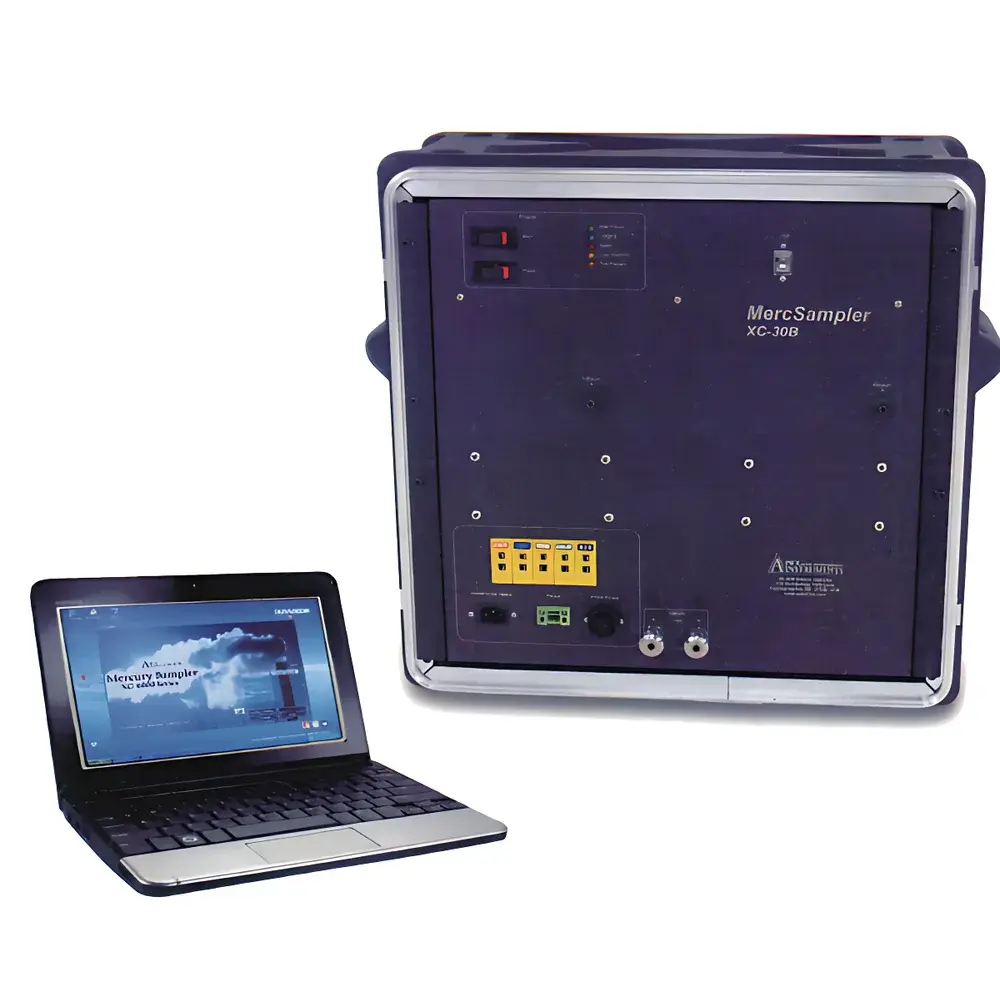
XC-30B Mercury Sampling System (Automatic, EPA Method 30-Compliant)
| Origin | USA |
|---|---|
| Manufacturer Type | Authorized Distributor |
| Origin Category | Imported |
| Model | XC-30B |
| Instrument Type | 24-Hour Temperature- and Flow-Controlled Gas Sampler |
| Configuration | Single-Channel Gas Sampler |
| Flow Range | 0.1–2500 mL/min |
| Maximum Vacuum Pressure | 30 kPa |
| Flow Stability | ±5% over 24 h |
| Flowmeter Accuracy | ±2.5% FS (dry gas meter), ±2% FS (mass flow sensor) |
| Rated Service Life at Max Flow & Backpressure | 5000 hours |
| Continuous Operation Time at Max Flow & Backpressure | 8 h |
Overview
The XC-30B Mercury Sampling System is an automatic, microprocessor-controlled gas sampling instrument engineered for compliance with U.S. EPA Method 30—specifically designed for the collection and quantification of elemental and oxidized mercury species in flue gas streams from coal-fired power plants, waste incinerators, and industrial combustion sources. It operates on the principle of isokinetic or constant-flow sampling, integrating real-time vacuum regulation, temperature-compensated volumetric flow measurement, and automated data logging to ensure traceable, auditable, and method-validated sample acquisition. Unlike manual or semi-automatic samplers, the XC-30B autonomously executes full Method 30 workflows—including pre-sampling leak integrity verification, dynamic flow adjustment in response to stack pressure fluctuations, continuous temperature monitoring of critical sampling lines, and automatic conversion of actual sampled volume to standard conditions (25 °C, 760 mmHg). Its architecture meets the mechanical and metrological requirements outlined in EPA Reference Method 30A and ASTM D6784-22 for sorbent trap-based mercury monitoring.
Key Features
- Automated dual-path sampling control — supports simultaneous operation of primary and backup sampling trains per EPA guidance
- Hybrid flow measurement system: precision positive-displacement dry gas meter (0.7 L/rev, optical encoder, 1 cm³ resolution) + thermal mass flow sensor (300–2500 mL/min range, ±2% FS accuracy)
- Integrated temperature-controlled sampling manifold with PID-regulated heating up to 120 °C, preventing mercury condensation and adsorption loss
- Real-time vacuum monitoring and proportional solenoid valve control (12 V DC) for stable flow under variable stack backpressure (up to 30 kPa)
- Onboard data acquisition module with 1 GB non-volatile memory, storing ≥99 complete sampling events with timestamps, flow profiles, temperature logs, and leak-test results
- USB 2.0 interface compliant with CDC/NIOSH and EPA-approved PC software for remote configuration, firmware updates, and raw data export in CSV/Excel format
- Compact benchtop design (58 × 53 × 30.5 cm; 17.7 kg) with reinforced aluminum chassis and EMI-shielded electronics for field-deployable reliability
Sample Compatibility & Compliance
The XC-30B is validated for use with EPA-approved mercury sorbent traps (e.g., gold-coated quartz, iodinated carbon, and sulfided activated carbon), as well as impingers containing acidic potassium permanganate (KMnO₄) or acidic stannous chloride (SnCl₂) solutions. It maintains isokinetic sampling fidelity across duct velocities from 5 to 30 m/s when paired with appropriate probe assemblies. The system conforms to ISO 10780:2022 (stationary source emissions — manual sampling of total particulate matter and gaseous pollutants), ASTM D3154-21 (standard test method for average velocity in a duct using a pitot tube), and US EPA 40 CFR Part 60, Appendix A–1, Method 30. All internal wetted materials (PTFE tubing, stainless steel valves, Kalrez seals) are certified mercury-inert per ASTM D7441-20. Data integrity complies with FDA 21 CFR Part 11 requirements when used with validated software, including electronic signatures, audit trails, and user-access controls.
Software & Data Management
The XC-30B communicates via a vendor-provided Windows-compatible application supporting GLP/GMP-aligned data handling. Each sampling session generates a structured metadata file containing operator ID, calibration certificate numbers, ambient barometric pressure (600–1100 mbar sensor, ±1 mbar accuracy), inlet temperature, cumulative flow integral, and pass/fail status for automated leak checks (per EPA Method 30 Section 8.3). Raw flow and temperature time-series data are logged at 1-second intervals. Export formats include ANSI X12-compliant ASCII, CSV with SI units, and PDF summary reports embeddable in laboratory information management systems (LIMS). Firmware versioning, calibration history, and memory usage diagnostics are accessible through secure admin mode.
Applications
- Regulatory mercury emissions monitoring at coal- and oil-fired utility boilers (40 CFR Part 75, MATS compliance)
- Performance testing of activated carbon injection (ACI) systems and wet scrubbers
- Source testing for municipal solid waste and medical waste incinerators
- Method validation studies requiring high-fidelity volumetric traceability (e.g., NIST-traceable flow intercomparisons)
- Research-grade speciation sampling when coupled with KCl-coated denuders and dual-sorbent traps
- QA/QC audits of continuous emission monitoring systems (CEMS) for Hg
FAQ
Does the XC-30B support isokinetic sampling?
Yes — when integrated with a Type S pitot tube, thermocouple, and velocity-calibrated probe, the system calculates and maintains isokinetic flow rates in real time based on measured stack velocity and cross-sectional area.
What calibration standards are required for routine operation?
Primary calibration must be performed annually using a NIST-traceable primary standard (e.g., bubble meter or critical orifice) per EPA Method 30 Section 9.1; field verifications require daily leak checks and quarterly flow audits.
Can the XC-30B operate unattended for full 24-hour sampling cycles?
Yes — its sealed lead-acid battery backup option (optional) enables >24 h operation during grid outages, and the internal memory retains all data even after power loss.
Is the USB interface compatible with modern Windows OS versions?
Yes — drivers and software are certified for Windows 10 and 11 (64-bit), with signed installation packages meeting Microsoft WHQL requirements.
How is temperature compensation applied to volumetric flow calculations?
The onboard atmospheric pressure sensor and heated line temperature sensors feed into the ideal gas law correction algorithm, automatically converting measured volume to standard cubic meters (scm) at 25 °C and 101.325 kPa.
Related Products







