
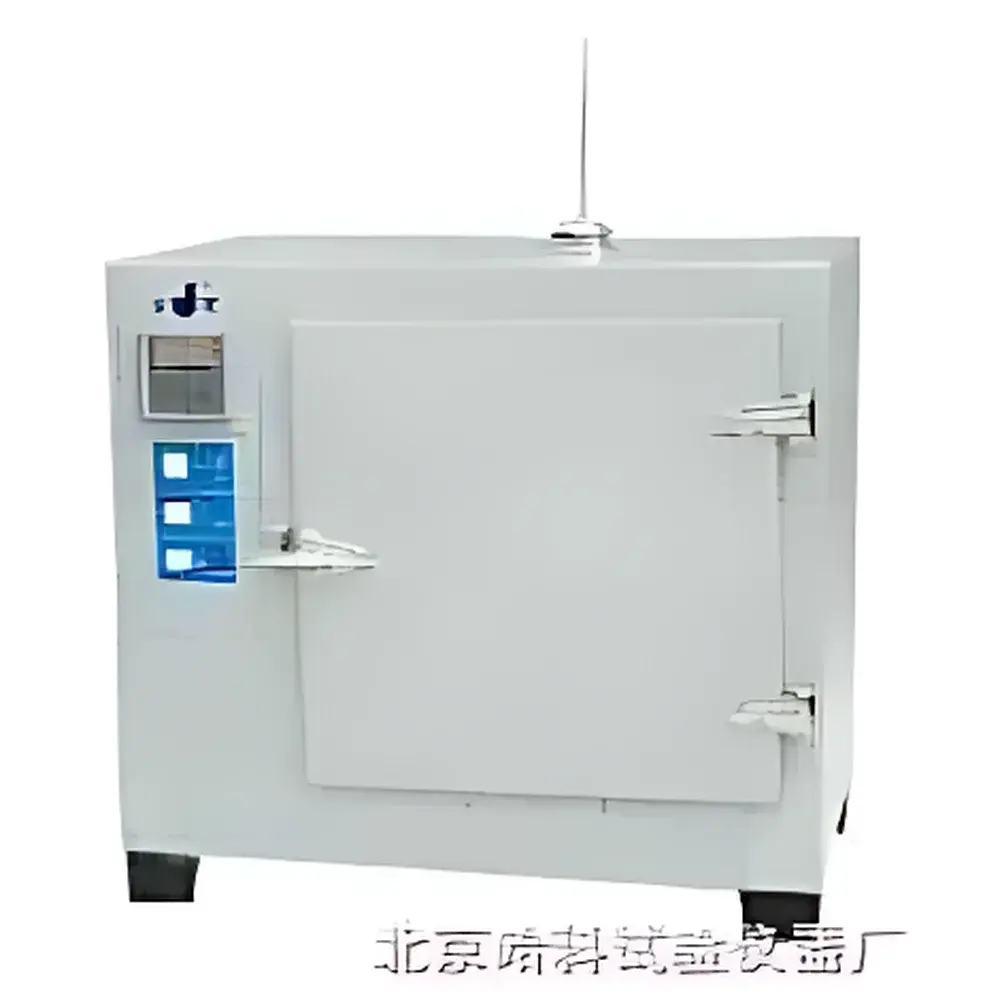
XCB-300I Forced-Air Laboratory Oven
| Origin | Beijing, China |
|---|---|
| Manufacturer Type | Authorized Distributor |
| Origin Category | Domestic (PRC) |
| Model | XCB-300I |
| Pricing | Available Upon Request |
| Max Operating Temperature | 300 °C |
| Temperature Control Range | 50–300 °C |
| Temperature Stability | ±2 °C |
| Temperature Uniformity | ±2.5% (at setpoint) |
| Internal Chamber Dimensions | 450 mm × 550 mm × 550 mm (W × D × H) |
| Fan Motor Power | 40 W |
| Heating Power | 2.8 kW |
| Input Voltage | 220 VAC ±10% (−15% to +10% tolerance) |
| External Dimensions | 675 mm × 920 mm × 950 mm (W × D × H) |
Overview
The XCB-300I Forced-Air Laboratory Oven is a precision-engineered thermal processing instrument designed for consistent, repeatable heat treatment across research, quality control, and routine analytical workflows. Utilizing a horizontally oriented forced-air convection system with a centrally mounted axial fan, the oven ensures rapid thermal equilibration and minimizes vertical temperature stratification within the working chamber. Its operational range spans from 50 °C to 300 °C—covering critical applications including moisture loss determination (per ASTM E1868), polymer curing, gravimetric residue analysis (e.g., ash content per ISO 2171), and pre-conditioning of samples prior to spectroscopic or chromatographic analysis. The chamber’s stainless-steel interior (304 grade), reinforced door gasket, and double-wall insulated construction contribute to energy efficiency and long-term thermal stability under continuous operation.
Key Features
- Forced-air circulation architecture with 40 W high-efficiency axial fan, delivering uniform airflow across all chamber zones
- Digital PID temperature controller with real-time setpoint tracking and auto-tuning capability
- Robust heating system comprising multiple embedded tubular heaters (total 2.8 kW), enabling rapid ramp-up and recovery after door opening
- Stainless-steel interior chamber (450 × 550 × 550 mm) with rounded corners for ease of cleaning and reduced contamination retention
- Temperature uniformity maintained at ±2.5% of setpoint across the full working volume—validated per IEC 60068-3-5 and aligned with ISO/IEC 17025 environmental conditioning requirements
- Integrated over-temperature protection circuit with independent mechanical cut-off (non-resettable at 320 °C)
- Front-access design with double-glazed observation window and magnetic door seal ensuring minimal heat leakage
Sample Compatibility & Compliance
The XCB-300I accommodates standard laboratory ware—including porcelain crucibles, aluminum weighing dishes, glass Petri dishes, and stainless-steel trays—within its 0.136 m³ internal volume. It supports batch processing of up to 20 × 100 mL beakers or 12 × 250 mL flasks simultaneously without compromising thermal homogeneity. The unit complies with CE marking requirements for electrical safety (EN 61010-1) and electromagnetic compatibility (EN 61326-1). While not certified as explosion-proof, it is suitable for use with non-volatile, low-hazard materials in accordance with OSHA 1910.1200 (HCS) and GHS classification guidelines. For GLP/GMP-regulated environments, optional validation kits (IQ/OQ documentation templates, thermocouple mapping protocols) are available upon request.
Software & Data Management
The XCB-300I operates via a standalone microprocessor-based controller with local data logging (up to 99 programmable segments, each with ramp/soak profiles). Optional RS-485 Modbus RTU interface enables integration into centralized lab management systems (LIMS) or SCADA platforms for remote monitoring and audit-trail generation. When paired with compliant third-party software (e.g., LabVIEW™ or WinCC), the oven supports 21 CFR Part 11–aligned electronic records—including user authentication, timestamped event logs, and change history for setpoints and dwell times. All calibration and maintenance records can be exported in CSV format for traceability during regulatory inspections.
Applications
- Drying and conditioning of soil, pharmaceutical excipients, and ceramic precursors prior to XRD or TGA analysis
- Thermal stabilization of reference standards and calibration weights per ISO 17025 clause 6.4.8
- Baking of filter papers and membrane filters in environmental water testing (EPA Method 160.1)
- Curing of epoxy-coated test coupons for adhesion and hardness evaluation (ASTM D4541, D3359)
- Pre-heating of metallographic specimens before etching or mounting
- Accelerated aging studies of packaging materials under controlled thermal stress (ASTM F1980)
FAQ
What is the recommended calibration frequency for the XCB-300I?
Annual calibration using NIST-traceable Class A PT100 probes is advised; additional verification is required after relocation, major maintenance, or when deviations exceed ±1.5 °C during routine performance checks.
Can the oven be used for sterilization?
No—this model is not validated for microbial kill kinetics and lacks the steam generation, pressure control, or biological indicator monitoring required for sterilization per ISO 17665 or EN 285.
Is the temperature uniformity specification measured at empty or loaded conditions?
The ±2.5% uniformity value is specified under empty-chamber conditions per IEC 60068-3-5; loading with standard labware typically degrades uniformity by ≤0.8 percentage points if airflow paths remain unobstructed.
Does the unit support ramp-and-soak programming?
Yes—the built-in controller supports up to 99 sequential segments, each configurable with target temperature, ramp rate (°C/min), and dwell duration (0–9999 minutes).
What maintenance is required to sustain long-term accuracy?
Bi-monthly inspection of door gasket integrity, quarterly cleaning of fan inlet grilles and heater sheaths, and annual verification of thermocouple linearity using a dry-block calibrator.
Related Products





